The elegant side of the forest
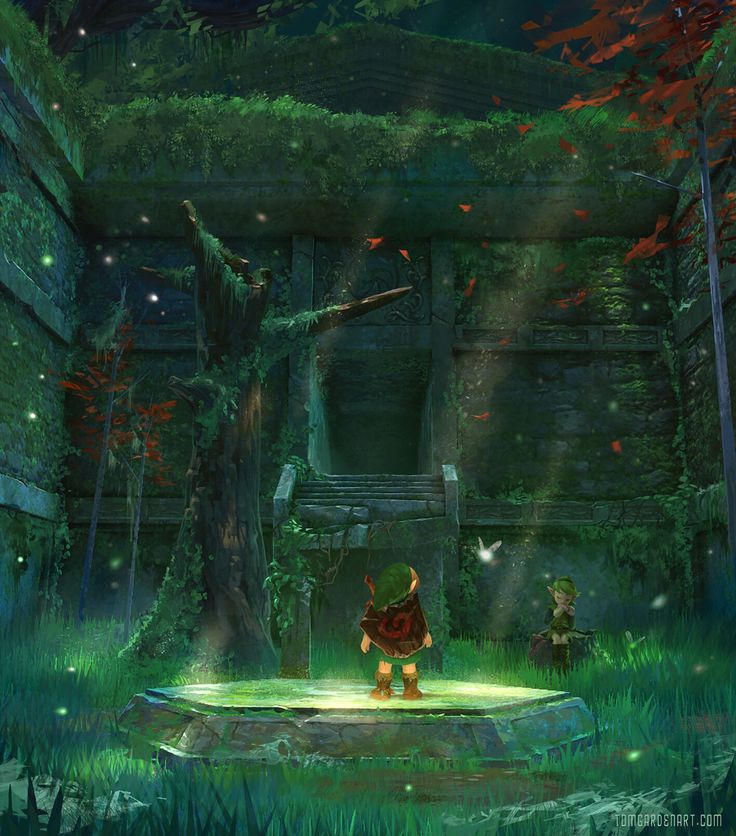
Link is an expert musician, so he is prepared now to play more complex songs accompanied by other performers while duetting with his companion Shiek.
After being familiarized for quite some time with the basics of the ocarina, both Link and the player are ready to tackle more complex tunes; both have grown not only as warriors but also as musicians. For the most part, the days of playing simple ‘3 repeated notes ‘ motifs of the child era are gone—which means Kondo had an additional limitation for the tunes we learn at the beginning of the game— The melodies Link will learn now from music maestro Sheik have a more complex question motif, some of them using 4 notes at most. The Minuet of Forest is one of them (Now Link even seems more confident with his vibrato technique).
Before entering each dungeon—which now are proper temples—Sheik mysteriously appears and relates something about the current situation and the relationship between Link and a the sage of that temple; they make for very poetic moments in the games considering the environments—specially the water one— and the music is overall a big part of the vibe. For this one, a now adult Link that leaves behind his fellow children of the forest in both space and body realizes that the music of the Lost Woods is not coming anymore from Saria and her band of merry Skull Kids. Her usual spot is vacant meaning something must have happened. The flow of time is always cruel indeed.
The musical genres picked for the name of the pieces might also say something about the relationship between sage and hero or tell us something about the sage.
It is about time that the ocarina is able to perform one of the characteristic tricks of the woodwind instruments in the Zelda series, that is to transport you across Hyrule like the humble recorder did on the original.
Musical Analysis
Structure: Section 1 / Section 2
Time Signature: 3/4
Tempo: 100 (ritardando to 80 at the end of Section 1)
Melodic and Harmonic Profiles: E Dorian (Section 1); E Aeolian/Minor, E Ionian/Major (Section 2)
Unlike the previous songs we had learned till this point, these ocarina melodies don’t belong to a cue heard elsewhere on the game; they are individual self-contained compositions played in duet with Sheik and accompanied by orchestration, this means they need a proper cadence—and what else could it be if not Koji Kondo’s favorite cadence?—Instead of ending on a dominant chord or something similarly unresolved like usually does video game music meant to loop these pieces have a proper ending.
These warp songs are named after different musical styles found in Western music, either because the composition itself is written in that particular tradition or because the name of the style works on a conceptual level.
The Minuet of Forest is indeed a minuet, an old French dance written in 3/4 time with a characteristic rhythm and structure to it. The strings and timpani mark the tempo with a constant rhythmic pattern while the harp and the ocarina do a call and response. After these first four measures the piece goes right to the outro; this will be the common pattern for the warp songs.
The minuet starts with a i – IV progression that always screams Dorian mode immediately. This particular chord change always conveys a magical, lifting feeling; like an ancient divinity is being rediscovered. It goes back and forth from Em to A in Section 1, and for the ending it sets up the VI – VII – i cadence of the Aeolian mode only to change the last chord to a major one, a musical device that is convolutedly known as a ‘picardy third’ rather than just saying the last chord is major, or better yet, in video game music lingo, the ‘Mario Cadence’. Koji never lets it end on a downer. Any minor key priece can have its happy ending via this device.
Thus the full chord progression ends up being:
[ Em – A7 – Em -A7 ] – [ C – D – E ]
The last chord of the progression ‘E major’ is also the same chord that ends the Lost Woods theme and starts the Forest Temple cue, adding an additional layer of connection and cohesiveness between the locations.
The song is reprised as the Ballad of Gales from The Wind Waker, perhaps alluding to it being the first warp song or that this was originally a wind themed temple.
Learning a warp song means that Link is about to tackle a dungeon. The Minuet of Forest marks the point where we reach the Forest Temple, the first dungeon of the adult era. As Saria said, this was indeed destined to be a special place. The temple of courage is upon us as Link has to slowly grow in the Zelda egendary attributes in order to fulfill his quest.

Help to keep the rites going around here by supporting the shrine:

Media Files, requests and support for more interactive content

Thou shall donate since this is a cult and you are now a sheep

Help staying awake analyzing game tracks and writing posts or else everything will end up being written by A.I
- Inside The Score – The Legend of Zeda: A Link to the Past – End Credits / Staff Roll
 The land rests As the last few minutes of this extensive journey that has now come to an end fly by, the nostalgia and reflective mood kicks in. Because such a massive enterprise as a Zelda game or a Lord of the Rings movie require multiple endings to convey everything… Read More »Inside The Score – The Legend of Zeda: A Link to the Past – End Credits / Staff Roll
 - Inside The Score – The Legend of Zelda: A Link to the Past – Ending / Epilogue ~ Beautiful HyruleFinal of the fantasy The Triforce has been touched. A wish has been granted. For the occasion, the newly undeceased king of Hyrule has commissioned a march in honor of the legendary hero to the Hylian Sousa, who might as well be composer Nobuo Uematsu since this piece is very… Read More »Inside The Score – The Legend of Zelda: A Link to the Past – Ending / Epilogue ~ Beautiful Hyrule
- Inside The Score – The Legend of Zelda: A Link to the Past – Triforce Chamber / Power of the GodsTake your boots off your feet And thus the Triforce spoke to men. And it became present in history. And you better treasure and contemplate this moment seldom witnessed in the course of the series. The elusive opportunity to interact and touch the most important artifact. You are now in… Read More »Inside The Score – The Legend of Zelda: A Link to the Past – Triforce Chamber / Power of the Gods
- Inside The Score – The Legend of Zelda: A Link to the Past – Ganon Battle / Prince of DarknessProgressive evil En Garde! And you better be prepared since you are about to duel the iconic enemy of the series at perhaps his canonically most powerful incarnation. Right after having touched the sacred Triforce which allowed him to conquer all of the Golden Land and whose evil and darkness… Read More »Inside The Score – The Legend of Zelda: A Link to the Past – Ganon Battle / Prince of Darkness
- Inside The Score – The Legend of Zelda: A Link to the Past – Boss Battle / Anger of the GuardiansQuick mayhem Ah, the simpler times when boss battles where not a multi epic orchestral suite but just an ostinato more basic that even what became the music for standard battle encounters out there. We are a long way from each boss having his own personalized track. And this early… Read More »Inside The Score – The Legend of Zelda: A Link to the Past – Boss Battle / Anger of the Guardians
- Inside The Score – The Legend of Zelda: A Link to the Past – Dark World Dungeon / Dungeon of ShadowsMemento mori We are getting closer to Ganondorf (or at least the wizard Agahnim who ultimately fulfills the same human side of evil role in this game) and that means getting closer to the profiles and motifs of his own theme song (which naturally was the theme of Agahnim at… Read More »Inside The Score – The Legend of Zelda: A Link to the Past – Dark World Dungeon / Dungeon of Shadows