The cowboy saga
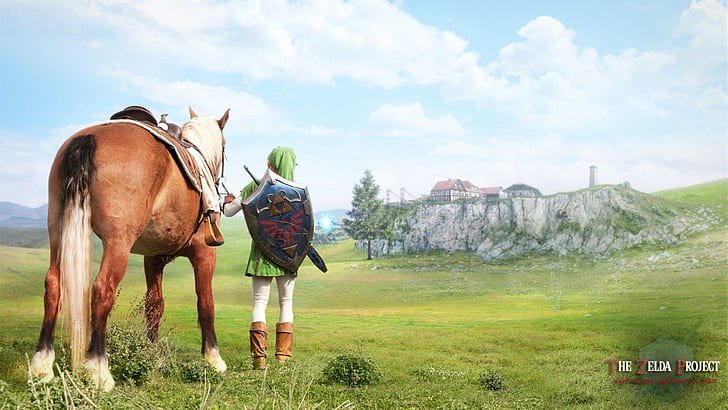
Epona and Link, this is another bond that will last across generations. The culmination of the Western subplot that is introduced from Ocarina of Time onwards and the reason why Hyrule Field was a huge expanse of land that you can cross at full speed mounted on your horse—although they were not able to implement sword fights on this one— giving that sense of accomplishment that these types of video games offer whenever a new ability opens up new possibilities or allows you to do something more efficient than in the beginning; the player feels that they have mastery over the game.
There is a reason why a horse galloping is the very first thing we hear and see when we boot up the game. This whole saga was one that series creator Shigeru Miyamoto was focused on getting it right since he is a big fan of Westerns. As a result, the bluegrass that is also so close to the heart of Zelda’s creator finally makes an appearance in the race upon which Epona’s destiny depends. For not being a place or a quest necessary to complete the game, the Lon Lon Ranch got plenty of love from the team as one of the most dynamic locations, moreover from the sound department. The developers certainly knew that being able to ride a horse would become one of the most memorable experiences to the player; they even went to the length of actually removing trees from Hyrule Field, making it feel bare and empty for the first part of the play-through, just so the player would have catharsis the moment he or she gallops with Epona through the land for the first time.
Here we get four cues that are exclusive to the ranch sagas and the adventures and misadventures of Link, Malon, Talon and Epona—okay, you also hear this on the Gerudo horseback training field.
Musical Analysis: Horse Race/Horse Mini-game
Structure: Section 0 / Section 1 / Section 2 / Section 3
Time Signature: 4/4
Tempo: 155 (ritatdando to 100 at the end of Section 0)
Melodic and Harmonic Profiles: F Ionian/Major
After being neglected in the country number for the Lon Lon Ranch cue, the banjo gets to shine at last, playing its traditional frantic accompaniment characteristic to the bluegrass. That the banjo is playing a galloping rhythm shouldn’t surprise anyone who is paying attention to the action on screen. Compared to classic country, bluegrass music is faster, harder, and more technically demanding; this can be seen in the addictive walking bass line played by the double bass, a fast plucking of notes across each chord.
The driving rhythm section is complemented by the acoustic guitar playing full chords on the offbeats; faithful to the instrument, the notes are more spaced out than they would be on a keyboard. The piece has a standard I – IV – I – V progression plus the quick I – V – I cadence characteristic of all kinds of American music.
The fiddles harmonize mostly in lower fifths and thirds during Section 1 and then change to an upper harmony in fourths and sixths for Section 2. exploiting the fact that perfect fourths and perfect fifths are equivalent, same with the thirds and the sixths. Meanwhile the harmonica does a virtuous performance full of articulations like pitch bending, vibrato and tremolo chords (sadly, the vibrato does not come as prominent in the MIDI conversion here)
Here included is the ending, which is technically another separate cue that sounds each time the race or the mini game is over, interrupting the horse race music at any time. This two measure short piece does the same I – V – I cadence, but this time around the melody ascends and ends on a higher F note, complete with an ornamental figure on the banjo that sounds like grinding the strings, creating a cool percussive effect; the double bass ends with a melodic line recognizable to anyone familiar with southern United States.
The track is appropriate both for the connotations of bluegrass to ranch and rural life, and for its rhythmic imitation of a horse movement; expect to hear this cue whenever there is a horse related mini-game. Kondo had already been proved adept for the genre on the even more overwrought slider track he made for Super Mario 64.
This track is also used for comedic purposes in relation to the Goron tribe in Majora’s Mask
Musical Analysis: Ingo’s Theme/Ingo Loses
Structure: Section 0 / Section 1
Time Signature: 4/4
Tempo: 80
Melodic and Harmonic Profiles: F Ionian/Major
We all know Luigi has always being envious of Mario and his reputation, it was just a matter of time before he snapped.
With this slow version of the Horse Race cue, we got covered both the uptempo bluegrass and the more traditional kind that was started by pioneers of the genre like Bill Monroe and his Blue Grass Boys— the name of the style actually comes from that band— in the 40s. Bluegrass music grew out of traditional string band music that formed the roots of country music. Traditional bluegrass is all about three chords and the truth; consisting of simple folk chord progressions played on acoustic instruments.
In most forms of entertainment mainstream audiences like things that are more polished. TV/film watchers might prefer more expensive production values than those on a student film or actors who have training more than random people off the street doing their best. Music is particular in that there is always that one subculture that prefers a back to basics approach, it has connotations of being more pure, genuine; so there will be always styles that are more dirty, unpolished and simple, preferably played with instruments of unreliable quality. it is no surprise that country being music by the people for the people would have this respect for tradition—the discussions can get pretty heated! This track would easily receive a seal of approval.
The cue limits itself to repeating Section 1 from ‘Horse Race’ this time with harmonica instead of the fiddle. The banjo accompaniment adds extra notes to each chord, and the only instrument whose pattern was altered in a significant way is the nylon guitar, playing now arpeggios starting on beats two and four.
A sample of the real style:
Not afraid of restating cliches in the slightest whenever they serve their purposes, if Japanese developers have a ranch, they will put ranch music even if the styles are far removed from this medieval setting.
Give Miyamoto another year of development and he would probably have an entire saga inspired in cowboys and western included in the game (or perhaps the sequel will allow them the opportunity; Twilight Princess also fulfills those dreams by having Link being an actual rancher, rescue the kids from the village, and reach a Native American town all while fighting with his sword on horseback).
Musical Analysis: Escape From Lon Lon Ranch
Structure: Section 1
Time Signature: 4/4
Tempo: 140 (ritardando to 110)
Melodic and Harmonic Profiles: G Mixolydian
The fact that Ingo loses the race does not mean this whole ordeal is over. In character for Ingo, he closes the entire ranch and now Link is trapped with Epona inside—in fact, Miyamoto had originally even more ambitious plans, burning the whole ranch down and making Link escape with Epona at the last minute surrounded by over the top flames … until they realized the player would be back to Lon Lon Ranch and scrapped the idea altogether (they still did it for Kakariko Village though)— Still, the escape they came up with was epic and cinematic for its time. To accompany this grandiose moment, they called again the services of Koji Kondo to provide a short cue that commemorates the occasion and connects directly with Hyrule Field.
After a huge jump, both Epona and Link get to Hyrule Field, so it’s appropriate that the cue is based around one of the sections from that theme. Specifically, it is based around Section 2 from the adventure sections, but ending on the high G to give it a convincing, stronger conclusion. The cue is a short fanfare played with the entire brass section and a piccolo ending with the ascending scale motif from the series’ main theme. After that, it goes smoothly to the normal music of Hyrule Field without missing a beat.
Finally, after the game teasing Epona since the child era—in fact, she is the first character to appear on screen—and at last, after you even learn Epona’s Song and play with her as a kid, developing an organic bond without the need for tutorials, not to mention connecting her seamlessly with the musical concept of the game, you get to ride her across the fields and live some unforgettable moments like the ridiculous jump to get to Gerudo valley. The developers didn’t manage to put the sword fighting they wanted until Twilight Princess, but nevertheless, they clearly worked very hard to make the whole horse saga a memorable experience, as evidenced by the amount of tracks dedicated to Lon Lon Ranch.

Help to keep the rites going around here by supporting the shrine:

Media Files, requests and support for more interactive content

Thou shall donate since this is a cult and you are now a sheep

Help staying awake analyzing game tracks and writing posts or else everything will end up being written by A.I
- Inside The Score – The Legend of Zeda: A Link to the Past – End Credits / Staff Roll
 The land rests As the last few minutes of this extensive journey that has now come to an end fly by, the nostalgia and reflective mood kicks in. Because such a massive enterprise as a Zelda game or a Lord of the Rings movie require multiple endings to convey everything… Read More »Inside The Score – The Legend of Zeda: A Link to the Past – End Credits / Staff Roll
 - Inside The Score – The Legend of Zelda: A Link to the Past – Ending / Epilogue ~ Beautiful HyruleFinal of the fantasy The Triforce has been touched. A wish has been granted. For the occasion, the newly undeceased king of Hyrule has commissioned a march in honor of the legendary hero to the Hylian Sousa, who might as well be composer Nobuo Uematsu since this piece is very… Read More »Inside The Score – The Legend of Zelda: A Link to the Past – Ending / Epilogue ~ Beautiful Hyrule
- Inside The Score – The Legend of Zelda: A Link to the Past – Triforce Chamber / Power of the GodsTake your boots off your feet And thus the Triforce spoke to men. And it became present in history. And you better treasure and contemplate this moment seldom witnessed in the course of the series. The elusive opportunity to interact and touch the most important artifact. You are now in… Read More »Inside The Score – The Legend of Zelda: A Link to the Past – Triforce Chamber / Power of the Gods
- Inside The Score – The Legend of Zelda: A Link to the Past – Ganon Battle / Prince of DarknessProgressive evil En Garde! And you better be prepared since you are about to duel the iconic enemy of the series at perhaps his canonically most powerful incarnation. Right after having touched the sacred Triforce which allowed him to conquer all of the Golden Land and whose evil and darkness… Read More »Inside The Score – The Legend of Zelda: A Link to the Past – Ganon Battle / Prince of Darkness
- Inside The Score – The Legend of Zelda: A Link to the Past – Boss Battle / Anger of the GuardiansQuick mayhem Ah, the simpler times when boss battles where not a multi epic orchestral suite but just an ostinato more basic that even what became the music for standard battle encounters out there. We are a long way from each boss having his own personalized track. And this early… Read More »Inside The Score – The Legend of Zelda: A Link to the Past – Boss Battle / Anger of the Guardians
- Inside The Score – The Legend of Zelda: A Link to the Past – Dark World Dungeon / Dungeon of ShadowsMemento mori We are getting closer to Ganondorf (or at least the wizard Agahnim who ultimately fulfills the same human side of evil role in this game) and that means getting closer to the profiles and motifs of his own theme song (which naturally was the theme of Agahnim at… Read More »Inside The Score – The Legend of Zelda: A Link to the Past – Dark World Dungeon / Dungeon of Shadows