The joy of two lifetimes
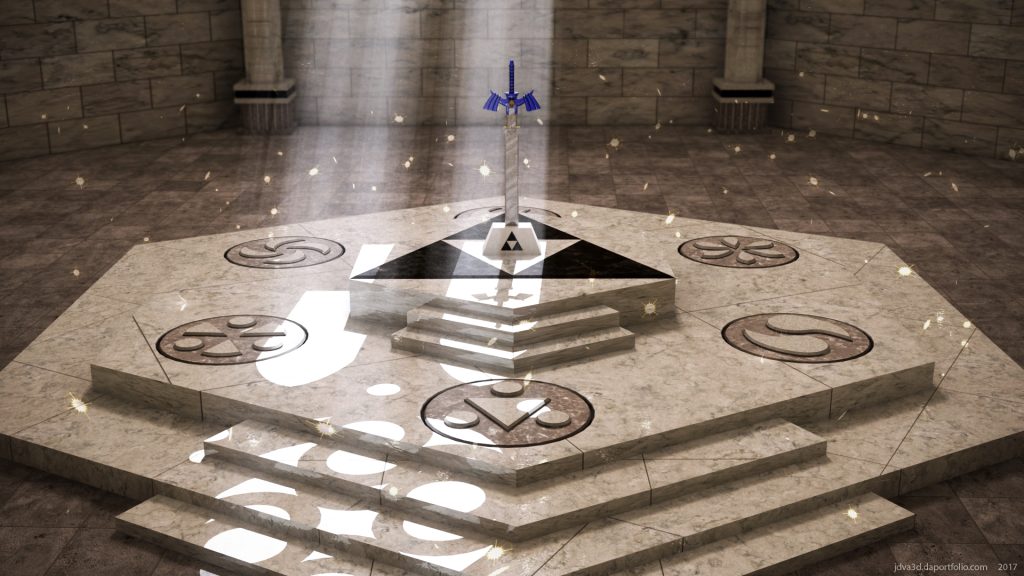
For the sake of narrative consistency and ease of transportation the most important place in all of Hyrule receives its own warp song; It might not be a dungeon—yet—but the Temple of Time is still a temple and its central location is very convenient as it was also a no brainer to make it the starting point whenever you restart your game file.
The mysterious warrior Sheik is waiting for Link here to give him further instructions, he just passed the courage test back at his own home and is ready to see what else went through with the rest of Hyrule during his seven long years of slumber. The world as he knew it no longer exists; time changes everything.
Here the hero will gain one of the most interesting capacities, and one that will alter the mythos of the entire The Legend of Zelda; it is the mechanic of time travel that will eventually allow the future to take two different paths. Because in Zelda you not only travel across lands but also across dimensions and time itself. After all, the game managed to still find useful things for child Link to do; this is the equivalent to the light/dark world dynamic present in other installments of the series yet being able to experience the passage of time and how it affects places and people you knew is way more realistic than magical dimensions.
For emphasis on solemnity, the Sheik song does not play over this cutscene that teaches you what might be one of the most used warp melodies.
Musical Analysis
Structure: Section 1 / Section 2
Time Signature: 4/4
Tempo: 120
Melodic and Harmonic Profiles: D Ionian/Major
The second song Sheik and Link play together, the Prelude of Light, is named after a piece in Western classical music that serves as an introduction to another piece or to succeeding movements with more weight on the composition; it doesn’t have any particular defining characteristics other than the association that it should announce a beginning. Perhaps on a conceptual level, the name was chosen because on this Temple Link can go back to the prelude of his own game.
There are some fancy seventh chords going on on this piece, but as always, we can simplify the music to see more easily what the intention of the composition is. It might be the happiest ocarina tune found in the game.
The only instrument playing a constant figure, the glockenspiel, is emulating here what is known as an altar bell; In the Roman Rite of the Catholic Church the altar bell is a small hand-held bell or set of bells whose main purpose is to create a joyful noise to the Lord as a way to give thanks for the miracle taking place atop the altar. The church motif of the Temple of Time continues to be reinforced.
There is also the strings that sustain chords gently against the melody; even though the chords change once per measure, the last note of the melodic phrase lands just before the start of the next measure, giving a subtle propulsion to the performance.
Taken at face value, the outro of the piece strings together various seventh chords underneath the melody, making the full chord progression:
D – G – D – G
Em7 – Ebmaj7 – Dmaj7 – D
The low strings function as a pedal point in Section 1 and then transition to a melodic role at the end.
Similarly to the term ‘Picardy third’ found on the Minuet of Forest, the classical analysis of the Prelude of Light comes with its own non-illustrative name of ‘Neapolitan chord’(the bII) to dub the harmony movement that is happening in Section 2.
However, focusing on compositional intent instead of just merely trying to make sense of all the notes present at a given time, can give us a simpler harmony that does not need to resort to cloudy sentences like ‘tritone substitution of a dominant chord with a sharp seventh in D major’ or chromatic alteration of the supertonic scale degree built on the parallel phrygian mode’ which basically does not say anything and makes music composition seem like a complicated arcane art.
Most of these extended chords are in reality just product of the composer simply doing good voice leading on account of his or her developed melodic instinct.
Undressing the final chords in the Prelude of Light tells us that Kondo simply was going for the common cadence of:
IV – iv – I
found in countless tunes.
With this, the harmony comes down to
D – G – D – G
G – Gm – D
The harmony just happened to encounter a bass melody line that was doing a chromatic descent from E to D, The chord change of Ebmaj7 to Dmaj7 only exists to make every pitch move down by a semitone.
In the same vein that the Minuet of Forest shares its last chord with the music of its location, the Prelude of Light uses the D tonality to tie with the music of the Temple of Time—with this, we have now encountered D Dorian, D Aeolian/Minor and D Ionian/Major on the same place.
In the meantime, Sheik gives additional advice of where Link can expect to find the next sages; it seems he has already a special bond with some of them. Death Mountain looks very strange, maybe he should check on his Goron friends.

Help to keep the rites going around here by supporting the shrine:

Media Files, requests and support for more interactive content

Thou shall donate since this is a cult and you are now a sheep

Help staying awake analyzing game tracks and writing posts or else everything will end up being written by A.I
- Inside The Score – The Legend of Zeda: A Link to the Past – End Credits / Staff Roll
 The land rests As the last few minutes of this extensive journey that has now come to an end fly by, the nostalgia and reflective mood kicks in. Because such a massive enterprise as a Zelda game or a Lord of the Rings movie require multiple endings to convey everything… Read More »Inside The Score – The Legend of Zeda: A Link to the Past – End Credits / Staff Roll
 - Inside The Score – The Legend of Zelda: A Link to the Past – Ending / Epilogue ~ Beautiful HyruleFinal of the fantasy The Triforce has been touched. A wish has been granted. For the occasion, the newly undeceased king of Hyrule has commissioned a march in honor of the legendary hero to the Hylian Sousa, who might as well be composer Nobuo Uematsu since this piece is very… Read More »Inside The Score – The Legend of Zelda: A Link to the Past – Ending / Epilogue ~ Beautiful Hyrule
- Inside The Score – The Legend of Zelda: A Link to the Past – Triforce Chamber / Power of the GodsTake your boots off your feet And thus the Triforce spoke to men. And it became present in history. And you better treasure and contemplate this moment seldom witnessed in the course of the series. The elusive opportunity to interact and touch the most important artifact. You are now in… Read More »Inside The Score – The Legend of Zelda: A Link to the Past – Triforce Chamber / Power of the Gods
- Inside The Score – The Legend of Zelda: A Link to the Past – Ganon Battle / Prince of DarknessProgressive evil En Garde! And you better be prepared since you are about to duel the iconic enemy of the series at perhaps his canonically most powerful incarnation. Right after having touched the sacred Triforce which allowed him to conquer all of the Golden Land and whose evil and darkness… Read More »Inside The Score – The Legend of Zelda: A Link to the Past – Ganon Battle / Prince of Darkness
- Inside The Score – The Legend of Zelda: A Link to the Past – Boss Battle / Anger of the GuardiansQuick mayhem Ah, the simpler times when boss battles where not a multi epic orchestral suite but just an ostinato more basic that even what became the music for standard battle encounters out there. We are a long way from each boss having his own personalized track. And this early… Read More »Inside The Score – The Legend of Zelda: A Link to the Past – Boss Battle / Anger of the Guardians
- Inside The Score – The Legend of Zelda: A Link to the Past – Dark World Dungeon / Dungeon of ShadowsMemento mori We are getting closer to Ganondorf (or at least the wizard Agahnim who ultimately fulfills the same human side of evil role in this game) and that means getting closer to the profiles and motifs of his own theme song (which naturally was the theme of Agahnim at… Read More »Inside The Score – The Legend of Zelda: A Link to the Past – Dark World Dungeon / Dungeon of Shadows