The first stage of awakening
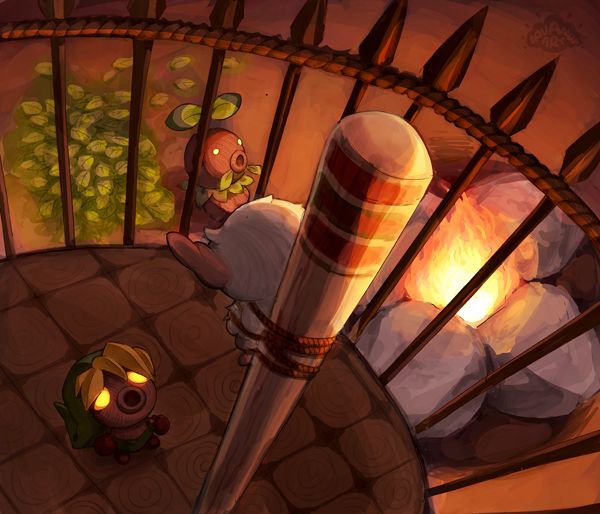
It’s not surprising that the first song we learn on the first stage of awakening for the hero is aptly called the ‘Sonata of Awakening’, a tune taught to Link by a monkey who seems to be the one with the least of a monkey mind in the entire room. He is captured and is about to get cooked, so Link better hurry up to the first dungeon in his adventure.
The songs that will allow Link entrance to the mere four dungeons of The Legend of Zelda: Majora’s Mask are the equivalents to the warp songs Sheik used to teach us; ocarina melodies which are self sustained short compositions not meant to loop that are magically orchestrated and are usually played as a duet between Link’s ocarina and other instrument. They are also named after traditional styles and forms of music, some for aesthetic reasons, others for true musical characteristics.
A sonata is type of musical composition, usually for a solo instrument or a small instrumental ensemble, that typically consists of two to four movements, or sections, each in a related key but with a unique musical character. On this track, the name is used only as an ornamentation without any pretension to be an authentic sonata; the term is very vague though, so technically anything goes as long as it remains instrumental.
But a duet with whom? There is no one else around this time but Link; well, not quite right. He still carries with him the souls of creatures from Termina with unfulfilled business and, coincidentally, they used to be musicians just like the Hero of Time. On this world, the ocarina Link posses will surreally adapt to the instruments owned by its host mask, the Deku having the perfect anatomy to play all kinds of horns and pipes. The tunes also follow the same format established by the warp melodies; the first member plays the phrase and the second responds. After that, the theme goes for a quick cadence.
Musical Analysis
Structure: Section 1 / Section 2
Time Signature: 4/4
Tempo: 94 (ritardando to 74)
Melodic and Harmonic Profiles: G Phrygian Major (Section 1); D Aeolian/Minor; D Ionian/Major (Section 2)
The Sonata of Awakening is the most positive of the ocarina tunes from Majora’s Mask, being focused on the major profile from the ocarina scale: D F A B and Upper D (in this case the last three notes). The composer keeps getting melodies out of his reliable scale.
The sense of wonder and curiosity for what is to come is automatically imbued within the harmony movement with the pseudo minor feel of G major to Bb major, going back and forth in order to emphasize this unique profile—a chord movement Koji was yet to use in his ocarina melodies— the I – bIII is special because it doesn’t commonly appear in the traditional music scales; it sounds heroic but with an extra dimension of dignity and responsibility added. This harmony movement forms the basis for the main themes and sensibilities of the Metroid and Star Fox series, which have a more militaristic feeling or a duty to be fulfilled, a feel that isn’t quite as bright or nostalgic as the Ionian/Major profile nor as dark and mournful as the Aeolian/Minor; it lives in between, still maintaining a sense of mystery and ambiguity—this is due to the scale using two minor tetrachords but opting to play the first degree as a major chord.
And even so, in this framework Koji Kondo fits once again the classic Mario cadence, the three triumphant major chords that must always end his self sufficient ocarina melodies—say goodbye to this cadence after this tune—the full progression being:
G – Bb – G – Bb – G – Bb – C – D
The song is made richer by way of using the strings to provide a countermelody, and each accompanying instrument having clearly defined roles, like the harp playing arpeggios going up, the pizzicatos marking the beginning of each bar and a bass-chord accompaniment pattern for the low strings. Also, the Deku pipes are a different sample from the usual brass sounds the games have been employing.
However, the world of Termina not only offers warp song equivalents, the proper warp song of this world is, ironically, a basic three repeated note pattern song, like the ones Link used to learn when he was beginning his adventure in Ocarina of Time. This time the owl made sure to provide the hero with more elaborate means of transportation.

Help to keep the rites going around here by supporting the shrine:

Media Files, requests and support for more interactive content

Thou shall donate since this is a cult and you are now a sheep

Help staying awake analyzing game tracks and writing posts or else everything will end up being written by A.I
- Inside The Score – The Legend of Zeda: A Link to the Past – End Credits / Staff Roll
 The land rests As the last few minutes of this extensive journey that has now come to an end fly by, the nostalgia and reflective mood kicks in. Because such a massive enterprise as a Zelda game or a Lord of the Rings movie require multiple endings to convey everything… Read More »Inside The Score – The Legend of Zeda: A Link to the Past – End Credits / Staff Roll
 - Inside The Score – The Legend of Zelda: A Link to the Past – Ending / Epilogue ~ Beautiful HyruleFinal of the fantasy The Triforce has been touched. A wish has been granted. For the occasion, the newly undeceased king of Hyrule has commissioned a march in honor of the legendary hero to the Hylian Sousa, who might as well be composer Nobuo Uematsu since this piece is very… Read More »Inside The Score – The Legend of Zelda: A Link to the Past – Ending / Epilogue ~ Beautiful Hyrule
- Inside The Score – The Legend of Zelda: A Link to the Past – Triforce Chamber / Power of the GodsTake your boots off your feet And thus the Triforce spoke to men. And it became present in history. And you better treasure and contemplate this moment seldom witnessed in the course of the series. The elusive opportunity to interact and touch the most important artifact. You are now in… Read More »Inside The Score – The Legend of Zelda: A Link to the Past – Triforce Chamber / Power of the Gods
- Inside The Score – The Legend of Zelda: A Link to the Past – Ganon Battle / Prince of DarknessProgressive evil En Garde! And you better be prepared since you are about to duel the iconic enemy of the series at perhaps his canonically most powerful incarnation. Right after having touched the sacred Triforce which allowed him to conquer all of the Golden Land and whose evil and darkness… Read More »Inside The Score – The Legend of Zelda: A Link to the Past – Ganon Battle / Prince of Darkness
- Inside The Score – The Legend of Zelda: A Link to the Past – Boss Battle / Anger of the GuardiansQuick mayhem Ah, the simpler times when boss battles where not a multi epic orchestral suite but just an ostinato more basic that even what became the music for standard battle encounters out there. We are a long way from each boss having his own personalized track. And this early… Read More »Inside The Score – The Legend of Zelda: A Link to the Past – Boss Battle / Anger of the Guardians
- Inside The Score – The Legend of Zelda: A Link to the Past – Dark World Dungeon / Dungeon of ShadowsMemento mori We are getting closer to Ganondorf (or at least the wizard Agahnim who ultimately fulfills the same human side of evil role in this game) and that means getting closer to the profiles and motifs of his own theme song (which naturally was the theme of Agahnim at… Read More »Inside The Score – The Legend of Zelda: A Link to the Past – Dark World Dungeon / Dungeon of Shadows