Metamorphosis
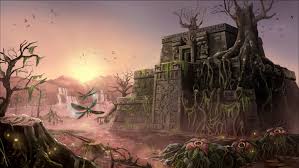
Time to put the Sonata of Awakening into practice in order to awaken the Woodfall Temple sleeping beneath the mountain, a temple that will take blatant inspiration from real world pyramids; the square type ones, mostly associated with Meso-American cultures like the Maya.
To celebrate these occasions, Majora’s Mask has a tune that signals that the path to a dungeon has been opened. However, this is a fanfare meant to cause fear and a sense of majestic brood as opposed to a triumphant emotion; the dungeons are, after all, where players have to test all of their skills gained and be at their most vulnerable (not to mention the pressure of the time limit before Termina is obliterated).
We will also include the other more triumphant fanfares for when the dungeons are actually conquered.
Musical Analysis: Dungeon Rises
Structure: Section 1
Time Signature: 2/4
Tempo: 60
Melodic and Harmonic Profiles: Ab Chromatic; Atonal
The theme consists of just five ascending chords in chromatic fashion played by the brass and the high strings; only the tuba goes against the grain by starting with a descending minor third first and then continuing going down chromatically, clashing with the rest of the brass section. This ascending pattern forms the chords:
Ab aug – A aug – Bb aug 9 – B aug – E aug #11
For the last chord, the ascending orchestra jumps a perfect fourth (minus the tuba). The percussion is doing what the percussion does in these scenarios; accents.
With this, the first dungeon is finally a reality. Compared to the first dungeon from Ocarina of Time, which was just around the corner from Link’s house, here the hero has travelled and familiarized himself quite a bit with his environment; the four dungeons of Termina, where the guardian deities of the land are trapped, ensue a set of challenging puzzles and battles for seasoned players.
The dungeon music is looking this time to match the visuals and design of the structure as opposed to a particular, specific culture; so it will grasp at anything that sounds tribalistic, coming right from the jungles of the world.
Musical Analysis: Land Restored (Short Version)
Structure: Section 1 / Section 2
Time Signature: 4/4
Tempo: 60 (ritardando to 50)
Melodic and Harmonic Profiles: G Mixolydian; C Phrygian Major; C Ionian/Major
Like many a Nintendo game, the first sign that things are going right is nature and the environment healing themselves back; a positive change all around. In the case of the Woodfall area, the poisonous swamp changes to crystal clear waters, and the darkening layer to a colorful world of light. You can feel the breeze also being purified. We see through nature the good deeds the hero has done.
To commemorate these moments, the music follows route and also heals itself from the Majora influence; but before that, Koji scores the healing cutscene with a little fanfare meant to both show the triumph of the hero and connecting this celebration with the music of Termina Field, which is going to replace the Majora theme heard on the swamp. It is now signaling the fact that Link has completed the first stage of awakening and has overcome a part of Majora’s influence; his theme can now override the theme of that cursed mask.
Equivalent to the previous fanfares used for the spiritual stones and medallions, the dungeon clear cue is a welcome celebration after the developers decided to use the generic ‘Item Get’ music for when Link acquires the boss’ mask—although the true reward is seeing the giants in their own pure lands, that situation would be the analogous to the sacred realm scenes from Ocarina of Time—So it means that this is the chime celebrating the player successfully completing a dungeon.
Many probably never noticed but there are actually two versions; this one plays when the Woodfall Temple and Great Bay Temple are conquered; it all depends on the length of the cutscene.
The theme starts in the same way that Majora’s Mask opened its curtain back in the very first cutscene: a sustained B note played by a single violin, by now an universal signifier of suspense. However, this time it resolves to a truly good happiness, the theme of the hero a.k.a the main theme of the Zelda series, played at its most earnest and then onto a quick magical cadence showing that something good is happening. Of course the theme has to be played in the same tonality from the Termina Field cue to make the transition smoother and because Koji is a man of consistency—the G tonality has been a thing since the overworld of Hyrule Field from the previous adventure.
The voice leading, consisting of descending bass lines, gives different colors to the melody by forming different chords along the way. it ends on a C maj7, a chord that is internally made of a C major and an E minor at the same time, giving it a magical, more ambiguous quality apt for a miracle—the harp ends up emphasizing the minor chord. Other than that it is the well known theme of the series we are accustomed to. Since the high strings were used for the sustained suspense note, it’s up to the low strings to play the entire string arrangement of the piece.
This is a land conquered by Link, the hero. His theme, as filtered by Termina, can be heard now loud and proud across the swamp. Time to go back home where everything will be exactly as we left it; see if we get to hear more Oriental influences. Just don’t forget the Deku Princess (impossibly putting her inside a bottle, which is something that can only occur in Majora’s Mask) in order to save the monkey, not that it will matter in a couple of hours.
Musical Analysis: Land Restored (Long Version)
Structure: Section 1 / Section 2
Time Signature: 4/4
Tempo: 60 (ritardando to 50)
Melodic and Harmonic Profiles: G Mixolydian; C Phrygian Major; C Ionian/Major
For the moment when Link and Tatl step out of the ethereal realm belonging to the giant, we are presented again with the healing of another land of Termina, the Snowhead region can now enjoy spring once again thanks to the efforts of the heroes Link alongside the wishes and strengths of the spirit of Darmani. These world healing cutscenes superficially seem to have the same cue, the song of the hero. But the reality is that there are in fact two versions of the theme; one is simply longer than the other—this one is used for Snowhead and Ikana.
Now, why would there be two cues so similar? It might have been just a pragmatic consideration; the most likely scenario was that the developers had put the original short cue accompanying this scene and were planning to subsequently place the same fanfare each time the player cleared a dungeon. Yet, somehow, the short version of the cue didn’t seem to fit the tempo of the scene no matter where they chose to start it. This meant they probably determined that they had to annoy Kondo by requesting a modified version of the cue that better matched the duration of the cutscene. Just do the same thing but longer (or this one was the original and was modified to fit certain scenes, however, it is not just a cut down version because the bass line is different here).
So easy piece, Kondo just had to use the same instruments and melody but add two additional measures in order to extend the duration. He fills the new measures with echoes of the Zelda series main theme melody —just like on the title theme of the original NES game— the very last one modulating the normal motif from being based around G directly to the C, connecting it even better with the outro (a fact that may point out more towards the possibility of this cue being the original and the one for the previous temple the modified version).
However, the bass line also plays a part in changing the harmony and thus the vibe. Instead of changing every two beats, it sustains the note for the whole bar, making the chromatic descent a longer enterprise and changing its relationship with the melody in subtle ways. The chords, which are really the same, only with different duration can work like this:
G – F – Em – Eb – Db – C
The second adventure of the Hero of Time in Termina has concluded. As always, before the next travel, it is better to go back to the human land to reset your spirit and maybe help some with the constant problems of the townsfolk. However, not all human souls reside in Clock Town, there is a big quest waiting for Link on the plains just outside the village, where a pair of familiar faces will involve him again in cowboy-inspired fare. But this being Majora’s Mask, the adventures end up being more outlandish and unpredictable. But wait, just before that there is still time on the clock to have a little fun before everything is reset to the beginning, why not allow Darmani to have one last bit of fun with his fellow Goron? Why go with horses when you have them around?

Help to keep the rites going around here by supporting the shrine:

Media Files, requests and support for more interactive content

Thou shall donate since this is a cult and you are now a sheep

Help staying awake analyzing game tracks and writing posts or else everything will end up being written by A.I
- Inside The Score – The Legend of Zeda: A Link to the Past – End Credits / Staff Roll
 The land rests As the last few minutes of this extensive journey that has now come to an end fly by, the nostalgia and reflective mood kicks in. Because such a massive enterprise as a Zelda game or a Lord of the Rings movie require multiple endings to convey everything… Read More »Inside The Score – The Legend of Zeda: A Link to the Past – End Credits / Staff Roll
 - Inside The Score – The Legend of Zelda: A Link to the Past – Ending / Epilogue ~ Beautiful HyruleFinal of the fantasy The Triforce has been touched. A wish has been granted. For the occasion, the newly undeceased king of Hyrule has commissioned a march in honor of the legendary hero to the Hylian Sousa, who might as well be composer Nobuo Uematsu since this piece is very… Read More »Inside The Score – The Legend of Zelda: A Link to the Past – Ending / Epilogue ~ Beautiful Hyrule
- Inside The Score – The Legend of Zelda: A Link to the Past – Triforce Chamber / Power of the GodsTake your boots off your feet And thus the Triforce spoke to men. And it became present in history. And you better treasure and contemplate this moment seldom witnessed in the course of the series. The elusive opportunity to interact and touch the most important artifact. You are now in… Read More »Inside The Score – The Legend of Zelda: A Link to the Past – Triforce Chamber / Power of the Gods
- Inside The Score – The Legend of Zelda: A Link to the Past – Ganon Battle / Prince of DarknessProgressive evil En Garde! And you better be prepared since you are about to duel the iconic enemy of the series at perhaps his canonically most powerful incarnation. Right after having touched the sacred Triforce which allowed him to conquer all of the Golden Land and whose evil and darkness… Read More »Inside The Score – The Legend of Zelda: A Link to the Past – Ganon Battle / Prince of Darkness
- Inside The Score – The Legend of Zelda: A Link to the Past – Boss Battle / Anger of the GuardiansQuick mayhem Ah, the simpler times when boss battles where not a multi epic orchestral suite but just an ostinato more basic that even what became the music for standard battle encounters out there. We are a long way from each boss having his own personalized track. And this early… Read More »Inside The Score – The Legend of Zelda: A Link to the Past – Boss Battle / Anger of the Guardians
- Inside The Score – The Legend of Zelda: A Link to the Past – Dark World Dungeon / Dungeon of ShadowsMemento mori We are getting closer to Ganondorf (or at least the wizard Agahnim who ultimately fulfills the same human side of evil role in this game) and that means getting closer to the profiles and motifs of his own theme song (which naturally was the theme of Agahnim at… Read More »Inside The Score – The Legend of Zelda: A Link to the Past – Dark World Dungeon / Dungeon of Shadows