From a fellow musician to another
“It seems my lucky color this week is green”
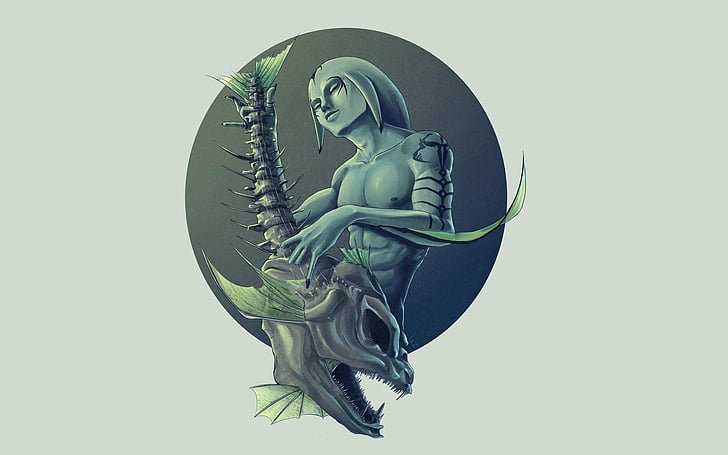
Now things are about to get real…or not. On the one hand, this is a moment where we experience the death of a character right on the screen, something that a company like Nintendo would shy away normally; on the other hand, this badly hurt character says good bye to the world not before taking the opportunity to sing a musical number, like the rockstar he is. Seriousness juxtaposed against levity, the scene would probably not fly in any other way.
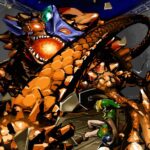
Mikau is the lead guitarist on a band of mermaid people, The Indigo-Go’s, and is also a hero of the Zora—which in Termina are now sea creatures as opposed to river ones; this means his body will die engulfed with the power of rock’n’roll.
Link did try to save him, getting him back to shore after catching a glimpse of birds flying over a body with fatal injuries. So it ends up being the only spirit from a mask that the hero of time managed to meet while the person was still alive; with his last effort, and in true rockstar fashion, Mikau sings his story to the hero and entrusts him with his wishes and regrets, passing on his spirit and condensing his feelings into a mask. It’s a bizarre scene that is in line with the weirdness and sorrowful themes of Majora’s Mask.
Even though the band of zoras is modeled as being a parody of rock stars, Koji Kondo didn’t go as heavy with the music, perhaps because it would feel disconnected with the Zora identity he already had established in Ocarina of Time; thus the music played by Indigo Go’s is made to sound consistent with the world of the Zora. Then it’s not surprising that the music played by the zora band is Latin-jazz, considering the influences of their original cue, the theme from Zora’s Domain, which already had some of these influences from bossa nova, latin music and new age. This whole saga of the Zora musicians is likely a standout part for Koji Kondo, seeing as how this style of music is perhaps his favorite, the one he, as a performer, was playing during his college years, and where a lot of his musical heroes and influences come from; maybe Kondo was even allowed a lot of input during this part of the story due to his experiences of being in a band—although Eiji Aounuma, the director in charge of these scenarios, is himself a musician that enjoys playing percussion, so perhaps his experiences also informed the dynamics of the Zora band.
However, the rock element is not forgotten, as exemplified by this short track and the guitarist’s punk -inspired design with tattoos and thick strap. It retains various classic elements from the genre, from the lyrics’ emphasis on words like oh!, baby!, girl!, yeah!—surprisingly some of the words were actually recorded in audio form— all from Western influence, fitting for the region of the in-game west and contrasting with the Eastern inspired Ikana region to the east, to the cowbell sound that starts the piece, like a drummer counting before the show starts and, in true punk fashion, the one! two! three!!! count (on this part of the game, for the final song of Mikau, maybe there was a lot of input and perhaps modifications from the English translator, seeing as how making original lyrics sound appropriate in a different language is one of the most daunting tasks for a translator).
After finishing, he dies…just like that. We get his soul engraved in a sequence where he says goodbye to the rest of his band members. After carving his grave and paying proper respects, Link then gets to work in order to fulfill the request of this Zora musician and, on a more fun note, become a rock star himself.
Musical Analysis
Structure: Section 0 / Section 1 / Section 2
Time Signature: 4/4
Tempo: 160 (Section 0); 120 (Section 1); 130 (Section 2)
Melodic and Harmonic Profiles: E Blues
The music we hear as his farewell is, of course, as punk as one can get; just two chords, probably played all with downstrokes in muscular, vigorous fashion. However, the Latin jazz influences come through by way of the weird extended chords that come out of his guitar as opposed to the expected wall of distortion. Technically, they are two cues stuck together because, ultimately, the player has control over when the music ends, meaning Koji composed the main bulk of the track and then a separate cue as the last sustained chord before the Zora falls to the ground.
After the cowbell goes 1 2! 1 2 3 4! the guitarist starts to sing over the chords: Em7 – Gm, finishing with an Em7 / 11 (funnily enough, the tempo of the guitarist is off from the one marked by the metronome, a true punk rocker!), with Kondo making sure to program the notes in a way suitable for the style by writing the note lengths slightly different between the intervals in order to make it sound more like a true guitar, in which the notes don’t normally ring at exactly the same time; he also has more space between notes, just like a real guitar is usually tuned, and not all the notes of the chord are always plucked, giving the performance a little air of organic, amateurish vibe. The chords are also in inversion, something that real guitarists don’t even think about, their instrument just plays the notes that are comfortable to the hand.
Like a spirit in pain, the harmony we found here is based around going back and forth between two chords where the tritone between E and Bb sticks out like a sore thumb, giving the piece its jazz flavor and that little touch of dissonance. Since Mikau just died and it would be an insult to leave his music in just piano format or standard music notation, here it is how he would have wanted his music notated, like a true punk guitar player:
0-0-0-0-3-3-3-3- – – – – – – – –0
0-0-0-0-3-3-3-3- – – – – – – – –0
0-0-0-0-3-3-3-3- – – – – – – – –0
0-0-0-0-X-X-X-X – – – – – – – –0
X-X-X-X-X-X-X-X – – – – – – – -0
X-X-X-X-X-X-X-X- – – – – – – – -X
Just two chords and the truth! For guitar players who want to fiddle a little with the song, there you have it. Sorry folks, but it seems Mikau was not that much of an accomplished instrumentalists since his final song can be played with just one finger and the open strings of the guitar. The chords are not as impressive and complex as they look in paper after all. What this tab notation means is that you can pick up any guitar laying there and stroke the four upper strings, you will sound just like Mikau without a single guitar lesson, (we ought to give him a break, perhaps he composed the song on the spot, in which case then it is commendable. He was also mortally wounded at the time so there is that too).
It’s with his band, the Indigo-Go’s, that we are gonna spend some time playing music, after all, Majora’s Mask still conserves the framework of the interactive ocarina, so it couldn’t leave behind the music sensibilities of its predecessor altogether. Time to go check backstage how a band of working musicians operates behind the scenes. As stated, it’s now up to Link to complete the Zora hero’s unfinished business, including the music for the upcoming carnival of time.
A fun fact is that the voice of Mikau is also the same from the hand (a famous Japanese poltergeist) that is asking for paper at the inn of Clock Town.

Help to keep the rites going around here by supporting the shrine:

Media Files, requests and support for more interactive content

Thou shall donate since this is a cult and you are now a sheep

Help staying awake analyzing game tracks and writing posts or else everything will end up being written by A.I
- Inside The Score – The Legend of Zeda: A Link to the Past – End Credits / Staff Roll
 The land rests As the last few minutes of this extensive journey that has now come to an end fly by, the nostalgia and reflective mood kicks in. Because such a massive enterprise as a Zelda game or a Lord of the Rings movie require multiple endings to convey everything… Read More »Inside The Score – The Legend of Zeda: A Link to the Past – End Credits / Staff Roll
 - Inside The Score – The Legend of Zelda: A Link to the Past – Ending / Epilogue ~ Beautiful HyruleFinal of the fantasy The Triforce has been touched. A wish has been granted. For the occasion, the newly undeceased king of Hyrule has commissioned a march in honor of the legendary hero to the Hylian Sousa, who might as well be composer Nobuo Uematsu since this piece is very… Read More »Inside The Score – The Legend of Zelda: A Link to the Past – Ending / Epilogue ~ Beautiful Hyrule
- Inside The Score – The Legend of Zelda: A Link to the Past – Triforce Chamber / Power of the GodsTake your boots off your feet And thus the Triforce spoke to men. And it became present in history. And you better treasure and contemplate this moment seldom witnessed in the course of the series. The elusive opportunity to interact and touch the most important artifact. You are now in… Read More »Inside The Score – The Legend of Zelda: A Link to the Past – Triforce Chamber / Power of the Gods
- Inside The Score – The Legend of Zelda: A Link to the Past – Ganon Battle / Prince of DarknessProgressive evil En Garde! And you better be prepared since you are about to duel the iconic enemy of the series at perhaps his canonically most powerful incarnation. Right after having touched the sacred Triforce which allowed him to conquer all of the Golden Land and whose evil and darkness… Read More »Inside The Score – The Legend of Zelda: A Link to the Past – Ganon Battle / Prince of Darkness
- Inside The Score – The Legend of Zelda: A Link to the Past – Boss Battle / Anger of the GuardiansQuick mayhem Ah, the simpler times when boss battles where not a multi epic orchestral suite but just an ostinato more basic that even what became the music for standard battle encounters out there. We are a long way from each boss having his own personalized track. And this early… Read More »Inside The Score – The Legend of Zelda: A Link to the Past – Boss Battle / Anger of the Guardians
- Inside The Score – The Legend of Zelda: A Link to the Past – Dark World Dungeon / Dungeon of ShadowsMemento mori We are getting closer to Ganondorf (or at least the wizard Agahnim who ultimately fulfills the same human side of evil role in this game) and that means getting closer to the profiles and motifs of his own theme song (which naturally was the theme of Agahnim at… Read More »Inside The Score – The Legend of Zelda: A Link to the Past – Dark World Dungeon / Dungeon of Shadows