A paradisiacal inferno
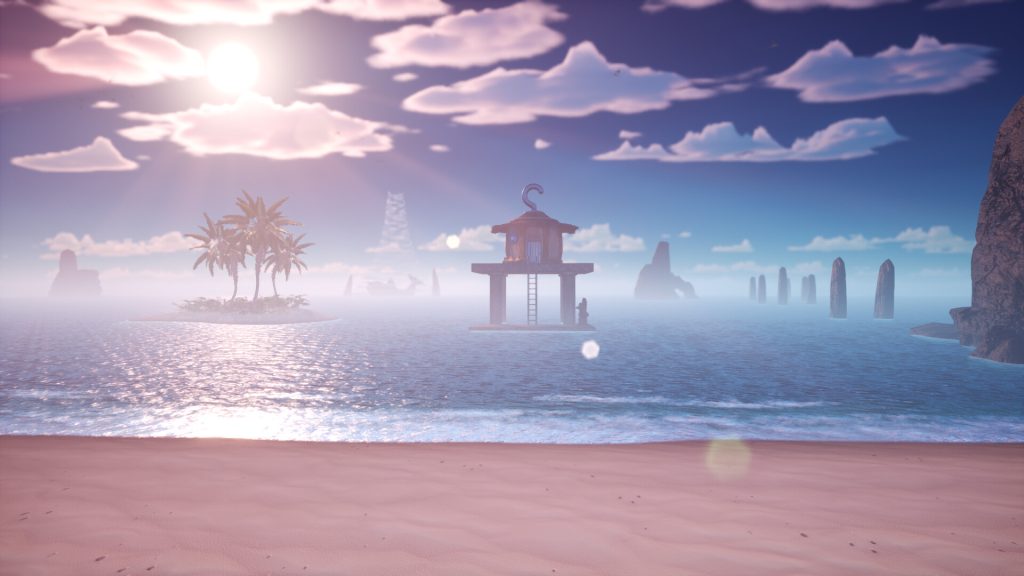
If you thought the whole alien saga was ridiculous—in the best possible way—then you will see Majora’s Mask not holding back on its ocean level. There is your standard fare, of course: aquatic mermaid people? Yes Fighting pirates that torment the people living in the region? Yes. A swimming competition? Kinda. Yet, that the mermaid people are a bunch of rockstars, or that these pirates do not come from your typical swashbuckler story but instead are an organized military navy based around the Middle Eastern women from the previous game was not something anybody would conceive in their right mind—not to mention beavers straight from some unreleased Mario game, an island-turtle and a seahorse trying to find love; oh and don’t get me started on how you get taught the main ocarina song from the area.
Making the regions outside Clock Town as weird and fantastical as possible was a conscious idea made by director Eiji Aounuma, since, for the most part, he was in charge of the overall four-dungeon structure of the game; meanwhile Yoshiaki Koizumi, his co-director, was focused on making Clock Town and its characters feel as real and human as possible (presumably including the people from the Milk Road too). Thus, it was decided that the outside areas contrast as much with the town by having a more fairy-tale, magical sensibility. In general, a project with more conceptual freedom than your standard Zelda game. The true successor to Link’s Awakening.
This region has the honor of having become a stage for Nintendo’s video game/museum Super Smash Bros.
Musical Analysis
Structure: Section 0 / Section 1 / Section 2
Time Signature: 4/4
Tempo: 64 (40 Section 0)
Melodic and Harmonic Profiles: D Whole Tone; D Diminished (Section 1) A Phrygian Major; A Harmonic Minor; A Chromatic (Section 2)
The music is once again the gloomy take on the Majora’s Theme; it feels heavy. It feels dirty, as if the entire ocean is sick. After all, nobody can’t quite point out what is wrong with it. It’s up to Link (and a new companion who joins the party) to explore and solve all the various dilemmas happening all around the bay. However, the theme still has to co-opt elements from water levels and the Zora race, most notably, the steelpan.
And it is the steelpan which we got playing similar patterns to the Zora’s Domain Cue such as the characteristic trill between two notes (of course in Majora’s Mask this trill will focus mostly on the tritone); In addition to this it is also in charge of the countermelody now characteristic of this theme.
Guess what? the steel guitar from Lon Lon Ranch is also present here with the main melody. So good thing you just remembered its sound by going to Romani Ranch to “rescue” Epona. Here they are in their original, quintessential context: a tropical beach reminiscent of the Hawaiian Islands, where people invented and popularized the particular instrument, and one of the most recurrent places of vacation for the Japanese—it doesn’t take too long to hear how this instrument typically sounds in any random episode of the TV show SpongeBob SquarePants— Koji Kondo complies by bringing them up but of course they sound totally abnormal, as if the aliens from the ranch continue to be present. This theremin-like quality is given to the guitars by exaggerating the vibrato of the instrument in certain parts; by playing notes an octave apart, they sound nothing like the style of the instrument, just a glassy tone as if coming from a glass harp, where a player runs his or her moist fingers on cups, Koji Kondo doesn’t even bother to make use of the characteristic portamento effect of the instrument till Section 2. There are just the standard notes of the melody played straightforward.
The Milk Bar also lends an instrument to the cause, the modern bass guitar strikingly playing its normal entity, a bass line. As we will see, this bass tone has connections with the Zora thanks to a very cool guy who plays a very imaginative bass guitar constructed with the body of a crab. Alongside the steel guitar it also plays the very dissonant note that begins every iteration of this theme, with a grace note a minor second apart.
For some inexplicable reason, Kondo decided to use the tanpura, previously heard on the ‘Rosa Sisters’ cue, on a water level, contrasting heavily with the standard use of the instrument in media for lava or fire levels. Maybe he was playing around till he found a sound that set the mood or there was an attempt to make it sound like some pirate accordion; perhaps he even wanted to make a connection with one of the main landmarks of the area, the Marine Research Lab, which plays Hindustani music, a style where the tanpura is heavily featured. Kondo retains the droning style of the instrument, so it seems he was really thinking of it as nothing but a tanpura, or… the sound of a boat.,,,or Kondo just thought of sand and used an instrument from the desert…who knows.
Last, the strings reprise their role from the original swamp region, doubling the melody and adding tritones to every single note in order to make the piece as uncomfortable as possible during Section 1 and then responding to the melody in Section 2. It seems Koji brought them straight from the swamp theme and never got around to find a different instrument that was better suited on this region, thus he just left them as they were.
It will be on this shore where Link will witness in real time the death of a character, the hero of the Zora who will be the last member of the party. Link will even end up with the responsibility of burying him after sealing his wishes, feelings and spirit inside a mask. He will go on to convince everyone else that this zora rockstar is still alive. But Nintendo would not let such dreaded image go on undoctored, adding some levity by making this zora go out with a banger of a song, the last song he will ever sing. It’s up to Link to complete his mission and, no less important, his unfinished music as a fellow instrumentalist.
Help to keep the rites going around here by supporting the shrine:

Media Files, requests and support for more interactive content

Thou shall donate since this is a cult and you are now a sheep

Help staying awake analyzing game tracks and writing posts or else everything will end up being written by A.I
- Inside The Score – The Legend of Zeda: A Link to the Past – End Credits / Staff Roll
 The land rests As the last few minutes of this extensive journey that has now come to an end fly by, the nostalgia and reflective mood kicks in. Because such a massive enterprise as a Zelda game or a Lord of the Rings movie require multiple endings to convey everything… Read More »Inside The Score – The Legend of Zeda: A Link to the Past – End Credits / Staff Roll
 - Inside The Score – The Legend of Zelda: A Link to the Past – Ending / Epilogue ~ Beautiful HyruleFinal of the fantasy The Triforce has been touched. A wish has been granted. For the occasion, the newly undeceased king of Hyrule has commissioned a march in honor of the legendary hero to the Hylian Sousa, who might as well be composer Nobuo Uematsu since this piece is very… Read More »Inside The Score – The Legend of Zelda: A Link to the Past – Ending / Epilogue ~ Beautiful Hyrule
- Inside The Score – The Legend of Zelda: A Link to the Past – Triforce Chamber / Power of the GodsTake your boots off your feet And thus the Triforce spoke to men. And it became present in history. And you better treasure and contemplate this moment seldom witnessed in the course of the series. The elusive opportunity to interact and touch the most important artifact. You are now in… Read More »Inside The Score – The Legend of Zelda: A Link to the Past – Triforce Chamber / Power of the Gods
- Inside The Score – The Legend of Zelda: A Link to the Past – Ganon Battle / Prince of DarknessProgressive evil En Garde! And you better be prepared since you are about to duel the iconic enemy of the series at perhaps his canonically most powerful incarnation. Right after having touched the sacred Triforce which allowed him to conquer all of the Golden Land and whose evil and darkness… Read More »Inside The Score – The Legend of Zelda: A Link to the Past – Ganon Battle / Prince of Darkness
- Inside The Score – The Legend of Zelda: A Link to the Past – Boss Battle / Anger of the GuardiansQuick mayhem Ah, the simpler times when boss battles where not a multi epic orchestral suite but just an ostinato more basic that even what became the music for standard battle encounters out there. We are a long way from each boss having his own personalized track. And this early… Read More »Inside The Score – The Legend of Zelda: A Link to the Past – Boss Battle / Anger of the Guardians
- Inside The Score – The Legend of Zelda: A Link to the Past – Dark World Dungeon / Dungeon of ShadowsMemento mori We are getting closer to Ganondorf (or at least the wizard Agahnim who ultimately fulfills the same human side of evil role in this game) and that means getting closer to the profiles and motifs of his own theme song (which naturally was the theme of Agahnim at… Read More »Inside The Score – The Legend of Zelda: A Link to the Past – Dark World Dungeon / Dungeon of Shadows