Music runs in the family
This is most likely the type of music Koji Kondo would e doing by himself if he wasn’t attached to a company but just following his muse, not restrained by any kind of visual medium. The New Wave Bossa Nova also presents us with the type of music the Zora race enjoys the most. It’s in their blood after all, from birth apparently; ever since we got to Zora’s Domain we have gotten a taste for their musical preferences, and they were always influenced by these Latin rhythms combined with jazz, just like Kondo during his college years.
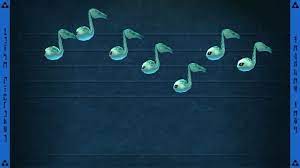
After recovering the seven Zora eggs we are treated to a scene only Majora’s Mask could have come up with; turns out the babies themselves are also the seven musical notes we need to unlock our path to the dungeon of the third region. A song that is said to run in the blood of the Zora sages, the tune is basically a DNA trait that was passed down from the past. It is taught by a clever use of the water measurements markings to create a musical staff—which in Zelda for some reason is composed of four lines as opposed to the standard five line staff.
Just like the past region could have a lesson about the relationship between a father and his child, the themes from the ocean could be about lovers and family responsibilities, assuming Mikau was indeed the father of the eggs and romantic partner of Lulu, the Zora singer.
There are two versions of this theme, one instrumental and the other with Lulu’s vocals.
Musical Analysis: Instrument Version
Structure: Section 1 / Section 2
Time Signature: 4/4
Tempo: 70
Melodic and Harmonic Profiles: F Lydian; C Ionian/Major; C Chromatic
Unlike the other “warp” songs accompanied by the lush orchestration from the classical tradition, this tune really honors its ‘new wave’ moniker due to being the most modern sounding ocarina tune, with this duet between Mikau and the baby Zoras being joined by the typical instruments of the Indigo-Go’s, a Latin-jazz ensemble; it is meant to be accompanied by this iconic Zora band. For the first time, Link and his ocarina don’t even participate; he knows when to step back and this is all about the Zora people.
The name of the song works in many levels, not only is ‘new wave’ an actual music genre, but the word ‘wave’ also connects with the ocean setting and, furthermore, the Portuguese meaning of “bossa nova” is…. new wave too! Making the true name of the piece New Wave New Wave. Four or more layers of meaning for the name of the tune right there; ocean connection, late 70s music genre connection, bossa nova connection, Zora connection, and Indigo-Go’s connection.
A bossa nova is of course one of the quintessential beach vacation styles alongside Hawaiian music; influenced by West coast jazz, it became a new music style that blended together gentle Brazilian rhythms and elements from samba and jazz alongside melodies with cool-toned improvising. The rhythms are usually played lightly as 3-3-4-3-3 with beats 1, 4, 7, 11, and 14 being accented during every two-bars (played in 8/4 time) characterized as the “bossa nova beat”, containing syncopated rhythms and unconventional chords played on the guitar performance style that originated in samba. It is often considered a subgenre of samba. You just need to listen to its most famous exponent: ‘The Girl From Ipanema’ to know all there is.
Koji Kondo naturally relies heavily on the rhythms of bossa nova, with syncopated bass lines and melodies. The presence of the sax here—a main instrument of The Indigo-Go’s even though we never see anyone playing it— brings to mind the music of the Japanese musician Sadao Watanabe, one of the main inspirations and influences of Koji Kondo throughout his ovreu, specially in the Mario music department. However, this is not only the case for Kondo, these kinds of styles are all over Japanese media and sometimes they are even featured on their mainstream popular music; after all, Japan has the largest proportion of jazz fans in the world according to some estimates so it’s not that much of a niche culture there.
The Majora’s Mask focus on the tritone is still alive and well. On this piece, however, it’s not so much about making it creepier or unsettling but to make it cool and sexy, like any true jazz standard that mixes consonance and dissonance as much as possible to give the music an acid flavor. Let’s see what is inside this song straight from Delfina Plaza in Super Mario Sunshine with a slightly darker shade.
The bass line is the spine of this piece (bassists will claim their instrument is always the spine of everything), creating the foundation and immediately giving the bossa nova flavor. Like your typical Kondo ocarina “warp song”, it starts by going back and forth between two chords: F5 and E5. Thank the heavily syncopated rhythm for the bossa nova feel. The piece was written in 70 bpm but the true feel of the piece would be double that time. After that, we go onto the coda, a chromatically ascending harmony adding the jazzy flavor Eb5 – D5 – Db5 – C5. It never varies the rhythm.
The very expressive tenor sax plays the main melody with modulation (vibrato) and pitch bends for a more realistic performance of the instrument. What the electric guitar is to rock, the saxophone is the sound most identified with jazz in the collective imaginary. A difference with respect to other ocarina melodies is that this tune borrows from two of the ocarina scale profiles, the happy profile (A B D), and the mystery/whimsical/dark profile (F A B), giving it a more ambiguous quality appropriate for jazz. It is doubled with Mikau’s guitar, also performed with pitch bends.
Kondo also probably had to scratch his head in order to come up with the voices of the zora babies. What he ended up with was an instrument that had voice-like effects already engrained combined with an electric piano sound; the Goron came to the rescue here by lending to the Zora their distinctive conga glissando sound, which on the high registers sound like a cute little voice, but one that is not coming from a human source; it fits quite satisfyingly with the image and design of the Zora babies.
It seems this Zora band also has a rhythm guitar player, since there is a muted guitar playing in the spaces left by the bass. Who needs percussion when you got this good of a rhythm section? Who wants to even deal with drummers? The interplay between bass and muted guitar provide the piece the extended-harmony feel. Obviously a Latin jazz ensemble would not be happy until it is filled with all kinds of weird chords; bonus points if nobody knows their name. The muted guitar strives to be as groove inducing as possible, varying slightly the note placement of the ostinato, by playing slightly off beat in some repetitions.
The heavy lifting of the track is already done. Now it is just a matter of having fun with ornamentation and flourishes in order to enhance the main melody, finding spaces on the song to fill with elegance. This is precisely what the Rhodes piano does throughout the piece; provide harmony when melody is playing and providing arpeggios and countermelodies when it is its place to do so. Some of the Japaneseness of the song comes from the choice of notes of this instrument, making use of pentatonic scales or at the very least pentatonic-like interval jumps (in simple terms, no chromaticism). Bands should take note of this experienced group of musicians.
Now it’s time to communicate the message of her babies to the mother, whose voice can call upon the path to the sacred temple of the Zoras from Termina. The legendary voice of the Zora idol is a voice that is already familiar to players of Ocarina of Time. making this the only ‘warp song’ with two different versions.
Musical Analysis: Vocal Version
Unlike the other dungeon opening ocarina songs, the New Wave Bossa Nova plays in its orchestrated version also when Link plays it at the entrance of the temple; this is in order to showcase the vocals of Lulu, the Zora diva from Great Bay who has a passionate following, stalkers included and all. She has been in distress due to the loss of her children and as a result also lost her beautiful voice. Mikau, the Zora hero, is hinted to be the father of the Zora eggs and what is certain is that he ultimately died trying to save them.
The resulting song after they hatch is a message to their mother, a maternal connection through music. A bond that permits her singing voice to come back in order to bring to life the island, which turns out to be a giant turtle and protector of the ocean. This turtle will carry Link on his back to the temple, just like on the Japanese legend of Urashima Tarō, who is carried on the back of a turtle to the dragon palace beneath the sea. The turtle was probably inspired on the legends of the bixi, a half turtle Chinese creature whose statues are placed at the entrances to temples. A myth claims that one still lives and resides in the Bohai Sea, where he carries three islands upon his back.
In similar fashion to Lon Lon Ranch, which also has two versions, this bossa nova arrangement is made by replacing a lead instrument for the vocals; in this case the saxophone is replaced with Lulu’s singing, that turn out to be none other than the exact same sound sample of the voice for Malon, the songstress from the ranch; we already got a singing voice, why spend more precious system memory recording additional clips? The Malon voice will come to be known as a placeholder for any female vocals, going as far as to appear on the soundtrack for the more modern Twilight Princess (2006). In Majora’s Mask it is used in different contexts to represent three different girls, the Zora idol is one of them.
The vocals are used once again with frenetic pitch wheel movements, trying to mimic how a human voice slides from one note to another; the most realistic you could get with just one small vocal sample and the technology of the time. In Ocarina of Time, the voice of Malon was used mostly for long sustained notes that tried to hide more its sample nature, however, here it is used in a more rapid melody, doubled by Mikau’s guitar.
The strange interplay between bass, electric piano and palm muted guitar can be decoded with the harmony:
F maj7 sus 2 – Em7 throughout Section 1
Eb maj7 / 13 – Dm 7/9/13 – [Db 6/9-Db ] – [C-C add9[ to cap off the piece.
Yep, this is definitively jazz, just a bunch of cryptic chords stitched together by barely comprehensible music theory that takes years of college to master (or alternatively, you can just feel the vibe and save some money “I’ll play it first and tell you what it is later.” as a famous jazz musician used to say) It wouldn’t be jazz without the little dissonances, where else would be the flavor?
You might hear the rhythm section (plus the cute zora babies) here:
Now onto the mechanical techno-powered water treatment plant where Nintendo shows that they are still not hand holding their water levels just because some poor souls couldn’t handle the Water Temple from Ocarina of Time; they never learn their lesson, do they? At least Zora Link doesn’t need the annoying iron boots and his swimming is formidable. Just remember, hint movies are still not a thing and guides are not allowed!

Help to keep the rites going around here by supporting the shrine:

Media Files, requests and support for more interactive content

Thou shall donate since this is a cult and you are now a sheep

Help staying awake analyzing game tracks and writing posts or else everything will end up being written by A.I
- Inside The Score – The Legend of Zeda: A Link to the Past – End Credits / Staff Roll
 The land rests As the last few minutes of this extensive journey that has now come to an end fly by, the nostalgia and reflective mood kicks in. Because such a massive enterprise as a Zelda game or a Lord of the Rings movie require multiple endings to convey everything… Read More »Inside The Score – The Legend of Zeda: A Link to the Past – End Credits / Staff Roll
 - Inside The Score – The Legend of Zelda: A Link to the Past – Ending / Epilogue ~ Beautiful HyruleFinal of the fantasy The Triforce has been touched. A wish has been granted. For the occasion, the newly undeceased king of Hyrule has commissioned a march in honor of the legendary hero to the Hylian Sousa, who might as well be composer Nobuo Uematsu since this piece is very… Read More »Inside The Score – The Legend of Zelda: A Link to the Past – Ending / Epilogue ~ Beautiful Hyrule
- Inside The Score – The Legend of Zelda: A Link to the Past – Triforce Chamber / Power of the GodsTake your boots off your feet And thus the Triforce spoke to men. And it became present in history. And you better treasure and contemplate this moment seldom witnessed in the course of the series. The elusive opportunity to interact and touch the most important artifact. You are now in… Read More »Inside The Score – The Legend of Zelda: A Link to the Past – Triforce Chamber / Power of the Gods
- Inside The Score – The Legend of Zelda: A Link to the Past – Ganon Battle / Prince of DarknessProgressive evil En Garde! And you better be prepared since you are about to duel the iconic enemy of the series at perhaps his canonically most powerful incarnation. Right after having touched the sacred Triforce which allowed him to conquer all of the Golden Land and whose evil and darkness… Read More »Inside The Score – The Legend of Zelda: A Link to the Past – Ganon Battle / Prince of Darkness
- Inside The Score – The Legend of Zelda: A Link to the Past – Boss Battle / Anger of the GuardiansQuick mayhem Ah, the simpler times when boss battles where not a multi epic orchestral suite but just an ostinato more basic that even what became the music for standard battle encounters out there. We are a long way from each boss having his own personalized track. And this early… Read More »Inside The Score – The Legend of Zelda: A Link to the Past – Boss Battle / Anger of the Guardians
- Inside The Score – The Legend of Zelda: A Link to the Past – Dark World Dungeon / Dungeon of ShadowsMemento mori We are getting closer to Ganondorf (or at least the wizard Agahnim who ultimately fulfills the same human side of evil role in this game) and that means getting closer to the profiles and motifs of his own theme song (which naturally was the theme of Agahnim at… Read More »Inside The Score – The Legend of Zelda: A Link to the Past – Dark World Dungeon / Dungeon of Shadows