Writer’s unblock
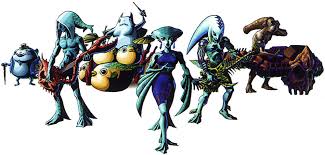
We will spend some more time with the legendary Indigo-Go’s. After all, they have the big responsibility of writing the important end credits song of the game, a very delicate matter that has to be treated with care; plus they are also an intrinsic part of Mikau’s life and unfinished business. We already got a glimpse into their personal practice space, Link is now going to participate in a songwriting session and a rehearsal.
The game showcases how a writing session for a group might go; somebody comes up with some catchy ostinato (a riff), then it is played till everyone is grooving, and then ideas starts to pile on top: melodies, an underlying harmony, a bass line etc. Japas and Mikau are the ones that kickstart the song, teaching us directly and unambiguously the art of the question-answer theory of composition which is ultimately what music is all about. A call and response. A single noise cannot hope to be considered music, it has to have a relation with at least another musical entity in order to constitute a duality. It can even be the same sound repeated but it has to be something—philosophers of music wannabes will try to claim that one note plus silence constitutes two musical entities, but for the sake of sanity nobody should dwell too much on this.
Musical Analysis
Structure: Section 1 / Section 2 / Section 3
Time Signature: 4/4
Tempo: 98 (110 Section 2)
Melodic and Harmonic Profiles: D Dorion; E Dorian
In the case of the jam session, Link encounters the appropriate riff responses in a diary written by the deceased Zora hero Mikau, the four magic notes that will unlock the groove between bassist and guitarist; the bass player ponders the queston, the guitar hero answers. Japas is playing some cool ghost notes on his bass, truly a master of groove. There are two question-answer blocks and that means you can now loop them indefinitely and just come up with a melody on top. And that is it, you just got yourself a barebones song.
What is the secret to coming up with good melodies? Some have tried to answer the question and usually come up with all kinds of contour theories, relationships between intervals, whether the melody rises up or goes down etc. Nonetheless, the best and most practical answer is to just listen to good melodies and tune your ears to what works, developing a melodic intuition. However, if we still insist on going deeper, the best we can do is just say that, at a basic level, it’s all about the balance. Balance between expected and unexpected. Balance between tension and release. Balance between fast and slow. Balance between too many notes and few, sparse notes. Balance between repetition and originality. Balance between major and minor. Balance between diatonic and chromatic. Balance everywhere, you name it. Still, as has been said, perhaps nothing will be as effective in this world as developing a melody intuition; a lot of the great composers, they just know what to do by making subconscious connections of all the different melodic phrases they have heard, combining and recombining them to form new phrases.
It seems that in The Indigo-Go’s, the member with the melody spark is Evan, the keyboardist of the ensemble, not coincidentally the same instrument Kondo plays. The keyboard is a good instrument for composition, you have all the notes arranged out in the most intuitive way possible—the notes just get higher from left to right—you also have the possibility of listening the melody on top of the harmony right there, with ten notes available at any given time to play together, more than you will practically need. So it has been a good composition tool throughout history. Evan doesn’t like other band members trying to write music, a common trait in some band leaders—just ask George Harrison of The Beatles, who had three albums worth of material that he never got the opportunity to put on the band records because he wasn’t the main songwriter— This means Link needs to communicate the song idea to him in his human form, making it seem as if some random kid just came out to his room and inspired him. He instantaneously recognizes the riff’s worth—a songwriting ability that might be as valuable as actually writing—and then writes a melody on top, harmonies included. He does this also by way of question-answers blocks, balancing repetition with new material; he employs the usual technique of making the question the same and the answers different. There is a balance already. If the answers were both the same, the piece would feel unbalanced; too much of the repetition ingredient.
For a melody we can subdivide it into question-answer blocks as grainy as we want to make it, creating questions and answers nested inside bigger question-answer blocks, where the question-answer block itself becomes a new question waiting for a big answer. Over here we can use math symbols to help with the nesting: ( ) [ ] { } each represents a question-answer block and they can progressively fit inside the next.
From the ground up, this is the melody Evan comes up for the upcoming carnival of time:
( ) could be the smallest unit with meaningful call and response information. On this theme it would just be (A E) the simple, humble perfect fifth interval that opens up the melody.
So for his melody, the main question is: [ (A-E) (E-F D) ] that’s it, that’s the motif of the theme; we just need to play with it by finding answering phrases:
{ [ (A-E) (E-F D) ] – [ (A C-C# D B G) (Low D-G Low E) ] } ornamental notes not included. The entire phrase now can now become a big question in and of itself.
Now we got a full satisfying melody. The piece, albeit very short, could perfectly end here if the composer wanted. The asymmetry of the question-answer blocks is part of the balancing that makes music more dynamic and less repetitive.
But if you want to keep going, just rinse and repeat the process until you get the required length of the song. You may even end up with the ultimate question-answer block songwriters sought: the one known as verse-chorus.
For the new super answer, Evan—or Koji— repeats the process but transposing the question a whole tone up, to E (technically, the transposition was already present since the bass and guitar session). This adds a new dimension to the music, Aatwist. However, the composer could have simply gone the route of employing the same question in a D tonality if he wanted. Combining the two big question-answer blocks we get the full melody:
Mega Question—————————————————————Mega Answer
{ [ (A-E) (E-F D) ] – [ (A C-C# D B G) (Low D-G Low E) ] }——{ [ (B-F#) (F#-G E) ] [ (A-G F# E D) (F# C#-A B) ] }
The balancing act emerges from the differences that arise between the question and answer. It’s up to the composer to decide how contrasting the sections should be and how symmetric or asymmetric the phrases should be.
Any melody can be analyzed within this framework, however, there are no rules set in stone; the composer can pick what he or she deems a question-answer block, the basic building units of music.
Since Evan doesn’t want inspiration to go away, he plays the song faster in order to get his ideas straight and get them into his instrument as quick as possible. Koji Kondo knows that a composer needs to hear the idea as soon as possible or the muse might go away as easily as it arrived.
After the most important thing is taken care of, it is just a matter of arranging and orchestrating, depending of the style that wants to be conveyed. In this case we get a taste of Kondo’s preferred music style, some Latin jazz in the style of Sadao Watanabe music and the like. We need to add some jazzy harmony to fit the signature style of the Zora and we are good to go.
The harmony has fun exploring the flavors provided by extended chords moving the upper notes through the scale.
Dm – Dm7 – Dm6 – B dim – B No 3 (b5) – B dim 11
Then they are the same chords but transposed to E. The piece ends in what could be an Em7. Truly a progression for a late night escape in some solitary bar.
Of course the drummer has to play in shuffle for the appropriate jazz feel. This drummer even has the means to play with brushes as opposed to sticks; they give the snare sound a more gentle touch (although the actual sample Koji used is maybe that of a shaker).
Surprisingly, Kondo chooses not to make Lulu’s vocal with pitch bending, which is how he usually treated human singing, instead going with normal notes. What could be behind this reasoning for doing this on this particular track? Only Koji can say.
After the songwriting team finishes the song, it’s time to present it to the diva singer, who fortunately has recovered her voice in time for the carnival of time—as any sane musician knows, the drummer shouldn’t have, under any circumstances, any input whatsoever on the songwriting process or else the whole enterprise will be jeopardized— With this, we hear a small taste of what the end credits theme of The Legend of Zelda: Majora’s Mask will be like and we get to see Indigo-Go’s In action; overall a great sequence. It’s up to Koji Kondo to help Mikau, Japas and Evan to come up with more question-answer blocks stitched together. There still plenty of time for that, and alas, there is one more land that needs to be purified.
We need to communicate the good news to the band’s manager and, while we are on that, check the sound system of the venue we are scheduled to perform at.
And we thought Ocarina of Time was the musical game… but it is here in Majora’s Mask where we actually get to experience some of the dynamics of real modern musicians.

Help to keep the rites going around here by supporting the shrine:

Media Files, requests and support for more interactive content

Thou shall donate since this is a cult and you are now a sheep

Help staying awake analyzing game tracks and writing posts or else everything will end up being written by A.I
- Inside The Score – The Legend of Zeda: A Link to the Past – End Credits / Staff Roll
 The land rests As the last few minutes of this extensive journey that has now come to an end fly by, the nostalgia and reflective mood kicks in. Because such a massive enterprise as a Zelda game or a Lord of the Rings movie require multiple endings to convey everything… Read More »Inside The Score – The Legend of Zeda: A Link to the Past – End Credits / Staff Roll
 - Inside The Score – The Legend of Zelda: A Link to the Past – Ending / Epilogue ~ Beautiful HyruleFinal of the fantasy The Triforce has been touched. A wish has been granted. For the occasion, the newly undeceased king of Hyrule has commissioned a march in honor of the legendary hero to the Hylian Sousa, who might as well be composer Nobuo Uematsu since this piece is very… Read More »Inside The Score – The Legend of Zelda: A Link to the Past – Ending / Epilogue ~ Beautiful Hyrule
- Inside The Score – The Legend of Zelda: A Link to the Past – Triforce Chamber / Power of the GodsTake your boots off your feet And thus the Triforce spoke to men. And it became present in history. And you better treasure and contemplate this moment seldom witnessed in the course of the series. The elusive opportunity to interact and touch the most important artifact. You are now in… Read More »Inside The Score – The Legend of Zelda: A Link to the Past – Triforce Chamber / Power of the Gods
- Inside The Score – The Legend of Zelda: A Link to the Past – Ganon Battle / Prince of DarknessProgressive evil En Garde! And you better be prepared since you are about to duel the iconic enemy of the series at perhaps his canonically most powerful incarnation. Right after having touched the sacred Triforce which allowed him to conquer all of the Golden Land and whose evil and darkness… Read More »Inside The Score – The Legend of Zelda: A Link to the Past – Ganon Battle / Prince of Darkness
- Inside The Score – The Legend of Zelda: A Link to the Past – Boss Battle / Anger of the GuardiansQuick mayhem Ah, the simpler times when boss battles where not a multi epic orchestral suite but just an ostinato more basic that even what became the music for standard battle encounters out there. We are a long way from each boss having his own personalized track. And this early… Read More »Inside The Score – The Legend of Zelda: A Link to the Past – Boss Battle / Anger of the Guardians
- Inside The Score – The Legend of Zelda: A Link to the Past – Dark World Dungeon / Dungeon of ShadowsMemento mori We are getting closer to Ganondorf (or at least the wizard Agahnim who ultimately fulfills the same human side of evil role in this game) and that means getting closer to the profiles and motifs of his own theme song (which naturally was the theme of Agahnim at… Read More »Inside The Score – The Legend of Zelda: A Link to the Past – Dark World Dungeon / Dungeon of Shadows