“You shall see with your own eyes…Just what kind of thing true darkness really is”
Nevertheless, Light is destined to shine in the land consumed by shadow.
The third and final theme belonging to the martial genre that we are presented from Majora’s Mask, each one progressively more serious and epic than the last. This right here is ancientness at its more ancient and magnificence at its more majestic; truly the wars of old and the grandiosity of what was once a very powerful kingdom are represented in this cue.
After traversing the catacombs full of cursed undead asking for specific things in order to let us pass—which most likely has a folkloric origin about a hero bargaining with the undead on the underworld in order to get out and finally reach the light— we are entrusted with the mirror shield that can redirect light sources toward darkness and evilness. The shield design is based around one of the masks that the happy mask salesman carries with him, strengthening the connection of the land with masks and perhaps the acts of sealing souls onto objects, something that Chinese shamans and priests do after performing music and dance in a rite. The series has already a long story with mirror shields, objects that the hero acquires at the end of his quest in order to shine light onto darkness; as we will see, this will be an important motif in the land of Ikana too. This particular idea might have been born from the mysterious Chinese artifacts known as Chinese magic mirrors, which do exactly what the mirrors in Zelda do, reflect complex patterns onto surfaces with light. It took Westerners many years of scientific research to finally crack the mechanism with which these mirrors operated. Turns out creating one of these is a painstakingly arduous process. You can check this interesting concept here:
Painting with the light
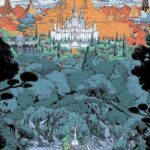
After all this we get to a staircase secret passage onto the heart and soul of Ikana; we are finally ad portas of what used to be the center of power of the mighty kingdom of Ikana. The way the music starts just as Link finishes to climb the ladder of the well makes the moment even more significant and full of weight, as if the building is trying to intimidate us right off the bat. And it is intimidating indeed to walk in the courtyard of this forbidden place, hoping to get an audience with the most powerful man in all of the kingdom, the long deceased king of the Ikana kingdom, Igos du Ikana. Remnants of the war fought are still present with the enemy spies still flanking the castle from outside.
The Castle was the center of the once-great Kingdom and home to the Ikana Royal Family. It was protected by Ikana’s soldiers, which Link now commands; if he wears the captain mask, the deceased corpses of the royal dancers will even receive him in full festive mode (the undead perform the same dances that Majora does in its battle—minus the moonwalk, which of course can only be performed on the moon).
The amount of symbols and the atmosphere of the place is stunning. It does really feel ancient and from a bygone era. We also get a glimpse of the colorful art of the people from Ikana, murals engraved in stone with all kinds of mask motifs and their main crest, what looks like some kind of harlequin in a specific pose; what could be its meaning? Three masks on top of each other? a dancer? Most likely, since ikana was destined to be the land of the dead, the figure refers to the ultimate undead in Chinese folklore: the jiangshi, also known as a Chinese hopping vampire. it is a type of reanimated corpse that implies a numb or dazed mind within a dead body. Jiangshi are often compared to Western zombies, but this is a misnomer because their original consciousness isn’t neglected like a zombie would be; they are just slow minded and stiff, and function on a subconscious level. The strangest part is how they walk, when the dead are prepared for burial, the corpse is dressed in their finest garments and their legs are tied together to make the corpse easier to handle , so when the priest reanimates the corpse and tells it to start walking, it has to hop with its stifled arms out in front. They are immensely popular in Japanese pop culture. It is a symbol that drains the life of living creatures, apt for the people living here.
You can check out this mysterious symbol which connects the land of Ikana with the Clock Tower, the Happy Mask Salesman, or even Hyrule here:
Along with some other cool details about the game. What could really be the meaning behind this symbol? The plot thickens. What is certain is that the people of Ikana, like the ancient Chinese, take their burial and body reanimation very seriously.
The overall theme of the dungeon is light versus darkness—why arent mini dungeons still a thing in Zelda?—Most of the puzzles require Link to create a source of light by interacting with the outside of the castle so that he can use the Mirror Shield to progress further through the interior of the complex. This is not the typical Western cone shaped tower castles like the ones which usually inspire Hyrule Castle (the inspiration for the design of Hyrule Castle was The Neuschwanstein Castle in Bavaria, Germany. It is the most popular castle in all of Europe. It also inspired the creation of the Cinderella and Sleeping Beauty castles, two iconic places in the world of Disney). This one is a square, ziggurat type, more like a true fortress of the ancient Chinese empire than any pretense at external ornamentation, befitting the combative nature of these harsh lands; a design more inspired by something like the Jiayu Pass and other passes located at desert borders in mainland China:
The concept behind the land of Ikana plays around with various ideas of Chinese royal dynasties, the conflicts and cultural interchange happening across the Silk Road and the constant invasions suffered by China from people coming from the Gobi Desert, like the Timur and the Mongols—that is why even in dead, the captain of the Ikana army was still protecting the wall— China is no stranger to lost kingdoms and armies of undead ready to still fight for their king. The developers could have taken inspiration from multiple kingdoms that have disappeared, like Kucha on the desert, Yelang kingdom and many more. In this way, the Ikana cemetery might be based around the Great Wall, the king of Ikana took inspiration from the real life emperor who created a terracota army full of soldiers with no hearts, and the stone-carved Buddhist grottoes famous all across the deserts of China are represented in the final dungeon of the game. After all, the king even has the same headgear as its Chinese counterpart and his soldiers the same from ancient Chinese generals. Still, lots of culture to unpack.
Melodic and Harmonic Profiles: G Aeolian/Minor; G Phrygian; D Phrygian
The military cue, like its previous two companions, focuses on the martial snare as its fulcrum, adding the brass fanfares to receive its visitors in proud fashion even after enduring years of decay. Their power and ancientness is given a dimension thanks to the choirs chanting epic phrases that would pump anyone for battle. The war cannot be avoided now.
Let’s see what is behind the epicness (hint: choirs, choirs everywhere, better if you don’t recognize the language they are singing in). Like a boss battle theme, the piccolo at its highest signals the entrance and beginning of the fanfare with a rapid flurry of ascending notes in a major scale; it’s a positive entrance befitting the new member of the Ikana army to the castle. However, the major scale is incomplete, giving way to the intimidating full intro to the piece, a martial fanfare with accents, usually used in regal ceremonies to signify the entrance of a major visitor. This intro brass is made of notes separated by perfect fourths, forming parallel sus2 chords, a favorite sonority for Kondo battle cues. The marching suddenly starts, putting the previous major scale into its proper context: as part of a Phrygian profile based in G capturing the ancientness and desert sensibility of a place just like it did with the Spirit Temple of the Gerudo.
G sus2 – Bb sus2 – A sus2
It doesn’t need to be explained the role of the ornamental percussion, it’s all about enhancing and accenting the chords in order to maximize their power.
After that the ancientness of a Phrygian ostinano rumbles beneath your feet, there is relentless marching toward a certain death. The cries of the choirs sprouting to the sides add gravitas to the proceedings. The ostinato maintains the same triplet rhythm profile played in fourths and accentuated by the snare drum across a question-answer block based around G, question approximating G from above, answer from below.
Large question
[ (G5 G5 G5 G5 – Bb5 Bb5 Bb5 Ab5) ]
Large answer
[ (G5 G5 G5 G5 – Ab5 Ab5 F5 Ab5) ]
A symmetric, monolithic ostinato where Kondo manipulates slightly the note length to create excitement and rhythmic variation.
Underneath it all we find the deepest octaves played the the low strings, giving us a bed and pedal notes where the rest of the track can confidently march, they stay put for the most part on G, only going down to F for a brief moment. This is indeed a very organized army marching with perfect synchronization. The male choirs are right there at the lower end of the spectrum also maintaining one note, joined shortly after by the women taking care of the high register. A level of grandiosity not seen since the Ganon battle; you start to realize the importance of Ikana and its probably might all across Termina.
The main melody is carried by the trombones, with spine tingling echoing chords responding to their phrases. A spiritual successor to the pirate fortress theme, with emphasis on spiritual. Everything is made of perfect fourths over here, like symmetric blocks made out of stone. The melodies, the harmonies. A compact and immovable army. These choirs are truly claiming for blood. Compared to the pirate fortress cue, the clarinets meant to be boat horns are substituted by the male choirs meant to be the army.
The male samples are playing just two notes, however, the nature of the samples make them feel as if they are singing three legato notes of the Phrygian tetrarchord.
Unexpectedly, the piece is transposed—what else?— a perfect fourth down to D. It seems Kondo really did follow closely the same lessons he applied to the Gerudo pirate fortress cue; they are truly sister cues (their other military companion, the Bremen march, is more like a little soldier toy war; yet you can actually use this little song to make generals of the Ikana army march to your tune).
The last sections come to remind us that this region has an horror motif and that this palace is not only ancient but also very, very dangerous and cursed; the classic, dissonant high pitched strings are here of course. And the royalty of the place is cemented by the horns fanfares. Nobody should bother naming the dissonant chords played by the violins, suffice to say there are tritones, minor seconds and perfect fourths embedded in the relationships between notes. A recipe for frightening dissonance since we get three different kinds of musical evils working together.
But the song is not finished yet. There is a last back and forth between the male and the female choirs; the women choir made more phantasmagorical by clustering their notes, giving them an air of pain; with their male counterparts they are condemning everyone who dares to set foot on the castle. This time around, the males are really singing three notes in question-answer form. Light and darkness.
Lesson leaned: Phrygian mode and war music are a match made in heaven. Also perfect intervals everywhere. Koji Kondo practically managed to do a full theme made of only perfect fourths, from the timpani to the ostinatos to the melodies; a monolithic layer of bricks just like this fortress.
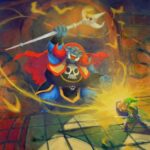
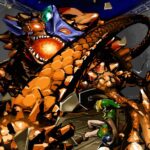
After traversing this fort directly to the magnificent throne room, whose light makes the king Igos truly a frightening and imposing figure. we must fight him and his generals in order to convince him of giving us command of our own personal terracota army. Empty shells at our service. Troops that will allow us entrance to the direct source of the undead. Link is about to enlighten to the sacred concept of emptiness.
Help to keep the rites going around here by supporting the shrine:
Media Files, requests and support for more interactive content
Thou shall donate since this is a cult and you are now a sheep
Help staying awake analyzing game tracks and writing posts or else everything will end up being written by A.I




 The land rests As the last few minutes of this extensive journey that has now come to an end fly by, the nostalgia and reflective mood kicks in. Because such a massive enterprise as a Zelda game or a Lord of the Rings movie require multiple endings to convey everything… Read More »Inside The Score – The Legend of Zeda: A Link to the Past – End Credits / Staff Roll