Uncanny valley
“That is the mask of those who roam this world with the most lingering regrets!”
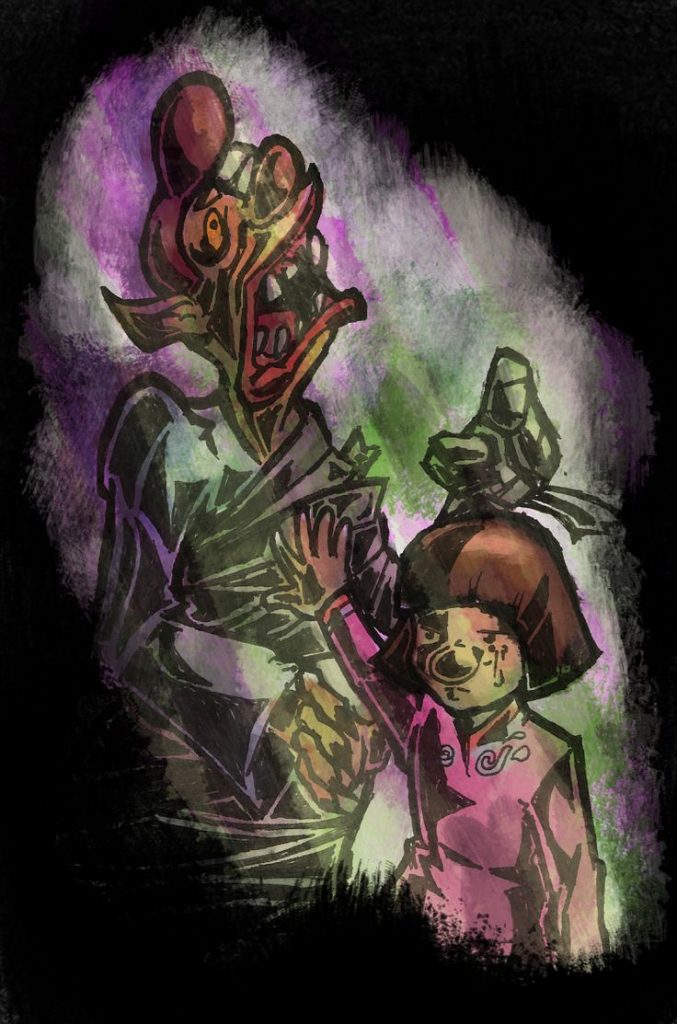
After the ridiculousness of the boat cruise, having to calm a crying baby and then a band of rockstars playing a part in the destiny of their land, Ikana could not be left out of this whimsical pattern. Turns out, after the disturbing Sharp’s curse is calmed, we start to hear little carnival music and moreover, it is what drives out the evil spirits roaming the land; they want to be as far from happiness after all. If Link manages to relearn the classic Song of Storms, he will be able to ward of the evil spirits dwelling at the river bank, managing to revert the water flow to the desert and restart the operation of the music box house.
What we get here is an analogous to how the Song of Storms was originally connected to the organ grinder from Ocarina of Time, also playing European folk oom-pah rhythms to make water flow. It is just that now the situation is in a giant edition, with a brand new cue playing a happy oom-pah tune, a positive counterpart to the ‘Windmill Hut’ theme, a little return to the Dutch sensibilities, their windmills pumping water and their rich history with barrel organ culture. Who knows what inspired this scenario or what came first: the Song of Storms, its relationship with water modification, or the phonograph connection.
However, this is Majora’s Mask showing its uncanny teeth at its more vicious level. Hearing the music against the disturbing cutscene and sounds emitted by the undead is quite the experience, not to mention that watching the door make a click sound is really frightening. Who knows what lurks inside that seemingly happy, whimsical looking house. There is a bad feeling about this already, but why? Shouldn’t the happy music be a signal of everything going fine? The power of context is at play here. In fact, the happy music on this context is perhaps more effective than any low dissonant music could ever hope to be. It plays with the uncanny as many horror soundtrack have, juxtaposing the setting of a comfortable place, like a fair or carnival with the land of the dead, where it definitively shouldn’t be.
This plays out with the trope of creepy circus music, where the juxtaposition of child-like music with horror is truly haunting , often sounding as if it’s being played on an old, rusty calliope. To make it even scarier, it’s often source music (diegetic) in an abandoned area to indicate that it is not so abandoned as the characters thought. Unlike the three other regions of Termina, here there are no bustling settlements around or amenities for tourists, nor is there the anticipation of festivity and happiness; Ikana is a place that exists in stagnation and ruin, a place whose time was a long time ago. Seeing the first signs of life is unnerving to say the least.
What we don’t know yet is that what we are going to meet is just a little girl, perhaps one of the most courageous characters Link will ever come across in his adventures, affronting a very difficult situation that surely would break any less resilient soul. The reason mummies have been gathering around her house is that they are waiting for the one of their kind who is trapped on the basement of the house by the little girl, but why would a small child have locked up a mummy in her house? Link tries to approximate her but she is evasive. She is definitively hiding something. In a moment of distraction for the little girl who just went outside perhaps to get some water or see what is going on, Link sneaks into the house, everything is normal apparently, except that on the basement there is a research lab. In a series of masterfully directed horror tropes, the terrible image of a man in the process of becoming the undead will haunt any demographic, and for some, the only solution to the puzzle will be to turn off the console and play some other game, like Kirby. Those brave enough to continue seeing this abomination will either way have their hearts break upon seeing the struggle the little girl, named Pamela, has with protecting her beloved father who has basically become a monster. The closet where he is trapped s even full of Japanese ofuda, or spirit talismans, which in Japanese Shinto and Buddhism are used to ward off bad fortune. The girl really has faith that her father is not totally gone, even lending her plush toy for him to entertain himself.
It’s a moving scene emblematic of Majora’s Mask, still finding ways to balance a deeply affecting theme with whimsical scenarios. After the cure, Pamela will keep protecting her father by not letting him know what happened—she even pointed some speakers playing this ‘Farewell to Gibdos’ tune at full volume directly at the closet— Poor girl seems to have tried everything in her power. It’s implied that she has been feeding him, entertaining him and cleansing him for some time.
The cure is, of course, the Song of Healing, the very last (or perhaps the only) exorcism Link will perform with the teachings of the Happy Mask Salesman. This time to heal a person that is alive. In doing so, Link gets a small fragment of the spirit of one of the undead and will now be able to communicate with the creatures that will lead him to the heart of the Ikana kingdom. The fact that we don’t get another transformation mask in this area gives the game a sense of novelty since it refuses to follow a predictable structure or pattern.
Musical Analysis
Structure: Section 1 / Section 2
Time Signature: 3/4 (6/8)
Tempo: 180
Melodic and Harmonic Profiles: C Ionian/Major
Going back to the cue from the music box, it is nothing that Kondo could not pull off in a matter of minutes, already having experience composing carnival music for ghost houses in the video game Super Mario 64 or mini-game music for various Nintendo games:
Here he continues the same idea, basically bringing again the accordion sounds and oompapa rhythms, this time with the characteristic tuba sound that was absent from previous attempts at the genre and the cadences and child-like sensibilities of the melody.
The oom-pah sound is usually made by the tuba alternating between the root (tonic) of the chord and the 5th (dominant) — this sound is said to be the oom. The pah is played on the off-beats by higher-pitched instruments such as the clarinet, accordion or trombone. Oompah is often associated with Volkstümliche Musik, a form of popular German music; also super popular with the street organ culture prominent in the Netherlands and other close countries.
We get the tuba going back and forth between C and G, beginning a progression based around the major chords of the scale, the I – IV and V. The melody makes use of accidentals, or notes outside the scale to add spice, like the F#, G# and A#. Rest of the instruments are from the orchestrated version of the Song of Storms.
The harmony for Section 1 goes simply as:
C – G – C – F – C – G – C
With chords sustained throughout multiple bars.
Well, actually the accordion gives the chords a more complicated flavor, making the G, a G7/9 sonority.
The ocarina and the glockenspiel have interchanged roles with respect to the original Song of Storms; now the glockenspiel is doing the main melody and the ocarina harmonizing it, in thirds. The melody uses a repeated motif creating well defined question-answer blocks with easily identified cadences as befits of this style of music.
There is time in the piece for a second section where the tuba drops off, letting the accordion bring the full oom-pah experience and the melodic instruments left to play in unison a fast, arpeggiated melody, where the harmonic profile is descending by a full tone and then a semitone at the end, creating, by virtue of voice leading the progression:
F – C – G7 – C
Still remaining positive and without modal sensibilities unlike the more mystic ‘Windmill Hut’ cue.
The oom-pah pattern is slightly altered to create variation between sections.
There is an unique effect where it is possible to hear the Ikana Valley cue and the Music Box House cue at the same time, something made possible perhaps due to the extra memory provided by the expansion pack. Until this point, the music being played had to fade out in order to transition to the new cue. The tuba from the cue also appears to be dynamic, disappearing when Link is not moving.
Now things are about to get more epic as Link embarks onto the heart of the kingdom to see what was it like and meet face to face with the king himself. He will have to travel through some grottoes with his new ability of communicating with the undead. There is still more to uncover about this strange land (Circumstantially, a Gibdo knows the elemental formula for water (H2O), and another uses the word “Calcium,” terms not in use until after the Industrial Revolution. Just Majora’s Mask being Majoras Mask).
As a fun fact, it appears that the main developers of The Legend of Zelda are inserted into the game, alongside a lot of their life experiences. With Pamela’s Father we complete the main players of the original The Legend of Zelda game. It seems the appearance of this character is based around that of Takashi Tezuka, the right-hand man of Miyamoto, with Shigeru Miyamoto himself being speculated to be the inspiration behind the Happy Mask Salesman design and personality. And our own man of the hour, Koji Kondo being immortalized in none other than the infamous Tingle. Is his personality anything like the character? Could there be other developers inserted into the game?
Help to keep the rites going around here by supporting the shrine:

Media Files, requests and support for more interactive content

Thou shall donate since this is a cult and you are now a sheep

Help staying awake analyzing game tracks and writing posts or else everything will end up being written by A.I
- Inside The Score – The Legend of Zeda: A Link to the Past – End Credits / Staff Roll
 The land rests As the last few minutes of this extensive journey that has now come to an end fly by, the nostalgia and reflective mood kicks in. Because such a massive enterprise as a Zelda game or a Lord of the Rings movie require multiple endings to convey everything… Read More »Inside The Score – The Legend of Zeda: A Link to the Past – End Credits / Staff Roll
 - Inside The Score – The Legend of Zelda: A Link to the Past – Ending / Epilogue ~ Beautiful HyruleFinal of the fantasy The Triforce has been touched. A wish has been granted. For the occasion, the newly undeceased king of Hyrule has commissioned a march in honor of the legendary hero to the Hylian Sousa, who might as well be composer Nobuo Uematsu since this piece is very… Read More »Inside The Score – The Legend of Zelda: A Link to the Past – Ending / Epilogue ~ Beautiful Hyrule
- Inside The Score – The Legend of Zelda: A Link to the Past – Triforce Chamber / Power of the GodsTake your boots off your feet And thus the Triforce spoke to men. And it became present in history. And you better treasure and contemplate this moment seldom witnessed in the course of the series. The elusive opportunity to interact and touch the most important artifact. You are now in… Read More »Inside The Score – The Legend of Zelda: A Link to the Past – Triforce Chamber / Power of the Gods
- Inside The Score – The Legend of Zelda: A Link to the Past – Ganon Battle / Prince of DarknessProgressive evil En Garde! And you better be prepared since you are about to duel the iconic enemy of the series at perhaps his canonically most powerful incarnation. Right after having touched the sacred Triforce which allowed him to conquer all of the Golden Land and whose evil and darkness… Read More »Inside The Score – The Legend of Zelda: A Link to the Past – Ganon Battle / Prince of Darkness
- Inside The Score – The Legend of Zelda: A Link to the Past – Boss Battle / Anger of the GuardiansQuick mayhem Ah, the simpler times when boss battles where not a multi epic orchestral suite but just an ostinato more basic that even what became the music for standard battle encounters out there. We are a long way from each boss having his own personalized track. And this early… Read More »Inside The Score – The Legend of Zelda: A Link to the Past – Boss Battle / Anger of the Guardians
- Inside The Score – The Legend of Zelda: A Link to the Past – Dark World Dungeon / Dungeon of ShadowsMemento mori We are getting closer to Ganondorf (or at least the wizard Agahnim who ultimately fulfills the same human side of evil role in this game) and that means getting closer to the profiles and motifs of his own theme song (which naturally was the theme of Agahnim at… Read More »Inside The Score – The Legend of Zelda: A Link to the Past – Dark World Dungeon / Dungeon of Shadows