Warriors without a soul
“I grant to you a soldier who has no heart. One who will not falter in the darkness”
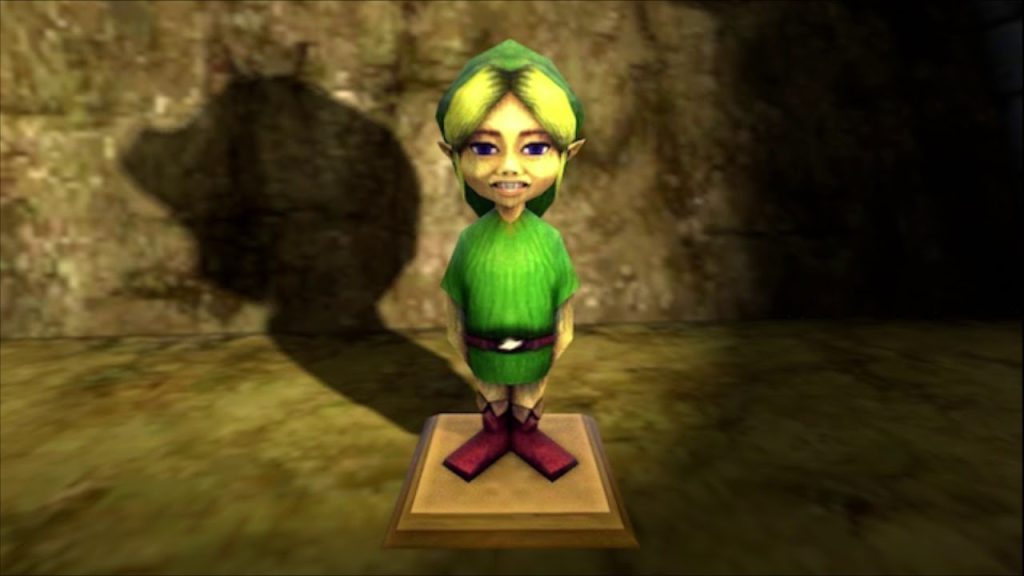
What would it be like to take a snapshot of your soul at its current state? The powerful magic of the Ikana Kingdom can answer this question.
After finally shedding some light into the throne room, Link convinces the king of Ikana to help him reach the entrance to the temple and final dungeon of the game. Still, the temple is not really closed, it’s just inaccessible to any single person; the most involved quest to reach a dungeon still has some more mileage. A true test of all the abilities Link has acquired awaits him, and all the members of the party will have to participate and collaborate together in order to reach the heavens.
And it is is in order to reach the heavens and attain the true inner light that Link must first shed his material self by way of learning the last important concept of emptiness; the ideal of attaining the highest reality which is formless and which is known as ’emptiness’ or shunyata. It is said that in the real world, approximately two thousand five hundred years ago, the Buddha was able to realize ’emptiness’. By doing so he freed himself from unsatisfactoriness. For a person on an awakening path, The realization of shunyata leads one to no attachment and clinging. It is the skillful means towards enlightenment and a very important step. So it is fitting that the journey of our hero began with the ‘Sonata of Awakening’ and ends now with the ‘Elegy of Emptiness’.
The Elegy of Emptiness is perhaps the strangest ocarina melody in both function and composition. With it, Link will be able to fabricate an sculpture of himself and the other souls he carries with him. Since both the king Igos du Ikana and his generals have armors and head gear based around ancient imperial China, it’s very likely that the concept behind the Elegy of Emptiness was inspired by that of the famous Terracotta Army, a collection of life-sized statues found in the tomb of first emperor Qin Shi Huang with the purpose of protecting and fighting for the emperor even in the afterlife; it is one of the most significant archeological discoveries of all time. The once full-color painted soldiers were discovered in 1974 by local farmers, hurried in pits containing more than 8000 soldiers, 130 chariots with 520 horses, and 150 cavalry horses surrounding the mausoleum of their emperor, all painstakingly made ready for battles beyond the realm of the living. In fact, the ornamental hat of Igos Du Ikana is exactly the same as emperor Qin Shi Huang, and in the land of ikana, his soldiers still fight for him even in death, just like the original one hoped. Now he will bestow upon Link the power of creating his own personal terra-cotta army, allowing him pass throughout the mysterious grottoes of Ikana. Link will receive the power accessible to the emperor of China, the power to create soldiers that will never falter—the song will also allows us to see for the first time the true form in life of the Deku mask we have been carrying since the beginning.
After the composer brothers of Ikana, the music box having an effect on the undead, and finally reaching the temple with the power of a song, we start to uncover the narrative tissue of the musical motif across the valley of Ikana and how it plays a magical role in the kingdom; perhaps the Elegy of Emptiness itself is a remnant of a process that culminated with the discovery of the Song of Healing or it descends from it in the ancient past of this land; a kind of imperfect Song of Healing. The Orientals themselves have different traditions of capturing souls and demons into inanimate objects (just in march of 2022, a volcanic rock said to have contained a demoness for hundreds of years split in two in Nikko National Park, Japan; so apparenty a demon is on the loose now).
A land based around the desert regions across Northwest China and the Silk Road, which is a name given to the overland luxury trade routes between China and the Mediterranean where “all the cultures of the world collided”—just like they will on our next dungeon— This makes it likely that the kingdom of Ikana founds inspiration on the mysterious ancient Buddhist kingdom of Kucha, that ran along the northern edge of what is now the Taklamakan Desert in the Tarim Basin and south of the Muzat River. A melting pot of cultures and a central metropolis of the Silk Road, the Kingdom of Kucha occupied a strategic position in Central Asia, which brought it prosperity, and made it a wealthy center of trade and culture. Their very specific style of music gained popularity and an aura of mysticism, spreading along the trade lines. Its influence was so great that it even was transmitted from China to Japan, and today it is still preserved there, somewhat transformed, as gagaku or Japanese court music. For more than a thousand years, Kucha was a proud and mighty kingdom. Then somewhat 1500 years ago, it mysteriously vanished, almost as if it had crumbled into the dust of deserts, leaving behind hardly a trace save a few weathered and wind-sculpted ruins, which archeologist are still studying today.
So, in the world of Termina, this could also mean that there was even a more ancient kingdom than Ikana, which vanished, and that kingdom was the one that built the Stone Tower Temple, which is implied to be a more ancient building than the Castle (since the thing even has its roots in the profound, void underground, it might not even have come from human hands, but something more sinister). Link is about to find what is really there and why the king of Ikana and all of the other spirits are fearful of it.
This ocarina melody only works in the areas pertaining to Ikana Canyon; outside of them it has no influence. The statues constructed by this music are truly the current states of the souls of the Deku Butler’s Son, Darmani III, Mikau and Link respectively. Since they don’t have the same appearance that the forms Link takes when using their masks, it means that if you want to grasp the state of their souls, you just have to glance at their statues. They all still have an objective to fulfill for the hero of time and the entirety of their land, Termina—if you think Link’s statue is particularly disturbing, then you know the state of his soul at this point in his life, and perhaps that, at a fundamental and meta level, the character’s soul is Japanese.
The name of the song also plays with the death motif all across Ikana. An Elegy is a mournful, melancholic, or plaintive poem, especially a funeral song or a lament for the dead, sometimes used as a catch-all to denominate texts of a somber or pessimistic tone, and sometimes as a marker for textual monumentalizing. None of the ocarina melodies here are taught via a musical instrument; they are sung for the most part.
Musical Analysis
Structure: Section 1 / Section 2 / Section 3
Time Signature: 4/4
Tempo: 84 (ritardando to 70)
Melodic and Harmonic Profiles: E Chromatic; E Harmonic Minor
Sort of a musical spiritual successor to the ‘Nocturne of Shadow’, the way Link receives the power to grasp emptiness is by means of a very angular, dissonant melody that shows three clearly defined emotions; this thing right here is the sound of a debilitating sickness, then contemplating life and ultimately the sadness of death. In its short span it is imbued with sentiments similar to what the king feels about the downfall of Ikana. In typical Majora’s Mask fashion, it emphasizes the tritone present in the notes accessible to the ocarina basic scale (F – B) Th.e piece never references the tritone directly and in fact combines the middle portion of the ocarina scale (F G B) with the more positive last one (A B D); it is one of the most elaborate pieces for players to memorize since it uses all four of the C-buttons on the controller and the melody is a complete phrase with not enough separation or definition between the question and the answer. A long form melody.
Also, compared to its other ocarina melodies counterparts, it is very different. It’s longer, with three defined blocks as opposed to the normal two common among the ocarina tunes, and its instrumentation doesn’t seem to imply any meaning or duet taking place between characters besides Link’s ocarina. The Deku pipes are here but they seem to be more related to the regal nature of Ikana than any character. The movement of the strings is the one more akin to the ‘Nocturne of Shadow’ though.
The main phrases are: the debilitating first part, the more hopeful Section 2 and the full-of-sorrow Section 3. Section 1 and Section 2 both consist of the similar phrases repeated, with the more sustained Section 2 replacing the F natural for its sharpened version F#. The harp plays through the cracks with small accentual flourishes, after that it changes to a never seen before arpeggio pattern, a dual mirror sequence going down and then being immediately reflected, perhaps a significance to the mirror statues the song produces, the mirror nature of the Stone Tower Temple and the mirror shield that brought us this far; it seems this Zelda is also coming to a dualistic ending. It finishes by taking the song to the evasive minor profile that wasn’t clear for most of the piece. Ikana doesn’t deserve a triumphant Mario cadence. Koji lefts this elegy to end, appropriately, on a mournful tone, not even the Nocturne of Shadow was this bleak, at least that song had a redemption at the end—if you wanna maintain your positivity and sanity, just notice that the harp ends with the coin sound from the Super Mario series, then you don’t have to think more about the elegy; it can’t be unheard.
The high strings also seem to be playing and going for a mirror pattern, with pairs of notes going against each other. The string section is even more creepy and dissonant than on the Nocturne of Shadow, with more chromatic steps. And at least the nocturne had the decency of harmonizing with perfect fourths and fifths. Over here we are treated to truly demonic tritones. The fact that we are still left with something recognizable as a song is nothing short of a miracle, and it’s all thanks to Kondo using strategically the upper note of the string to maintain some semblance of harmony. The interplay with the upper strings forms all kinds of interesting harmonies, but the heart of the piece is still the diminished fifths.
Section 1
Bb(b5) – A(b5) – Ab(b5) – G(b5)
On Section 2 it begins to stabilize itself, albeit still starting with diminished fifth chords
C (b5) – B – C (b5) – B – Em – E sus2 – Em
Just like on the ‘Requiem of Spirit’, the theme pivots from a sus2 to the tonic, creating a cadence that feels as if it went from B to Em (this is because the E sus2 contains a B5 interval.
We also get some fast ornamental countermelodies that are not characteristic of Koji Kondo, giving the piece an elegant an epic feel that only the counterpoint technique can shine on a piece.
You can hear some of this elegance in the accompaniment here:
“Believing in your friends and embracing that belief by forgiving failure.. these feelings have vanished from our hearts”
And with those parting words, the king of Ikana sends Link and his army to take over the darkness emanating from the mysterious stone structure that can be seen all over Termina, a tower as tall as the deities from Termina. A testament of power and the very last stage of awakening for the Hero of Time, going directly to the heavens in order to become the fifth protector of this world, the fifth giant. He will be accompanied by his friends from Termina. Four heroes of four different cultures cooperating together.

Help to keep the rites going around here by supporting the shrine:

Media Files, requests and support for more interactive content

Thou shall donate since this is a cult and you are now a sheep

Help staying awake analyzing game tracks and writing posts or else everything will end up being written by A.I
- Inside The Score – The Legend of Zeda: A Link to the Past – End Credits / Staff Roll
 The land rests As the last few minutes of this extensive journey that has now come to an end fly by, the nostalgia and reflective mood kicks in. Because such a massive enterprise as a Zelda game or a Lord of the Rings movie require multiple endings to convey everything… Read More »Inside The Score – The Legend of Zeda: A Link to the Past – End Credits / Staff Roll
 - Inside The Score – The Legend of Zelda: A Link to the Past – Ending / Epilogue ~ Beautiful HyruleFinal of the fantasy The Triforce has been touched. A wish has been granted. For the occasion, the newly undeceased king of Hyrule has commissioned a march in honor of the legendary hero to the Hylian Sousa, who might as well be composer Nobuo Uematsu since this piece is very… Read More »Inside The Score – The Legend of Zelda: A Link to the Past – Ending / Epilogue ~ Beautiful Hyrule
- Inside The Score – The Legend of Zelda: A Link to the Past – Triforce Chamber / Power of the GodsTake your boots off your feet And thus the Triforce spoke to men. And it became present in history. And you better treasure and contemplate this moment seldom witnessed in the course of the series. The elusive opportunity to interact and touch the most important artifact. You are now in… Read More »Inside The Score – The Legend of Zelda: A Link to the Past – Triforce Chamber / Power of the Gods
- Inside The Score – The Legend of Zelda: A Link to the Past – Ganon Battle / Prince of DarknessProgressive evil En Garde! And you better be prepared since you are about to duel the iconic enemy of the series at perhaps his canonically most powerful incarnation. Right after having touched the sacred Triforce which allowed him to conquer all of the Golden Land and whose evil and darkness… Read More »Inside The Score – The Legend of Zelda: A Link to the Past – Ganon Battle / Prince of Darkness
- Inside The Score – The Legend of Zelda: A Link to the Past – Boss Battle / Anger of the GuardiansQuick mayhem Ah, the simpler times when boss battles where not a multi epic orchestral suite but just an ostinato more basic that even what became the music for standard battle encounters out there. We are a long way from each boss having his own personalized track. And this early… Read More »Inside The Score – The Legend of Zelda: A Link to the Past – Boss Battle / Anger of the Guardians
- Inside The Score – The Legend of Zelda: A Link to the Past – Dark World Dungeon / Dungeon of ShadowsMemento mori We are getting closer to Ganondorf (or at least the wizard Agahnim who ultimately fulfills the same human side of evil role in this game) and that means getting closer to the profiles and motifs of his own theme song (which naturally was the theme of Agahnim at… Read More »Inside The Score – The Legend of Zelda: A Link to the Past – Dark World Dungeon / Dungeon of Shadows