Conquer yourself
“Masks… You have… a lot. You, too… Will you be… a mask salesman?”
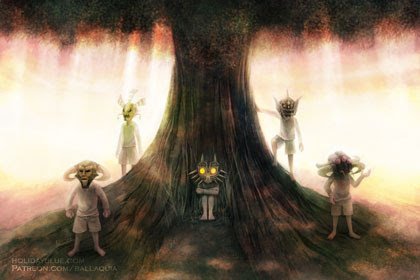
In the beautiful anticlimax for The Legend of Zelda: Majora’s Mask we find ourselves at the presence of a solitary tree surrounded by white Lily flowers right in the middle of a peaceful meadow, with yellow butterflies fluttering and the same magical ambience reminiscent of the forest where the Hero of Time began his journey. This is a seminal sacred moment for the Hero. The natural conclusion for this Chinese based mystical adventure.
Yes, just as Link promised the unassuming guy at this mysterious new shop in Hyrule that appeared from nowhere, he became a salesman, a happiness salesman, dealing in masks that bring acceptance and healing to sentient beings all over the land. It’s here on this ethereal plane of existence where the game finishes to reveal its true colors, its true influences and, ultimately, what it was going for all along. The healing and subsequent awakening of the Hero of Time, an undaunted growing up allegory signaling that Link (and perhaps even the player) is now capable of annihilating any obstacle towards enlightenment, a reward for all the good deeds performed during the quest.
That is…only if everything went right. Here we have the potential to see the results but it’s not guaranteed. Our battle can be either significantly more difficult or ridiculously easy depending of how much feelings of gratitude were recollected and how much we grew up during our quest. Now, what is really at stake here? It Is not like Link just helped everybody on a single cycle before coming up here, the masks collected remaining the sole proof that he did something good for somebody on a past that doesn’t even exist anymore; symbols of promises fulfilled. For Termina this ride has been only three days, not for the hero; he has already lived multiple lives and got to know the regrets and deepest desires of each and every single soul in Termina, the land destined to be based around time, trapped by time and conquered by time. Like the opening of the game promised, this was indeed a personal journey. The reward, finding the direction lost, recovering an identity and becoming an awakened being that can conquer himself. A person who sees the truth. The very last obstacle towards enlightenment is against the heart shaped titular Mask of Majora. What would really happen if he were to fail?
There is one last chance to reflect here alongside this sacred Bodhi tree before our most important battle; and four last tests provided by the mysterious children running around inside the moon. Happiness, friendship, truth and the “right” path to take, four notions that a being on a path towards awakening would benefit from pondering. After presenting each one of them with the proof of his good deeds, Link will reflect on four noble truths from each of these children who look just like the Happy Mask Salesman.
Just as Cremia says, every good deed gets you closer to adulthood, and if the player manages to do plenty of good deeds, the game will reward them with the ultimate mask signaling that Link is truly an adult now, a being capable of destroying all the obstacles toward enlightenment and finally be able to easily suppress the demonic nature that has caused trouble throughout his adventure. Thus we are treated to a conceptual reprise of the scene from the similarly Eastern inspired Water Temple from Ocarina of Time, where at the feet of a mythical tree Link purifies himself against his reflection (Which is why Ravio, his counterpart, is also in possesion of Majora’s Mask).
In the 3Ds remake it appears as if this location where we end this personal journey fighting the mask could actually be inside the Bodhi tree, with the floors giving a more reflective nature, getting it closer to the same mirror room at the top of the Water Temple; a room designed for both literal and figurative reflection, where legends say a being attains enlightenment and conquers his own self. In Majora’s Mask this is represented as a fight against the mask shaped like a dark heart full of thorns. And because Link has the potential to become an awakened wrathful deity, The Legend of Zeda Majora’s Mask takes this notion literally in the figure of the Fierce Deity Mask, based around an adult form of Link that is now prepared to annihilate his last obstacle.
After healing souls all over Termina, there is just one soul left to heal; it all comes down to fighting emotion, because like the other masks from the game, the mask of Majora must also be the personification of an emotion. As stated, the difficulty of this fight will depend on how much Link managed to grow up as a person during his time on Termina; fail to become an enlightened being, your fight against this dark heart will be difficult. So don’t forget to fulfill your promises to all the people of Termina before coming to this, the most important of showdowns. The first cue we hear on this shrine is the one for the final hours, reminding us what is at stake here.
The battle is also against each of the monsters lurking in each of the dungeons of Termina, which were figments of Majora’s essence. Now we will fight its true face, transported once again to yet another plane of existence, what looks as a shrine specifically designed for this mask. It also follows the game paradigm of letting Link use a number of different strategies to defeat it, even including the transformation masks.
Musical Analysis
Structure: Section 0 / Section 1 / Section 2 / Section 3 / Section 4 / Section 5 / Section 6
Time Signature: 4/4
Tempo: 90 (180 Section 0 with ritardando to 119)
Melodic and Harmonic Profiles: Bb Diminished; Bb Chromatic; F Diminished
The music starts subtle, just threatening. This is just the beginning of the battle after all and Kondo follows the slow movements of the mask with the tempo. It is just a reprise and rearrangement of the Majora’s Theme, as foreboding, grand and full of mystery as the mask itself, which for now it’s just a disembodied face fighting along its remnants. This is the second part of the tetralogy of Majora inspired battle themes (all with almost the same intro), with Koji Kondo contributing his battle quota for this soundtrack since all the other battle themes were left for his co-composer Toru Minegishi. All of the Majora battle themes begin with the motif of the Majora ’s Theme and then go somewhere else. This one in particular is the closest to the original arrangement, employing the instruments and gongs in a more eerie fashion that matches the rhythm of the battle.
It’s quite rare that the battle cue is the villain’s own theme, after all, Koji never used the same treatment for the villain Ganonforf, giving him brand new themes for his battles and not an arrangement based on his own theme. But again, no other Zelda game has had its villain right on the title.
This version in particular feels as if danger is bubbling up, but still not quite released.
The gongs are not the sole percussion, there is also the reinforcement provided by the timpani playing in echoing fashion, with patterns where each hit plays with lesser strength, similar to the metal clang from the Final Hours cue. The second intro before the main melody starts is composed of the foreboding strings playing in perfect fourths just like on the Title Theme when Majora was about to appear atop the clock tower; it shares its affinity for perfect fourths with Ganondorf. It is accompanied by two of the opera gongs resonating with each other by playing on different frequencies. This intro sounds once again as a breathing creature preparing to attack from the shadows, giving that classic sense of danger. Only the male, serious gongs as conceptualized on the Peking opera are employed throughout the piece; their female, comedic counterparts (the small opera gong) will only appear when the battle gets more maniac and Majora begins to display a more feminine and quirky behavior, as seen with the ballerina dance and the high register vocals.
The yueqin or moon lute (a.k.a “nylon guitar) plays also a similar figure to what the harpsichord played on the Final Hours theme, further connecting these two themes that just played in sequence, a series of rapid notes a semitone apart like an S.O.S signal and associations with danger and villainy; the volume goes up and then down for each phrase.
The main theme from Majora is finally played by the high strings harmonized; together with the low strings they form minor chords full of dread and diminished chords full of evilness. Surprisingly, all sets of strings play together, the emblematic ethereal strings of the soundtrack could not be left out of the battle with its main antagonist.
It was a bold movement by Kondo to make the music sound nothing like a battle but as a theme that would sound previous to the battle while the villain is talking and explaining how the hero will be massacred. However, this is not the final battle after all and Koji is always striving to capture the rhythms present in the game; this part of the battle is slow, thus the music follows.
Contrasting with the theme from Ganondorf, which is dissonant at the beginning and then more sad and desperate at the end, this villain’s theme has the dissonance at the last part, where the high strings play all tritones on the last phrase and the voice leading of the low strings contributes to the formation of various diminished chords; truly a descent into madness. This is not pleasant, epic nor heroic music like on the Ganon battle, which presented us a clash between good and evil. This track is all consumed by the mask of Majora, looming larger and consuming everything.
Like on the Enraged Moon cue, the tuba keeps doubling the low strings to make it for a powerful low end, rumbling on the speakers of the TV. For the first time we hear what the combination of the uncanny strings with the orchestral ones sounds like; it somehow sounds sacred and cursed at the same time; a fitting sound for the plane of existence we are inhabiting right now.
Finally, we got the piano playing a figure reminiscent of the ostinatos played on the Enraged Moon cue, showing that while we fight here the moon is still moving and the giants are still struggling with it. We are inside of an enraged moon. Since the piano manages to reach the point where the track is preparing to loop, it gets transposed to the same scale as the one that started the intro. During this section only the ethereal strings carry the melody. The suona as always has to begin the piece. The theme doesn’t try to provide rhythm dislocations in any way; it’s a faithful rearrangement of the Majora Theme, the theme at its most sinister.
Link manages to fight Majora along its essences, but just like any final battle, this is not a simple endeavor; like Link, this mask is about to open its third eye and the results are erratic to say the least. The Legend of Zelda: Majora’s Mask will continue to subvert your expectations about what a final battle is and as we get close to see the true colors of Majora it becomes clear that the danger of this villain does not come from its intentions but from its unrestrained emotions, a totally screwed being.
Help to keep the rites going around here by supporting the shrine:

Media Files, requests and support for more interactive content

Thou shall donate since this is a cult and you are now a sheep

Help staying awake analyzing game tracks and writing posts or else everything will end up being written by A.I
- Inside The Score – The Legend of Zeda: A Link to the Past – End Credits / Staff Roll
 The land rests As the last few minutes of this extensive journey that has now come to an end fly by, the nostalgia and reflective mood kicks in. Because such a massive enterprise as a Zelda game or a Lord of the Rings movie require multiple endings to convey everything… Read More »Inside The Score – The Legend of Zeda: A Link to the Past – End Credits / Staff Roll
 - Inside The Score – The Legend of Zelda: A Link to the Past – Ending / Epilogue ~ Beautiful HyruleFinal of the fantasy The Triforce has been touched. A wish has been granted. For the occasion, the newly undeceased king of Hyrule has commissioned a march in honor of the legendary hero to the Hylian Sousa, who might as well be composer Nobuo Uematsu since this piece is very… Read More »Inside The Score – The Legend of Zelda: A Link to the Past – Ending / Epilogue ~ Beautiful Hyrule
- Inside The Score – The Legend of Zelda: A Link to the Past – Triforce Chamber / Power of the GodsTake your boots off your feet And thus the Triforce spoke to men. And it became present in history. And you better treasure and contemplate this moment seldom witnessed in the course of the series. The elusive opportunity to interact and touch the most important artifact. You are now in… Read More »Inside The Score – The Legend of Zelda: A Link to the Past – Triforce Chamber / Power of the Gods
- Inside The Score – The Legend of Zelda: A Link to the Past – Ganon Battle / Prince of DarknessProgressive evil En Garde! And you better be prepared since you are about to duel the iconic enemy of the series at perhaps his canonically most powerful incarnation. Right after having touched the sacred Triforce which allowed him to conquer all of the Golden Land and whose evil and darkness… Read More »Inside The Score – The Legend of Zelda: A Link to the Past – Ganon Battle / Prince of Darkness
- Inside The Score – The Legend of Zelda: A Link to the Past – Boss Battle / Anger of the GuardiansQuick mayhem Ah, the simpler times when boss battles where not a multi epic orchestral suite but just an ostinato more basic that even what became the music for standard battle encounters out there. We are a long way from each boss having his own personalized track. And this early… Read More »Inside The Score – The Legend of Zelda: A Link to the Past – Boss Battle / Anger of the Guardians
- Inside The Score – The Legend of Zelda: A Link to the Past – Dark World Dungeon / Dungeon of ShadowsMemento mori We are getting closer to Ganondorf (or at least the wizard Agahnim who ultimately fulfills the same human side of evil role in this game) and that means getting closer to the profiles and motifs of his own theme song (which naturally was the theme of Agahnim at… Read More »Inside The Score – The Legend of Zelda: A Link to the Past – Dark World Dungeon / Dungeon of Shadows