Dancing mad, dancing maid
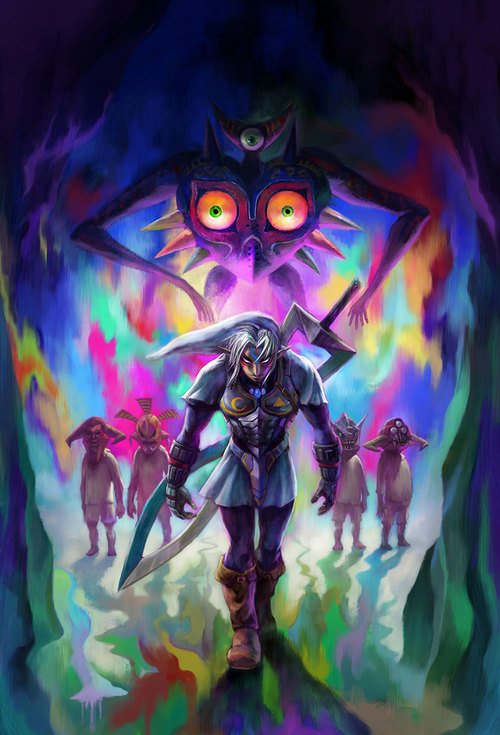
If Link is meant to having become an adult what better than to fight the most immature, childish opponent possible. The layers on top the mask of Majora keep being peeled off in one last ridiculous moment the game unapologetically throws at us right on the climax, the developers committed to the uncanniness of this game right to the very end.
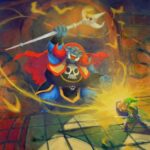
The second phase of Majora is the a decent into madness, where the mask is perhaps too confident on its power that it stops taking the battle seriously and starts dancing around and running around; there is no point in trying to explain what is going on inside the mind of this cursed mask, it just cares about destruction and play. Just as the child wearing the Mask of Majora says, Link and Majora are only playing. We are starting to see what this mask embodies, hence the name incarnation, whose meaning can be interpreted as embodied in flesh, referring to the conception and live birth of a sentient creature who is the material manifestation of an entity or force whose original nature is immaterial—basically this being just got arms and legs, opened its third eye, and is behaving in a more human fashion.
The mask is even making most of the dances we saw at Ikana, like the squat dance, strengthening its connection to the region and looking a little bit like the Ikana emblem—the only brand new dance is the moonwalk, which of course has to be performed inside the moon—The high pitched voice of this opponent and its ballerina moves could mean that we are fighting a being with feminine qualities or conception; as previously stated, this could be referring to the mask being based around the popular Hannya mask, which represents a choleric woman in Japanese drama (we begin to see small traces of Majora being a demon in this transformation). Or it could even have deeper Oriental meanings like the well known yin and yang concept from ancient Chinese philosophy (Japanese equivalent is in-yō), a characteristically dualistic concept like the ones found in many Zelda games. The yin/dark side is know as the feminine side and the yang/light side is conceptualized as the masculine side; so there they are, Majora and Link, the dark side vs the good side.
Alternatively, Majora’s Mask is just a weird game.
Musical Analysis
Structure: Section 0 / Section 1 / Section 2 / Section 3 / Section 4
Time Signature: 4/4
Tempo: 100 (180 Section 0) Melodic and Harmonic Profiles: Bb Diminished; C Diminished; F Diminished
The instrumentation is sparse and the music is a testament to Kondo’s ability to write songs that feel as if they were always meant to be on that particular scene; you can’t imagine anything else that would fit as well with the action happening on screen in both movement and context. The theme is, of course, a third reiteration of the Majora theme. Like on a real Chinese opera, the comedic gongs (small opera gongs) are frantically used here to reflect the new, unexpected atmosphere of the battle. With Majora not taking the battle as serious and dancing around, Majora’s Mask keeps presenting us with uncanny moments meant to distraught right till the very end, one last ridiculous surprise at hand from a game where pretty much anything goes.
After the now standard Majora intro, Koji Kondo goes crazy with the gongs, basically improvising as if it was the cuica of the Gorons. It is a truly maniac vibe as if Link is now losing his mind, the small opera gong sounding just like Navi used to when she called out attention by saying “Hey!”—that would have been even more disturbing— Koji plays around with just two notes of the small gong sample which makes it appear as two different instruments. Then on the later sections he now shifts to the large opera gong and chau gong, ending with a cacophony between all gongs at the same time in truly lunatic display.
The other main instrument is the marimba playing an entrancing figure, as if somebody is moving a pendulum in front of your face in order to hypnotize you or somebody experiencing fever dream. The marimba, which also accompanied Ganondorf, is a success in communicating the childish nature of Majora alongside its mystery thanks to the notes selected for the ostinato which profile an augmented chord plus a minor second. It sounds like clock ticking faster and more erratic. A clock that never goes away during this phase; if the previous theme matched the movements of the floating mask then it does not come as a surprise that this one matches the speed that the mask has now acquired thanks to its disturbing extremities. It sounds evil and clownish at the same time; a cursed circus music that would drive anyone into madness. And it keeps going around and around—the uncannily happy feel of the augmented chord comes from being composed of major third intervals— The notes chosen by Koji Kondo for this 16th note riff seem to be scientifically picked to match the character of Majora’s Incarnation.
The sparseness of the track is due to the melody returning to the monophonic sensibility of a true Chinese opera, making this perhaps the most Eastern opera inflected tune of the bunch; even the low strings that appear at the end do so in a fashion that is not meant to harmonize but to keep doubling the melody, courtesy of the returning suona as the centerpiece with all of its crazy note bends synonym with this dark mask. It is doubled again by the yueqin (nylon guitar) and the sheng (accordion). The full song is fundamentally composed of just three parameters: the percussion gongs, melody line and crazy ostinato. The agitated Section 4 confirms for us that his mask has no redemption at all; this thing is just jinxed and has to be decimated. The combination of the dramatic gongs and the marimba defines this character. An emblematic battle theme of a game like Majora’s Mask.
The curtain to this Eastern opera is about to be closed. Just like the Fierce Deity Mask, the demonic mask opened its third eye, revealing its true self. And soon, Link will be face to face against the emotion that this terrifying mask was always meant to represent. Some masks are born of a sentiment of gratitude, others from acceptance; some emotions need to be embraced, others left unchecked, others need to be conquered.
As a fun fact, during the battle the mask appears to be singing the Death Mountain theme from the original The Legend of Zelda for the NES; this Majora fella is aware that it is the final boss.
Help to keep the rites going around here by supporting the shrine:

Media Files, requests and support for more interactive content

Thou shall donate since this is a cult and you are now a sheep

Help staying awake analyzing game tracks and writing posts or else everything will end up being written by A.I
- Inside The Score – The Legend of Zeda: A Link to the Past – End Credits / Staff Roll
 The land rests As the last few minutes of this extensive journey that has now come to an end fly by, the nostalgia and reflective mood kicks in. Because such a massive enterprise as a Zelda game or a Lord of the Rings movie require multiple endings to convey everything… Read More »Inside The Score – The Legend of Zeda: A Link to the Past – End Credits / Staff Roll
 - Inside The Score – The Legend of Zelda: A Link to the Past – Ending / Epilogue ~ Beautiful HyruleFinal of the fantasy The Triforce has been touched. A wish has been granted. For the occasion, the newly undeceased king of Hyrule has commissioned a march in honor of the legendary hero to the Hylian Sousa, who might as well be composer Nobuo Uematsu since this piece is very… Read More »Inside The Score – The Legend of Zelda: A Link to the Past – Ending / Epilogue ~ Beautiful Hyrule
- Inside The Score – The Legend of Zelda: A Link to the Past – Triforce Chamber / Power of the GodsTake your boots off your feet And thus the Triforce spoke to men. And it became present in history. And you better treasure and contemplate this moment seldom witnessed in the course of the series. The elusive opportunity to interact and touch the most important artifact. You are now in… Read More »Inside The Score – The Legend of Zelda: A Link to the Past – Triforce Chamber / Power of the Gods
- Inside The Score – The Legend of Zelda: A Link to the Past – Ganon Battle / Prince of DarknessProgressive evil En Garde! And you better be prepared since you are about to duel the iconic enemy of the series at perhaps his canonically most powerful incarnation. Right after having touched the sacred Triforce which allowed him to conquer all of the Golden Land and whose evil and darkness… Read More »Inside The Score – The Legend of Zelda: A Link to the Past – Ganon Battle / Prince of Darkness
- Inside The Score – The Legend of Zelda: A Link to the Past – Boss Battle / Anger of the GuardiansQuick mayhem Ah, the simpler times when boss battles where not a multi epic orchestral suite but just an ostinato more basic that even what became the music for standard battle encounters out there. We are a long way from each boss having his own personalized track. And this early… Read More »Inside The Score – The Legend of Zelda: A Link to the Past – Boss Battle / Anger of the Guardians
- Inside The Score – The Legend of Zelda: A Link to the Past – Dark World Dungeon / Dungeon of ShadowsMemento mori We are getting closer to Ganondorf (or at least the wizard Agahnim who ultimately fulfills the same human side of evil role in this game) and that means getting closer to the profiles and motifs of his own theme song (which naturally was the theme of Agahnim at… Read More »Inside The Score – The Legend of Zelda: A Link to the Past – Dark World Dungeon / Dungeon of Shadows