Royal whims(y)
It seems that just like Mario is being followed by a camera crew inside the picturesque castle walls he also has at his disposal throughout the adventure Peach’s own royal string quartet brought to liven up the very first hub world, the idiosyncratic Mushroom Kingdom castle where the adventure takes place. This classically inspired piece written for a small ensemble is what you would fit in a palace chamber for the entertainment purposes of royalty or very rich aristocrats, hence the name of the genre, chamber music; and even though Peach and her castle—at least the exterior—take a page from the medieval castle playbook, her musical tastes, just like her interior design, are very modern, opting for the relatively more recent form of chamber music developed during the classical period of Western music as codified in the eighteenth century.
The string quartet, one of the purest forms of music since you must employ its basic elements to create a composition, each musician in charge of an entire texture of music like the bass line, the melody, and the accompaniment, is a tried and true format that still lives on stuff like the four piece rock combo (singer, two guitars, one bass) and the perfect masterclass in five line writing for a composer who cut his teeth during the NES era since he also had to deal with four to five voices on a regular basis making sure that each voice counts.
So this is pretty much a NES piece with the modern coat of N64 sounds. And by the power entrusted by MIDI, the composer is not limited and does not care about the real world ranges of the instruments he is supposedly mimicking so he takes the instruments to ranges they are not supposed to go just in service of a rich musical composition that interplays melody and harmony just like a good string quartet or NES tune is supposed to. Other than the instruments, the piece has elements that you could get from the classical, baroque, and romantic eras; and sophisticated harmony interplay you will not probably hear on the more traditional string quartets by classical composers. It comes more from the princess tradition explored by Disney where romantic, lush orchestral scores were now the rule and appoggiaturas and chromatic notes were used for that yearning emotional expression that princesses trapped in their castles waiting to be rescued by their princes must certainly feel.
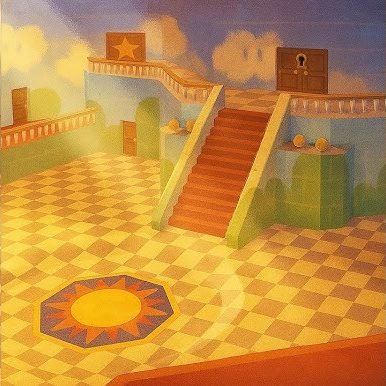
The castle first appeared on Super Mario RPG with its traditional red and gray/white colors that mix nicely with the classic mushrooms (items and toads) that populate the kingdom but its appearance for the series was codified in Super Mario 64, with its central tower, the courtyard and the princess stained glass. The interior of the castle though seems straight from a….Mario game, with the colorful and whimsical interior design honoring the 2-D side scrolling legacy of the series by mimicking what the levels of the original Super Mario Bros looked like. Even the perfect square doors and the positioning of 4 random coins at the main hall mimic the way surprise blocks and coins sit in midair in the Mario universe. The tile, chess-like floor was inspired by the castles from Super Mario Bros 3 which in turn was a design in vogue for actual palaces and castle. The iconic carpet foreshadows that it receives sunlight directly at certain times of the day.
However, not only was the castle codified in Super Mario 64 but also the main leitmotif of Princess Peach, who until this point only had the Ending theme from Super Mario Bros being related to her, a sort of wedding march possibly inspired by the Christmas carol ‘O Tannenbaum’. Here, that ending theme is expanded and its motifs serve as the basis for the B section—and the loop— of the brand new Princess Peach theme whose first iteration is the very first thing hear when we start a new file in the game, as her theme plays regally on a harpsichord when she is reading her letter to Mario.
Musical Analysis
The full iteration of the theme is heard when you step into the castle and memories of the Super Mario Bros side scrolling adventures are awakened., The only similarities with the Main Theme of the series would be the opening rhythm of the first two notes, the heavy use of syncopation and the fact that its first section is based around a stack chordal melody while its B section is allowed a more contrapuntal style. The A Section is more open, with more silences only filled with the playful pizzicatos and with the melody and accompaniment completely fused together like in the A Section from the main theme of the series. The princess presence is always felt in the castle even though she is missing; this first section will go on to become the main leitmotif of Peach, also heard at the end of the game when you rescue her.
In classical era style the piece is playful and jumpy, with little ornaments of non tonal notes sprinkled in as appoggiaturas. The main melodic motif is transposed to different starting points in descending fashion. The piece is in C Ionian/Major and, just like the ending theme from Super Mario Bros, it has special emphasis on the outside the scale F# leading into the G for ornamental purposes. As can be heard in the deconstruction there is interesting voice leading going on as any composer from the NES had to learn by force in order to make interesting, repetitive music. Each voice is pretty much its own little melody but together their form a tapestry of harmonic melody, with little dissonances here and there that make the piece not feel completely light chamber music but with some sinister underpinnings; a jazzier string quartet than what papa Haydn would have come up with, with more chromatic approach notes for all the voices. Just looking at the chords formed you would think the piece is going to sound way more dissonant than it does. The composer most likely was not even thinking in terms of chords but in terms of melodic lines and these were just the chords that happened to be formed on when the melodies intercept each other.
The performance is interpreted with little nuances like some violins playing some rhythms earlier in order to sound more natural and organic—the first violin seems to be the less experienced player on this ensemble— Technically the string quartet here would be the two violins, the viola and the cello but each voice sometimes plays notes that the parent instrument would not play; for example you can see that what would be the violins end their phrases descending too low for their registers and what would be the cello playing the pizzicatos goes from very low to too high; the silences during the melody are filled with those picaresque pizzicatos.
Some of the harmony formed by the chordal melody from A Section:
C – F(b5) – Edim – Ebdim – Em – C5/#11 – C
Just looking at some of the implied chords you would think it is some avant grade dissonant fest but in fact it is just playing with a descending chromatic pattern that could be the inverse of the Ending theme which was the original Peach Theme and also featured heavily use of these chromatic approach tones. The chordal melody is then transposed lower to different starting notes of the scale and thus forming different types of chords, the same phrase going then to start on Bdim and then Am all with the same syncopated rhythm. For the end of the phrases the bass line gains a consciousness of its own and does a proper albeit sinister accompaniment to the cadences while the other two voices play in more standard thirds. The Pizzicatos play an ascending arpeggio, revealing the true harmony that would accompany the piece.
C – G7 – Am –
Now we are talking about more standard harmony that then goes into weird places. It is as if the theme begins with Peach happy and ends up taken over by Bowser…wait that is actually what happened; the dissonances are introduced by focusing on those harmonies outside the profile like F#dim and D major both featuring that tritone note. The entire phrase then repeats and and now ends with the proper coda to the section.
C – G7 – Am –
D – Bm – C – Db – C
The B section is the one more inspired by the ending theme from Super Mario Bros, with the composer taking the melodic motif and running with it to create variations just like the fifth from Beethoven. Now all of the voices gain a proper identity by doing counterpoint melodies where each voice has its own rhythm creating complex layers of harmony. Naturally, the bass voice is the one moving slower and less agile in order for it to be the ground over which the other two voices dance. Just like with the A section it is based around a melody transposed to different starting points but in contrast with the A section it its literally more uplifting since the contour is ascending. The harmony implied is a very traditional and romantic major key one, with the exception of the ending of phrases that bring back the D major chord thanks to the use of the F# note.
C – F – Dm – G – Em – Am
D – Dm – Em7 – Dm – G
C – F – Dm – G – Em – Am
D – Dm – G – C – Db – C
In fact it is almost the same progression as the Title Theme from the original Donkey Kong NES game, fitting since it is the game where Mario debuted. The melodies of both themes are also based on the same transposition principle. You can even sing that melody over Peach’s Castle B Section. Both the A and B section end with the same playful C to Db movement bringing cohesiveness to the entire piece. The loop ends with the figure motif of the Ending theme from Super Mario Bros connecting back to the main piece. To complete the NES analogy a fifth channel and voice is added to this string quartet with a brass instrument establishing the royalty of the princess by way of associations with brass fanfares.
And just like Princess Peach gained three dimensionality with Super Mario 64, her original NES theme gained more dimensions here establishing her definitive leitmotif and making for a memorable stay at her strange, mystical and full of wonder castle accompanied by its equal theme. Her theme is melodic yet more complex and sophisticated, not just pretty; it follows the spirit Koji Kondo tries to emphasize in the Mario series when he says to other composers that tackle the series that no matter how child-like the world of Mario is they should never by any circumstance think of him as a cute character but a cool one, meaning that the music should be more than surface level catchy.
The theme has continued to be used for Peach and her castle, with the most modern yet faithful rendition being heard in Super Mario Odyssey which was the spiritual successor to Mario 64; here it was recorded with actual instruments showing that it can actually be played as long as the viola and cello support the violins with the lower notes and vice-versa. Other idiosyncratic iterations include Grant Kirkhope’s arrangement of the theme for the Mario and Rabbits game where he actually received an email from Koji Kondo asking for the theme to be more faithful and even received sheet music of the proper notes. It is one of the most important and lasting contributions in the Super Mario 64 score and now Peach, Bowser and even Toad have their own leitmotifs.

Help to keep the rites going around here by supporting the shrine:

Media Files, requests and support for more interactive content

Thou shall donate since this is a cult and you are now a sheep

Help staying awake analyzing game tracks and writing posts or else everything will end up being written by A.I
- Inside The Score – The Legend of Zeda: A Link to the Past – End Credits / Staff Roll
 The land rests As the last few minutes of this extensive journey that has now come to an end fly by, the nostalgia and reflective mood kicks in. Because such a massive enterprise as a Zelda game or a Lord of the Rings movie require multiple endings to convey everything… Read More »Inside The Score – The Legend of Zeda: A Link to the Past – End Credits / Staff Roll
 - Inside The Score – The Legend of Zelda: A Link to the Past – Ending / Epilogue ~ Beautiful HyruleFinal of the fantasy The Triforce has been touched. A wish has been granted. For the occasion, the newly undeceased king of Hyrule has commissioned a march in honor of the legendary hero to the Hylian Sousa, who might as well be composer Nobuo Uematsu since this piece is very… Read More »Inside The Score – The Legend of Zelda: A Link to the Past – Ending / Epilogue ~ Beautiful Hyrule
- Inside The Score – The Legend of Zelda: A Link to the Past – Triforce Chamber / Power of the GodsTake your boots off your feet And thus the Triforce spoke to men. And it became present in history. And you better treasure and contemplate this moment seldom witnessed in the course of the series. The elusive opportunity to interact and touch the most important artifact. You are now in… Read More »Inside The Score – The Legend of Zelda: A Link to the Past – Triforce Chamber / Power of the Gods
- Inside The Score – The Legend of Zelda: A Link to the Past – Ganon Battle / Prince of DarknessProgressive evil En Garde! And you better be prepared since you are about to duel the iconic enemy of the series at perhaps his canonically most powerful incarnation. Right after having touched the sacred Triforce which allowed him to conquer all of the Golden Land and whose evil and darkness… Read More »Inside The Score – The Legend of Zelda: A Link to the Past – Ganon Battle / Prince of Darkness
- Inside The Score – The Legend of Zelda: A Link to the Past – Boss Battle / Anger of the GuardiansQuick mayhem Ah, the simpler times when boss battles where not a multi epic orchestral suite but just an ostinato more basic that even what became the music for standard battle encounters out there. We are a long way from each boss having his own personalized track. And this early… Read More »Inside The Score – The Legend of Zelda: A Link to the Past – Boss Battle / Anger of the Guardians
- Inside The Score – The Legend of Zelda: A Link to the Past – Dark World Dungeon / Dungeon of ShadowsMemento mori We are getting closer to Ganondorf (or at least the wizard Agahnim who ultimately fulfills the same human side of evil role in this game) and that means getting closer to the profiles and motifs of his own theme song (which naturally was the theme of Agahnim at… Read More »Inside The Score – The Legend of Zelda: A Link to the Past – Dark World Dungeon / Dungeon of Shadows