Turtle’s Bach
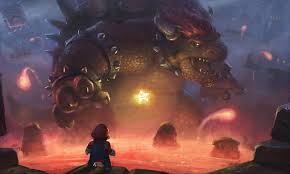
Time to begin celebrating Halloween and what better than to have a look back to the times when Bowser commanded respect, especially on the apocalyptic final showdown in the brand new 3D world of Super Mario 64. As composer Koji Kondo exclaims for the relationship between Mario and music, “he is not cute, he is cool”. So no matter how wacky the characters and environments get, the music will always had that sophisticated flair that takes itself seriously. This means that Bowser, the latest development in the eternal—or at least medieval— struggle between fire breathing dragons and princesses, receives the ultimate ominous villain treatment with a powerful baroque organ rendition of the leitmotif cooked for him in Mario 64. (Even though at this point Bowser wanting to marry Peach was not explicit, it can be inferred since in the mythologies where this trope started, the dragon/serpentine monster usually abducts the princess to make her his wife as another status symbol just like the gold they hoard—or in the case of Bowser, super stars).
The hopelessness and somberness of the final struggle of the unorthodox dungaree clad hero against the dragon for the coveted princess engulfs the stage and is given the final touch with the organ piece that canalizes Bach’s Toccata and Fugue in D minor due to its villain connotations and the church organ that represents godlike power both visually and sound wise.
Musical Analysis
Following on the footsteps of Super Mario World, the score for Super Mario 64 finds Kondo once again trying to pull off a cohesive sound by way of repurposing a main theme for different levels and the use of motifs for characters like Peach, Bowser and even Toad. The King Koopa one is composed of 4 notes that include the two most dissonant intervals; it does not get any more evil than this. The notes are: A D A G#. There is a perfect fourth, a minor second and of curse the tritone there, The diabolus in musica interval. It is first heard when Mario enters the castle in search of cake, only to be mocked and informed that the damsel is once again in distress. The music is constantly foreshadowed throughout the castle whenever Mario tries to access a locked location. Then it serves as the melodic basis for the Koopa Road track, which also features heavily the minor second and the tritone in a similar rhythmic profile before blossoming fully on the encounter against Kinga Bowser, the camera slowly panning and shaking against the steps of the huge nemesis. The Bowser song is a heavy metal track with big 80s compressed drums that transforms the motif into a series of head banging guitar riffs with codas straight from the likes of Deep Purple’s Smoke in the Water or In-A-Gadda-Da-Vida by Iron Butterfly, for sure a music style and bands that influenced Koji in his early days. These are combined with the soundtrack’s fire related Indian instruments playing diminished profiles.
That track is used for the first two encounters with Bowser. For the final one everything changes. Bowser takes on an unnatural dark color and the stage comes from a scene straight of the end of the world. The music is not a cool hard rock song but a despair inducing organ arrangement of the tune. The organ is arranged as a baroque piece with accurate four distinct organ parts meant to be the four limbs of the human body that are used to play the organ. There is a reason this is the ultimate instrument; it was actually the most complex human-made device for many centuries.
Unlike the standard Bowser cue, this piece has a long buildup made possible with tempo manipulation, creating the foreboding atmosphere right off the bat with the requiem rendition of the Bowser motif that sustains the tritone interval between the bass and the upper note as long as possible. This overture is accompanied by the echoing motif of the ethereal voice choir that was previously used as the lead instrument in Koopa’s Road. Then in pure classical fashion similar to Beethoven’s Fifth the piece takes this motif and plays with it in frantic fashion, moving its notes downwards while the organ pedals—which is where the musical term pedal note actually comes from— do their pseudo counterpoint (closer to a modern bass line in fact). There is more reliance on the sad Aeolian/Minor profiles as opposed to just the diminished ones, adding a despairing edge to the purely evil diminished profiles. Harmonically, there is an emphasis on tritone intervals and sustained diminished chords.
After sustaining the diminished chord with a ritardando, the upper voices go into a frenzy rendition of the melody originally played by the tanpura on the standard Bowser’s Theme, making out of it a mini pseudo fugue which is another of Bach’s techniques that consists in a systematic imitation of a melody beginning at different points in time (here the four voice part is cheated a little since the composer uses the pedal organ to play this melodic fugue in order to sustain the last note; yet, the part could still be played by a real organist assuming this sustain is achieved with the reverberation of the church they find themselves in). After this, it climbs back up with block chords towards another set of main guitar riff variations. This time we get real counterpoint on the lower voice since it plays the same diminished tanpura melody from the normal Bowser’s Theme. Another low voice is added for the repeat, making it a three voice counterpoint.
At the very end of the loop we arrive at the gothic induced coda of the piece where the chordal melody goes between Dm – Edim – Gdim – Dm – Dm – Edim – C#dim – Edim in a fast manner. This is now a pure Dracula climax. The piece then loops to the motif variations part but since we are now in the midst of the battle there is not a ritardando anymore.
The Bowser leitmotif or similar variations have been used inconsistently to represent the dragon turtle after its debut in Mario 64. The Kinga turtle is sometimes represented with heavy metal, other times with epic scores or dixieland jazz. Most memorable return of the theme might be as a riff in the actual song ‘Break Free’ from Super Mario Odyssey.
As a fun fact pretty much all voices from Super Mario 64 come from Mario’s voice actor Charles Martinet, including Bowser’s laugh and Boo’s Laugh—actually the same recording—which were pulled off a sample library and coincidentally were recorded by the same actor picked for Mario.
The ethereal voice sample used here is known as Lost Boy (Stereo) and comes from the Digidesign SampleCell Factory Library.

Help to keep the rites going around here by supporting the shrine:

Media Files, requests and support for more interactive content

Thou shall donate since this is a cult and you are now a sheep

Help staying awake analyzing game tracks and writing posts or else everything will end up being written by A.I
- Inside The Score – The Legend of Zeda: A Link to the Past – End Credits / Staff Roll
 The land rests As the last few minutes of this extensive journey that has now come to an end fly by, the nostalgia and reflective mood kicks in. Because such a massive enterprise as a Zelda game or a Lord of the Rings movie require multiple endings to convey everything… Read More »Inside The Score – The Legend of Zeda: A Link to the Past – End Credits / Staff Roll
 - Inside The Score – The Legend of Zelda: A Link to the Past – Ending / Epilogue ~ Beautiful HyruleFinal of the fantasy The Triforce has been touched. A wish has been granted. For the occasion, the newly undeceased king of Hyrule has commissioned a march in honor of the legendary hero to the Hylian Sousa, who might as well be composer Nobuo Uematsu since this piece is very… Read More »Inside The Score – The Legend of Zelda: A Link to the Past – Ending / Epilogue ~ Beautiful Hyrule
- Inside The Score – The Legend of Zelda: A Link to the Past – Triforce Chamber / Power of the GodsTake your boots off your feet And thus the Triforce spoke to men. And it became present in history. And you better treasure and contemplate this moment seldom witnessed in the course of the series. The elusive opportunity to interact and touch the most important artifact. You are now in… Read More »Inside The Score – The Legend of Zelda: A Link to the Past – Triforce Chamber / Power of the Gods
- Inside The Score – The Legend of Zelda: A Link to the Past – Ganon Battle / Prince of DarknessProgressive evil En Garde! And you better be prepared since you are about to duel the iconic enemy of the series at perhaps his canonically most powerful incarnation. Right after having touched the sacred Triforce which allowed him to conquer all of the Golden Land and whose evil and darkness… Read More »Inside The Score – The Legend of Zelda: A Link to the Past – Ganon Battle / Prince of Darkness
- Inside The Score – The Legend of Zelda: A Link to the Past – Boss Battle / Anger of the GuardiansQuick mayhem Ah, the simpler times when boss battles where not a multi epic orchestral suite but just an ostinato more basic that even what became the music for standard battle encounters out there. We are a long way from each boss having his own personalized track. And this early… Read More »Inside The Score – The Legend of Zelda: A Link to the Past – Boss Battle / Anger of the Guardians
- Inside The Score – The Legend of Zelda: A Link to the Past – Dark World Dungeon / Dungeon of ShadowsMemento mori We are getting closer to Ganondorf (or at least the wizard Agahnim who ultimately fulfills the same human side of evil role in this game) and that means getting closer to the profiles and motifs of his own theme song (which naturally was the theme of Agahnim at… Read More »Inside The Score – The Legend of Zelda: A Link to the Past – Dark World Dungeon / Dungeon of Shadows