Merry Melodies
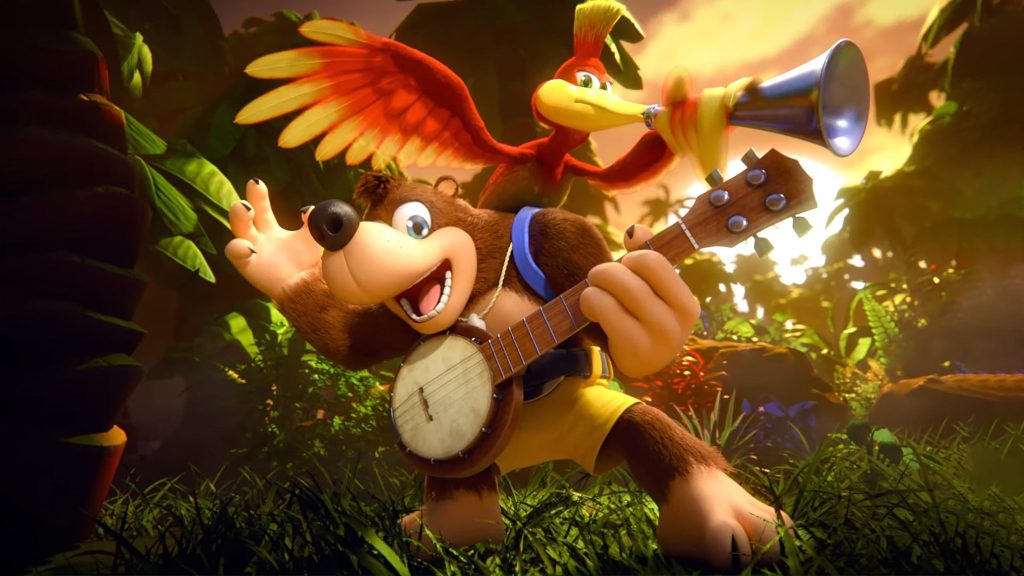
All Banjo series musical ingredients already begin popping out in the main theme for the series which otherwise would be just a friendly bluegrass tune played by the cute main cast with their namesake instruments.
We will delve into the full soundtrack (mostly the original versions sans the arrangements). Here we cover the opening of the curtain and the Cartoon theme song played by the characters themselves.
Musical Analysis
Structure: Section 0 / Section 1 / Section 2 / Section 3 / Section 4 / Section 5 / Section 6 / Section 7
Time Signature: 4/4
Tempo: 180 (Section 0) 150
Melodic and Harmonic Profiles: C Ionian/Major; F Lydian; G Ionian/Major; C Aeolian/Minor
The opening notes accompanying the logos are played by what will become the most iconic instrument in the Banjo series; the raspy low tone of the baritone saxophone played at the lower register is synonymous with Banjo-kazooie—curiously not the banjo or the kazoo. It just seems like a game called Baritone Sax-Bassoon does not have the same catchy ring—and fittingly enough the marching low tone of the instrument is the first thing we hear. It is basically Mickey Mousing the action we see on screen, following the steps and stops of the Nintendo 64 logo. But even then, the odd note is already present this early; in this case in the figure of the dissonant chord right in the middle. The baritone sax plays the typical figure of a chord where the bass alternates between the root C and the lower fifth G. Suddenly the tritone makes its first appearance giving the full Banjo-Kazooie treatment to the intro and establishing the tone of the entire game in a short amount of time; it does not only play the tritone but the full major chord born out of the F#. It is just a small tease, like an accompaniment gone wrong, since it goes back to the standard fare of alternating between the first and the fifth.
After that we get into the presentation where the characters do a musical concert with their respective instruments. Originally, each character was going to be named after an instrument and then they would play it here (so Tooty would be piccolo or something like fluuty). Only the main characters ended up being named after their instrument but the idea of a musical opening still remained. So music was an important part of the game since the beginning, hence why musical notes are collectibles that a Banjo and a Kazoo would need to advance. Rare specially wanted to accomplish the typical video game feat of making music that could be loped indefinitely and not get tiring; they also wanted the music to change dynamically depending on location just like the game Monkey Island.
As was said, one of the first songs made specifically for the game when Banjo was introduced was the theme for Click Clock Wood. And perhaps it was originally destined to be the main theme since this composition serves as the basis of the main title here, with the main motif and intro notes being the same; except that for Click Clock Wood Grant had not stepped into the idea of the tritone yet—for that reason he feels Click Clock Wood is not representative of the Banjo-Kazooie sound— So now inspired by Danny Elfman and the fact that the tritone signifies the polar personalities of the main characters Banjo and Kazooie (since the tritone is the less compatible note with the root of the scale, something to do with harmonics and the cultural baggage of this interval), the theme gains its edge by alternating between a melody that happily goes from C to G and then disturbs the G by a semitone to a Gb.
“I thought that Banjo-Kazooie were very odd characters, being opposites (like Banjo’s a bit dumb and Kazooie’s a bit snazzy and sarcastic) so I tried to get the music to match that. I hit on the idea of this tritone thing. It’s the furthest point in a musical scale, so I wondered if I could work it in somehow.”
The intro to the actual bluegrass piece is something you would hear also opening a circus performance or vaudeville number, with the low brass sustaining a G and the trumpets on top playing a F major chord in anticipation of the chromatic run from the flute. The woodblock is used as a mickey mousing device to follow Banjo touching the TV screen of the player.
So the melody starts with the Click Clock Wood motif and then immediately corrupts it by tritonizicing it. We then get the response on the kazoo (which does not look like a kazoo) courtesy of Kazooie making justice to her character by playing the well known melody known to annoying kids around the world: the Nyah nyah nyah nyah nyah nyah song.
https://en.wikipedia.org/wiki/Nyah_nyah_nyah_nyah_nyah_nyah
In media and playgrounds across the world whenever a child is mocking another they will sing this melody that kazooie as a trickster personality feels compelled to play; curiously, this melody is present all across the world and nobody is quite sure of what are its origins or why it is so universal. It is just known that when one character has experienced a humiliating incident, or is just minding his own business, another character will immediately mock him to the tune of “Ring Around The Rosie”. A recurring taunt in both fiction and real life; a character might put both hands to the side of their face, with their thumbs at their cheeks, then wiggle their fingers and go “Nana Na Nana Na” to the same tune. This trope is done mostly by immature characters. The melody has puzzled musicologists and composer Leonard Russell even had an entire dissertation on the origins of this melody. He claims that the reason this chant is so derogatory, from a musicological perspective, is because the tonic note is withheld. When reciting the notes the ‘C’ is missing (the last note is an ‘E’, and the second to last is a ‘G’ which is the dominant of ‘C’ and makes the ear expect the ‘C’ to arrive soon). The taunt therefore derives by withholding the natural tone that the ear ‘would like’ to hear at the end of this sequence of notes, and just giving a troll ‘E’ before starting the chant again. So there is that. Seems like it is a natural thing that children pick in the overtone series. Whatever the case, Kazooie—and the kazoo—are constantly annoying and mocking other characters so of course Grant wanted this association to be obvious.
Danny Elfman used exactly the same figure in the cues for Pee Wee’s Big Adventure
And other annoying characters also make use of the figure or close to it like Dee Dee’s leitmotif from Dexter’s Laboratory.
The rest of the music consists of following the action on screen—or since the music was made first it was the other way around— and playing around with the different instruments responding to each other. We get the classic accompaniment that will be prevalent across the Banjo-Kazooie series, a low instrument, usually the tuba alternating between the root and the fifth of the chord and another instrument playing full chords on the upbeats. The main chord sequence we get is also a favorite of Grant Kirkhope, the I – bVI.
There is also some use in the melody of the Bb note which also adds a bluesy feeling (just like in the Donkey Kong Country Map Theme) all contributing to the piece not sounding like just a forgettable children song; instead, the chromaticism, modal notes and wacky chords give the Banjo-Kazooie feel. The piece jumps a lot between keys but maintaining the same relation between chords, giving it the schizophrenic vibe. The flute and the marimba play some notes that give a Lydian feel to the composition. The fiddle gets more fidelity thanks to pitch bending the notes and it goes totally crazy at the end, jumping to practically any chord before ending with a new take on the shave and a haircut type of call and response melody, an outro which will form the basis for the music of the Glitter Gulch Mine level in Banjo Tooie. This coda figure is also straight from vaudeville, which is at the end of the day where cartoons come from.
The important thing is always that I – bVI movement first in C then in F and last in G. So there are the pairs:
C – Ab
F – Db
G – Eb
At the end it goes ultra fast between keys trying to do a Mario cadence (bVI – bVII – I) in C but immediately back tracking and going abruptly to a G chord before finally ending the piece on the home key of C. A truly manic ending; a chord progression that should not work yet does thanks to the strong melody connecting seamlessly
Ab – Bb – Db – G
C – Ab – C – Ab – C
Grant was not kidding when he said he looks for the odd note. This is the definition of zaniness at its best and the game would not be the same without it
“I realized you can use really dark chords with dark harmonies, and as long as the rhythm’s quite comical it’s not going to scare the kids”
It is all about making it sound not quite pretty.
Help to keep the rites going around here by supporting the shrine:

Media Files, requests and support for more interactive content

Thou shall donate since this is a cult and you are now a sheep

Help staying awake analyzing game tracks and writing posts or else everything will end up being written by A.I
- Inside The Score – The Legend of Zeda: A Link to the Past – End Credits / Staff Roll
 The land rests As the last few minutes of this extensive journey that has now come to an end fly by, the nostalgia and reflective mood kicks in. Because such a massive enterprise as a Zelda game or a Lord of the Rings movie require multiple endings to convey everything… Read More »Inside The Score – The Legend of Zeda: A Link to the Past – End Credits / Staff Roll
 - Inside The Score – The Legend of Zelda: A Link to the Past – Ending / Epilogue ~ Beautiful HyruleFinal of the fantasy The Triforce has been touched. A wish has been granted. For the occasion, the newly undeceased king of Hyrule has commissioned a march in honor of the legendary hero to the Hylian Sousa, who might as well be composer Nobuo Uematsu since this piece is very… Read More »Inside The Score – The Legend of Zelda: A Link to the Past – Ending / Epilogue ~ Beautiful Hyrule
- Inside The Score – The Legend of Zelda: A Link to the Past – Triforce Chamber / Power of the GodsTake your boots off your feet And thus the Triforce spoke to men. And it became present in history. And you better treasure and contemplate this moment seldom witnessed in the course of the series. The elusive opportunity to interact and touch the most important artifact. You are now in… Read More »Inside The Score – The Legend of Zelda: A Link to the Past – Triforce Chamber / Power of the Gods
- Inside The Score – The Legend of Zelda: A Link to the Past – Ganon Battle / Prince of DarknessProgressive evil En Garde! And you better be prepared since you are about to duel the iconic enemy of the series at perhaps his canonically most powerful incarnation. Right after having touched the sacred Triforce which allowed him to conquer all of the Golden Land and whose evil and darkness… Read More »Inside The Score – The Legend of Zelda: A Link to the Past – Ganon Battle / Prince of Darkness
- Inside The Score – The Legend of Zelda: A Link to the Past – Boss Battle / Anger of the GuardiansQuick mayhem Ah, the simpler times when boss battles where not a multi epic orchestral suite but just an ostinato more basic that even what became the music for standard battle encounters out there. We are a long way from each boss having his own personalized track. And this early… Read More »Inside The Score – The Legend of Zelda: A Link to the Past – Boss Battle / Anger of the Guardians
- Inside The Score – The Legend of Zelda: A Link to the Past – Dark World Dungeon / Dungeon of ShadowsMemento mori We are getting closer to Ganondorf (or at least the wizard Agahnim who ultimately fulfills the same human side of evil role in this game) and that means getting closer to the profiles and motifs of his own theme song (which naturally was the theme of Agahnim at… Read More »Inside The Score – The Legend of Zelda: A Link to the Past – Dark World Dungeon / Dungeon of Shadows