Once upon a time
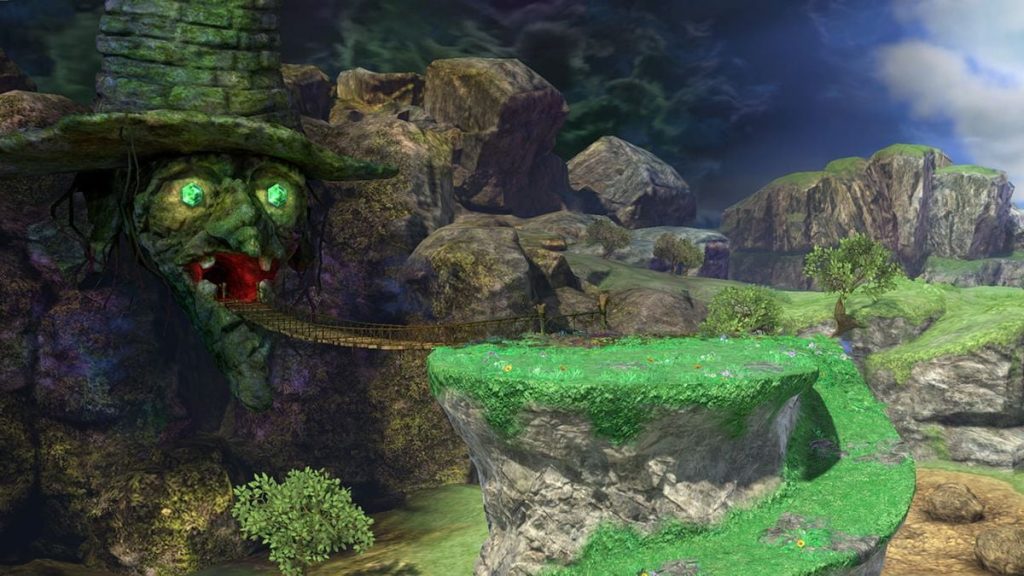
And so the fable begins in a most sinister and mysterious fashion, way more than what the subject matter calls for. A story based on the fairest of them all trope which dates back to at least Greek myths but popularized by the Snow White tale. With the music having this menacing, mysterious quality right off the bat, the game gains an extra layer that would perhaps have been lost without its development history. Could the fact that the game started as an epic fantasy, pirate themed RPG have dictated the direction of the music and mindset of the composer? Most likely as we will see, with entire themes incorporated directly from that first adventure.
Even so, Grant Kirkhope’s cinematic chops and influence alongside his knack for whimsical notes and chords is what transforms this fable into a true magical fairy tale, close in spirit to the prologue to the Disney film Beauty and the Beast which also showcases its castle alongside some majestic and imposing score. And this is basically a film score piece in all but name (and real orchestra), the music following the narrative beats of the picture, introducing us to leitmotifs of characters and setting the stage in the literal sense. Grant himself would have the opportunity to become a film composer many years later, moving to Los Angles to pursue the career and participating in scores for feature films like The King’s Daughter (curiously starring Pierce Brosnan making sort of a connection with the game GoldenEye 007).
Musical Analysis
Structure: Section 0 / Section 1 / Section 2 / Section 3 / Section 4 / Section 5 / Section 6 / Section 7 / Section 8 / Section 9 / Section 10
Melodic and Harmonic Profiles: C Lydian; C Whole Tone; C Harmonic Minor; C Ionian/Major; B Diminished
The score opening the scene is standard magical fairy tale fare straight from a Tim Burton film, the celesta accompanying the sounds of the night and the notes designed to enhance that certain mysterious quality. In fact, the very first scene with the camera panning to a door that slowly opens also mimics the opening from the film Edward Scissorhands. Either way it could be a later addition inspired by the music or the music was inspired by this opening.
This kind of harmony and instrumentation—like the celesta and glockenspiel—to score the mysterious and magical in film goes back to Russian composers and is in full form in the heavily influential piece The Planets by English composer Gustav Holst.
Here Grant makes use of Lydian profiles with the help of the mystical chord—Just add a minor sixth to any major chord—adding dizzying whole tone runs along the way that are characteristic of the magical. It is going C (b6) – D (b6) with menacing low bass notes, practically rumbling beneath and turning up a notch the darkness of the piece. It ends with an ominous fanfare that introduces the main villain of the game, the witch Gruntilda. It uses the brass ensemble and changes the major chords to minor ones, adding the major chord built from the tritone: Cm – Abm – F# – Cm
The bosses at Rare wanted a game with film music philosophy behind it; with characters having their own leitmotifs and the music dynamically changing to adapt to the different environments—this is something that was easier to do with the sequence based audio of the Nintendo 64 compared to the pre-recorded track based system of other consoles. Originally, even the main characters were to be named after musical instruments and represented with them, just like in the Peter and the Wolf musical symphony. But even though only the protagonists ended up following this shtick, we get a semblance of this concept, with characters related to certain instruments and melodies. Here we are introduced to Grunty’s leitmotif, an harmonic minor melody originally inspired by the children song Teddy Bears’ Picnic. Her characteristic instrument throughout the franchise is going to be the bassoon, an instrument that gained its whimsical witchcraft pedigree mostly thanks to the Paul Dukas’ composition named The Sorceress’s Apprentice; it was popularized in the famous scene from the Disney movie Fantasia, where brooms dance around.
The music hits closely the beats of the dialogue and picture, with a short failure, game over type of fanfare for Gruntilda just before transitioning into the second leitmotif.
Tooty’s theme is heard the first of three times here. It is a characteristically romantic melody played with the light flute, a standard for femininity and purity in media; remember that Tooty was initially going to be named after this instrument. Here it is just ethereally stated briefly without its full accompaniment. It is just a pedal Fmaj7 chord with the Celesta providing no musical meaning but instead transitioning into a sound effect device to signify the magic operating in the picture—a typical magic dust sound effect. In Banjo-Kazooie, unlike other N64 games, many sound effects were made sequencing notes as opposed to pre-recorded audio. Going back to Tooty, her theme is the first we will encounter that was not originally meant for her. Its romantic nature belonged originally to Madeleine, the heroine from the RPG game Project Dream. Grant realized it fit her too and so another fantasy tune is introduced into the wacky fable.
Following the action, the music then goes for a danger ostinato based around the Gruntilda motif, where strings double each other across octaves. It follows closely the harmonic profile of Grunty’s theme. It ends with ascending diminished chords to signify the moment Gruntilda snaps and decides to attack.
Act 1 ends.
We now hear the complete Tooty’s Theme with its full orchestration, all continuing to follow the action on screen. The harmony remains majestic befitting its fantasy origins. It is a major piece harmony consisting of C – F – C – C – Am – F – G – C. Nevertheless we get the Kirkhopeism right at the turn around of the loop with his C – F# chord movement, where the melody follows closely the notes of each chord.
After that, we hear the Banjo series theme played in a laidback feel with the namesake instrument following the laidback scene (it is practically the same as the pause theme, reflecting the current state of Banjo the bear).
A moment later, tragedy strikes and the music dramatically changes to a fast paced, percussion heavy theme. This tune is based in none other than the most important piece for the musical identity of the series; because it contains the kernel that spurred Grant Kirkhope to pursue a different direction for the music. The story goes that Grant had composed a handful of tunes for various levels in the game with standard harmonies and melodies that would fit any mascot platform video game (trying to avoid the pop jazz of the Mario series in order to differentiate it). Forest, Beach, snow…However, when he got to do the music for the haunted mansion level, the gothic fantasy scores of Danny Elfman made him have a lightbulb moment, the realization that this style was a perfect fit for the Banjo series as a whole. And so he decided that these tritone based harmonies would be all along the place in the game, not just in the spooky level; this works well especially due to the villain being a straight Halloween trope. The characteristic sound of Banjo-Kazooie got its final ingredient and the game’s music got another edge that differentiated it even more from others in the same genre.
We hear just a snippet of the harmony with a melody that will not return until the final battle. The distinctive harmony Cm – Abm – Cm – F# was inspired directly by the Batman score during the scene where the characters enter the cathedral; this harmony served as the basis for the Mad Monster Mansion level. You can listen to it here:
However, although the harmony was an eureka moment, the main melodic motif already existed way back in Project Dream. After hearing the final variation of Tooty’s Theme, this time in a minor key, we hear the Mad Monster Mansion melody which comes appropriately from the track titled Chase in Project Dream; so it fits with the chase here. Certainly Grant had lots of material written that could fit the new scenes from Banjo. Who knows how the music of this adventure would have turned out just based on the visuals without the fantasy RPG background, Pirate background and Danny Elfman spooky influence.
The piece ends in a whirlwind of ascending diminished chords to create the sensation of utter chaos and then comes to a stop with the full orchestra emphasizing Grunty’s triumph by playing a reprise of her theme.
Act 2 Ends.
The piece was remade by Grant Kirkhope with better samples for a special soundtrack release of Banjo-Kazooie:
Help to keep the rites going around here by supporting the shrine:

Media Files, requests and support for more interactive content

Thou shall donate since this is a cult and you are now a sheep

Help staying awake analyzing game tracks and writing posts or else everything will end up being written by A.I
- Inside The Score – The Legend of Zeda: A Link to the Past – End Credits / Staff Roll
 The land rests As the last few minutes of this extensive journey that has now come to an end fly by, the nostalgia and reflective mood kicks in. Because such a massive enterprise as a Zelda game or a Lord of the Rings movie require multiple endings to convey everything… Read More »Inside The Score – The Legend of Zeda: A Link to the Past – End Credits / Staff Roll
 - Inside The Score – The Legend of Zelda: A Link to the Past – Ending / Epilogue ~ Beautiful HyruleFinal of the fantasy The Triforce has been touched. A wish has been granted. For the occasion, the newly undeceased king of Hyrule has commissioned a march in honor of the legendary hero to the Hylian Sousa, who might as well be composer Nobuo Uematsu since this piece is very… Read More »Inside The Score – The Legend of Zelda: A Link to the Past – Ending / Epilogue ~ Beautiful Hyrule
- Inside The Score – The Legend of Zelda: A Link to the Past – Triforce Chamber / Power of the GodsTake your boots off your feet And thus the Triforce spoke to men. And it became present in history. And you better treasure and contemplate this moment seldom witnessed in the course of the series. The elusive opportunity to interact and touch the most important artifact. You are now in… Read More »Inside The Score – The Legend of Zelda: A Link to the Past – Triforce Chamber / Power of the Gods
- Inside The Score – The Legend of Zelda: A Link to the Past – Ganon Battle / Prince of DarknessProgressive evil En Garde! And you better be prepared since you are about to duel the iconic enemy of the series at perhaps his canonically most powerful incarnation. Right after having touched the sacred Triforce which allowed him to conquer all of the Golden Land and whose evil and darkness… Read More »Inside The Score – The Legend of Zelda: A Link to the Past – Ganon Battle / Prince of Darkness
- Inside The Score – The Legend of Zelda: A Link to the Past – Boss Battle / Anger of the GuardiansQuick mayhem Ah, the simpler times when boss battles where not a multi epic orchestral suite but just an ostinato more basic that even what became the music for standard battle encounters out there. We are a long way from each boss having his own personalized track. And this early… Read More »Inside The Score – The Legend of Zelda: A Link to the Past – Boss Battle / Anger of the Guardians
- Inside The Score – The Legend of Zelda: A Link to the Past – Dark World Dungeon / Dungeon of ShadowsMemento mori We are getting closer to Ganondorf (or at least the wizard Agahnim who ultimately fulfills the same human side of evil role in this game) and that means getting closer to the profiles and motifs of his own theme song (which naturally was the theme of Agahnim at… Read More »Inside The Score – The Legend of Zelda: A Link to the Past – Dark World Dungeon / Dungeon of Shadows