Life affirming tunes
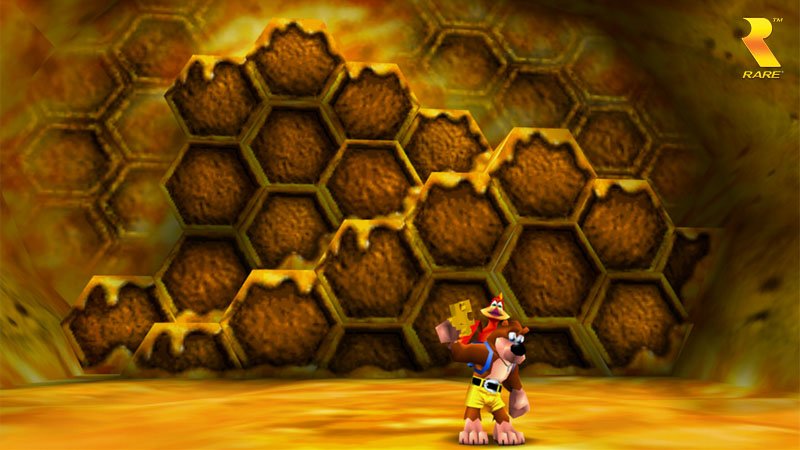
Of course ever since the days of arcades, gamers have had the need to notice when their characters get harm and then when something good, like replenishing health, happens. In many video games they can usually count on finding a box of medical supplies or similar, with which they can instantly restore their health. This moment is almost always reinforced through a combination of both visual and aural cues. And while sci-fi or fantasy games sometimes need elaborate explanations for why something works in improving health, in platform games it can be just anything desirable independent of whether it would have real life medicinal properties. From Mario’s cha-ching coin sound effect to this Appalachian bear’s love for honey; it is a unique video game consideration.
As long as you have at least one hit point left, your character will seem perfectly fine in their movements and performance, which is something that happens slightly in cartoons, much less in live action and almost nonexistent in real life. In the case of Banjo-Kazooie we are dealing with the hyperactive metabolism of honey in order to get health back; honey is of course the de facto diet of bears in media, just like fish is to cats or cheese is to mice (since Banjo was originally meant to be a rabbit, we all know what his health bar would have been Note: don’t feed that to rabbits). Unlike mice, however, brown bears being mad about honey is actually true.
People think of video game composers as making the glamorous melodies accompanied with orchestral scores. But in the early days, the work of the composer encompassed also the sound effects that signal events and states inside the game for the players. Grant Kirkhope had to do each of the sound effects of Banjo-Kazooie, from the characteristic chopped voices made with vocal samples from the Rare staff to the usual fanfares and audio cues for items, no matter how mundane.
Just like when comparing the music to that of Mario, the main sound effects for the items in Banjo are longer and more musical sounding, blurring even more the line between sound effect and music. The game always trying to one up the plumber; if the coin sound is just two notes, the honey sound will be five and so on. The sound effects presented here are those related to health and consist of featuring the banjo instrument with a simple cue that evolves in complexity depending on the value of the reward, trying to capture the level of excitedness that the player and the characters should feel. Naturally, this sensation cannot be other than overtly positive.
Musical Analysis
Structure: Section 1 / Section 2 / Section 3 / Section 4
Tempo: 170 (Section 1); 150 (Section 2); 130 (Section 3); 140 (Section 4)
Melodic and Harmonic Profiles: C Ionian/Major
Continuing the bluegrass motif, these sounds consist on congratulatory movements based around the standard Banjo-Kazooie key of C. They all end on the triumphant C major chord coming from the dominant G. It is what is known as a perfect or authentic cadence, a widely used cadence, common practically to the point of ubiquity, that describes a V – I chord progression that resolves a musical phrase or piece, its name deriving from the fact that for most people this movement truly feels like ‘the end’ of a composition; it is the fullest resolution possible, perfect for short snippets of music. Just like Grant does over here, a seventh is usually added to the dominant chord since that seventh would be located a half step above the third of the tonic chord, creating a stronger pull towards the I chord—two notes are now displaced by a semitone. The music overall trajectory is upward; it reinforces the common up/good-down/bad binary of kinesthetically oriented sound (The origin of this probably has to do with higher pitches physically involving more energy, and thus more lively, than lower pitches). In opposition to the up is good, down is bad dichotomy, the fast is good/slow is bad is not as present here since the ‘gain a new honeycomb cue is slower than the single extra honeycomb one. We do find the ‘more is good’ trope when it comes to orchestration though.
So the honeycomb pieces grow in structural complexity while the extra life—which here we are gonna pretend it is made from honey—grows in number of instruments. The standard honeycomb that replenishes health is just the banjo playing the aforementioned authentic cadence, then the extra honeycomb adds the I chord again for a I – V7 – I progression, with the first bar devoted entirely to an ascending movement throughout the C chord. It adds just one flute which plays a trill; the notes of this flute trill are the same opening notes from Click Clock Wood, which was the first track made when the concept for the Banjo-Kazooie game was decided (This trill is also the same as the ‘Get a Feather’ sound effect, just transposed). The main melody was probably based around the ‘Shave and a Haircut’ ending motif of the main theme of the series, a common ending that is strongly associated with the stringed instruments of bluegrass music, particularly the 5-string banjo.
For the gaining extra honeycomb fanfare we see, for the first time here, one of the usual tricks for reaching the tonic. Grant Kirkhope will employ this trick to frantically get to the tonic in some other tracks in the series no matter how far outside the key he goes. It consists on hoping around the circle of fifths, step by step until reaching the desired chord; it can be made as long or as short as the composer wants. The circle of fifths is just a way of organizing the 12 chromatic pitches as a sequence of perfect fifths. Thus it can go C G D A E B and so on; This order places the most closely related key signatures adjacent to one another. Naturally, if you move backwards you will be moving in perfect fourths. The normal version would be to play the triads born from the key. But this being Banjo-Kazooie, we are stuck with traveling to unexpected chords outside the tonality; the zany nature comes from all the chords being major, which pretty much produce a chain of overlapping authentic cadences. It gives an effect of jumping around in zigzag platforms like a caffeinated bunny, perfect for the genre to which Banjo-Kazooie belongs. The extra honeycomb cue is just the mid version off this technique which will get more ludicrous later on. The harmony is directed by the tuba playing each of the root notes, the harmony being E7 – A7 – D7 – G7 – C – G7 – C. It ends with the same music as the other versions. We get a second banjo playing in the characteristic Scruggs style from bluegrass.
As for the extra life cue, it returns to being a 1-bar tune played with more energy and celebration courtesy of the kazoo from the character and the cymbals. (As a fun fact, the bird is named Kazooie because Kazoo is a trademarked name).
As far as congratulatory music goes, they are standard fare. The extra quirkiness, the tritone and the sinister vibe will only become apparent when the bear and the bird enter the ominous villain’s lair.

Help to keep the rites going around here by supporting the shrine:

Media Files, requests and support for more interactive content

Thou shall donate since this is a cult and you are now a sheep

Help staying awake analyzing game tracks and writing posts or else everything will end up being written by A.I
- Inside The Score – The Legend of Zeda: A Link to the Past – End Credits / Staff Roll
 The land rests As the last few minutes of this extensive journey that has now come to an end fly by, the nostalgia and reflective mood kicks in. Because such a massive enterprise as a Zelda game or a Lord of the Rings movie require multiple endings to convey everything… Read More »Inside The Score – The Legend of Zeda: A Link to the Past – End Credits / Staff Roll
 - Inside The Score – The Legend of Zelda: A Link to the Past – Ending / Epilogue ~ Beautiful HyruleFinal of the fantasy The Triforce has been touched. A wish has been granted. For the occasion, the newly undeceased king of Hyrule has commissioned a march in honor of the legendary hero to the Hylian Sousa, who might as well be composer Nobuo Uematsu since this piece is very… Read More »Inside The Score – The Legend of Zelda: A Link to the Past – Ending / Epilogue ~ Beautiful Hyrule
- Inside The Score – The Legend of Zelda: A Link to the Past – Triforce Chamber / Power of the GodsTake your boots off your feet And thus the Triforce spoke to men. And it became present in history. And you better treasure and contemplate this moment seldom witnessed in the course of the series. The elusive opportunity to interact and touch the most important artifact. You are now in… Read More »Inside The Score – The Legend of Zelda: A Link to the Past – Triforce Chamber / Power of the Gods
- Inside The Score – The Legend of Zelda: A Link to the Past – Ganon Battle / Prince of DarknessProgressive evil En Garde! And you better be prepared since you are about to duel the iconic enemy of the series at perhaps his canonically most powerful incarnation. Right after having touched the sacred Triforce which allowed him to conquer all of the Golden Land and whose evil and darkness… Read More »Inside The Score – The Legend of Zelda: A Link to the Past – Ganon Battle / Prince of Darkness
- Inside The Score – The Legend of Zelda: A Link to the Past – Boss Battle / Anger of the GuardiansQuick mayhem Ah, the simpler times when boss battles where not a multi epic orchestral suite but just an ostinato more basic that even what became the music for standard battle encounters out there. We are a long way from each boss having his own personalized track. And this early… Read More »Inside The Score – The Legend of Zelda: A Link to the Past – Boss Battle / Anger of the Guardians
- Inside The Score – The Legend of Zelda: A Link to the Past – Dark World Dungeon / Dungeon of ShadowsMemento mori We are getting closer to Ganondorf (or at least the wizard Agahnim who ultimately fulfills the same human side of evil role in this game) and that means getting closer to the profiles and motifs of his own theme song (which naturally was the theme of Agahnim at… Read More »Inside The Score – The Legend of Zelda: A Link to the Past – Dark World Dungeon / Dungeon of Shadows