A musical transition into the proper mood
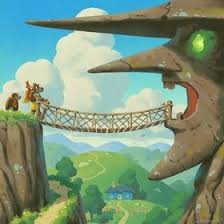
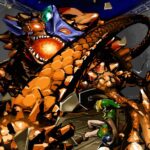
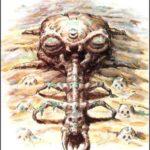
The bleakness wraps the characters both visually and musically. Leaving subtlety aside, the super villain’s lair, which is usually located at the end of the world, is here located just a couple of blocks from the protagonist bear’s house, looking like it should, pretty un-unassuming, with black clouds surrounding it and built as an elaborate tower with the form of the witch; it contrasts and pops out against the idyllic Spiral Mountain and its blue skies (the eponymous mountain’s grass even changes halfway to reflect this disparity). Thankfully, even a short-sighted mole following his instincts would conclude that here is where they took Tooty. So no need for an epic quest looking for the lair other than repairing the bridge.
After the ‘Elaborate Underground Base’, this is perhaps the most common form of a lair. A jaw-droppingly massive tower that, well, towers over everyone and everything around it. The princess—or in this case the sister—will inevitably be at the very top, reaching it will be the difficult part (This fairly common fairy tale device is possibly inspired by the Tower of London; originally a royal residence, the Tower later became a prison that was often used to house royal prisoners, the most famous story involving young princes—older civilizations trapped their ladies far above in either the sun or the moon).
Within the soundtrack we begin to realize the power of adaptive music, a technique that will define the score of Banjo-Kazooie. Melodies are rearranged and reorchestrated throughout the adventure in ways that will be recognizable to players but still giving enormous variety to the sonic palette. In video games, adaptive music (also called dynamic or interactive music) is background music whose volume, rhythm or tune changes in response to specific events in the game. Something that comes naturally in film or television is not viable in a game since the directors will never know when a player will enter certain sections or take certain actions. This means composers need to rely on the game engine to change the tracks depending on the action of the players. The sequence based musical interface of the Nintendo 64, in which music pieces are mostly not saved as pre-recorded audio but rather as musical notation that is interpreted on-the-fly by the sound hardware, is well suited for this sort of thing, though from the seventh generation of console video games onward, game developers found ways of doing this with live music recordings as well—usually through middleware. A standard feature of Banjo-kazooie will be that music changes slightly depending on where the player is in real time, no loading needed to happen. This is very noticeable as, for example, the music always changes to a harp arrangement of the standard tune when diving underwater. The developers at Rare were inspired by the iMUSE (Interactive Music Streaming Engine) system used in a number of LucasArts video games, like Monkey Island. It was notable in that it segued seamlessly between different pieces of music rather than having an abrupt cut. Grant Kirkhope usually uses the reorchestration technique between locations. This is one of the few moments when the music changes dynamically to a completely different piece.
Artificially generated fully formed music tracks seems to be the next frontier of this technology, with some games already employing algorithmic generated scores.
Musical Analysis
Structure: {ABA’}
Tempo: 110
Melodic and Harmonic Profiles: C Harmonic Minor
Back from the overture of the game, we have another one of multiple reprises we will find of Gruntilda’s theme. The characteristic tune from the witch is played here just as a short tease of the full theme to come, sounding more like an extended intro than a complete piece. The melodic material of the sections is almost the same, with section A sounding like an echo meant to caution the bear and the bird of what awaits them; In a longer piece this music composition would be more akin to an intro, using a similar device to the Title Theme from The Legend of Zelda (NES) where the main melodic phrase is teased twice without completing it before going all in. However, section B is also a smaller version of the full Grunty’s Theme phrase that we are about to hear inside the tower, the bassoon going immediately for a coda. This is also because it is expected that the player will take no more than 30 seconds to cross the bridge—many players probably will not even get to hear the full loop.
If the oom-pah is the trademarked rhythm of the Banjo series as a whole, then the staccato steady strings is the close second, specially for sadder or more serious compositions (also heard in the opening cinematic). Here the high strings are in charge of carrying the harmony while a lone contrabass just maintains a pedal on the C note, giving depth to the G chord (Gadd11 would be the combination). Following the harmonic minor scale, it uses the B natural to generate a dominant chord that is major. So it goes Cm – G; the harmonic minor profile will become associated with witchcraft.
The marimba was used throughout the soundtrack as a melodic instrument due to mallet instruments sounding more authentic at that time when compared to other instruments. It also has a pretty short sustain, quick attack and therefore uses less space on the memory. in short, it is an instrument which was easy to make sound good on the N64 hardware. That being said, its sound here is also appropriate since its characteristic trills, like those from its younger brother the xylophone, have been used to go along Halloween tropes like skeletons dancing—and of course a skeleton’s rib cage would be played as one. The bassoon will continue to be used for Grunty seeing as how it is both an instrument fit for old people (Peter and the Wolf) and for witchcraft (The sorceress’ Apprentice). The phrases begin with a fast chromatic ornamentation that slide to the note. Even in this short piece Grant still varies the reprise of section A by giving it a call and response feature between the marimba and a lower octave bassoon. The trills and melodies stay within the harmony; the marimba trills are made with the major third interval and minor sixth interval, which are interval inversions of each other.
As for the sound effects, they are moved throughout the stereo spectrum to make them more dynamic and immersive. The birds move randomly while the wind slowly goes from side to side.
This will be the theme that keeps on giving; it is going to be arranged and orchestrated in all forms possible to reflect the different environments and story beats the characters will encounter. Whatever is happening with Tooty is one of those instances.

Help to keep the rites going around here by supporting the shrine:

Media Files, requests and support for more interactive content

Thou shall donate since this is a cult and you are now a sheep

Help staying awake analyzing game tracks and writing posts or else everything will end up being written by A.I
- Inside The Score – The Legend of Zeda: A Link to the Past – End Credits / Staff Roll
 The land rests As the last few minutes of this extensive journey that has now come to an end fly by, the nostalgia and reflective mood kicks in. Because such a massive enterprise as a Zelda game or a Lord of the Rings movie require multiple endings to convey everything… Read More »Inside The Score – The Legend of Zeda: A Link to the Past – End Credits / Staff Roll
 - Inside The Score – The Legend of Zelda: A Link to the Past – Ending / Epilogue ~ Beautiful HyruleFinal of the fantasy The Triforce has been touched. A wish has been granted. For the occasion, the newly undeceased king of Hyrule has commissioned a march in honor of the legendary hero to the Hylian Sousa, who might as well be composer Nobuo Uematsu since this piece is very… Read More »Inside The Score – The Legend of Zelda: A Link to the Past – Ending / Epilogue ~ Beautiful Hyrule
- Inside The Score – The Legend of Zelda: A Link to the Past – Triforce Chamber / Power of the GodsTake your boots off your feet And thus the Triforce spoke to men. And it became present in history. And you better treasure and contemplate this moment seldom witnessed in the course of the series. The elusive opportunity to interact and touch the most important artifact. You are now in… Read More »Inside The Score – The Legend of Zelda: A Link to the Past – Triforce Chamber / Power of the Gods
- Inside The Score – The Legend of Zelda: A Link to the Past – Ganon Battle / Prince of DarknessProgressive evil En Garde! And you better be prepared since you are about to duel the iconic enemy of the series at perhaps his canonically most powerful incarnation. Right after having touched the sacred Triforce which allowed him to conquer all of the Golden Land and whose evil and darkness… Read More »Inside The Score – The Legend of Zelda: A Link to the Past – Ganon Battle / Prince of Darkness
- Inside The Score – The Legend of Zelda: A Link to the Past – Boss Battle / Anger of the GuardiansQuick mayhem Ah, the simpler times when boss battles where not a multi epic orchestral suite but just an ostinato more basic that even what became the music for standard battle encounters out there. We are a long way from each boss having his own personalized track. And this early… Read More »Inside The Score – The Legend of Zelda: A Link to the Past – Boss Battle / Anger of the Guardians
- Inside The Score – The Legend of Zelda: A Link to the Past – Dark World Dungeon / Dungeon of ShadowsMemento mori We are getting closer to Ganondorf (or at least the wizard Agahnim who ultimately fulfills the same human side of evil role in this game) and that means getting closer to the profiles and motifs of his own theme song (which naturally was the theme of Agahnim at… Read More »Inside The Score – The Legend of Zelda: A Link to the Past – Dark World Dungeon / Dungeon of Shadows