Campy October
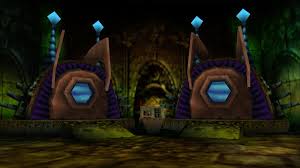
As the bear and the bird make their way to the entrance of the castle, the tried and true Halloween tropes keep pilling as we are treated to a new cutscene involving the fates of evil Gruntilda Winkybunion and beautiful damsel in distress Tooty. In order to develop the story further beyond the fairy tale domain, Rare brings into the table a frankenstein of horror, sci-fi and B movie influences, including Frankenstein itself. Anything is fair game. Going outside the fairy tale influence, we know see that this witch not only has the characteristic magic and sorcery tools under her belt but also the attributes of the mad scientist; instead of a potion, Grunty uses a beauty steal machine inspired by the 1957 short story “The Fly” where the famous machine capable of transferring properties between two subjects was first seen and popularized. We also see the “Igor” archetype from Frankenstein in the figure of a deformed assistant unconditionally loyal to his master (or misssssstressss). So in Banjo-Kazooie the worlds of fairy tale, horror and science fiction collide in a pastiche of influences.
Musical Analysis
Structure: {AB}
Tempo: 90
Melodic and Harmonic Profiles: C Harmonic minor; C Aeolian/Minor
Appropriately, Grant Kirkhope follows suit and brings the common instruments so ubiquitous on these genres that today have ascended to the status of being parodied and used in cartoons all over the place. The theremin is of course a staple; an electronic instrument spookily controlled without physical contact by the performer, the theremin was developed by the Russian mad scientist Leon Theremin in the old 20s. The sound of the instrument is often associated with eerie situations, popularized in film scores such as Miklós Rózsa’s Spellbound, The Lost Weekend and Bernard Herrmann’s The Day the Earth Stood Still. Its retro futuristic sound has served well for speculative science fiction and body horror, becoming a common shorthand for the presence of the paranormal such as aliens, ghosts or technology gone wrong. Following the tone of the Banjo series, the use of the theremin is also relegated for a kooky musical effect, as in amusingly sinister and somber. In those old films the theremin was utilized for its destabilizing effect (owing to the inherent dissonance of the instrument’s wavering tone), moaning and shrieking whenever the lead characters are shown suffering a psychological breakdown on screen (Sadly, the characteristic vibrato effect of the real thing and from the game is not as prevalent here). The soundtrack of Banjo-Kazooie will also make heavy use of the theremin in an unconventional manner; we will encounter this instrument (meaning this sample) in various tracks playing chords as opposed to the standard single lines.
The other main accompaniment instruments are the ominous pipe organ and the Tim Burton’s enchanted celesta. Not only organ music and villanery go hand in hand but its slow moving chords contribute to this Requiem for Tooty, its funeral and general downer associations gained through countless funeral services for the church. Seeing as how the music appears in tragic cutscenes involving the unfortunate fate of Tooty, it is composed in a similar style to that of a funeral march or dirge, usually a minor piece imitating the low, solemn pace of a funeral procession. It is an example that shows how varying rhythm alone can affect the mood of musical material. Rhythm is a large part of music’s ability to sculpt time and produce different moods. The right rhythm can sculpt a five-minute piece of time to convey a sense of urgency and hurriedness or to make the listener feel laid back and relaxed; like many other emotions, this phenomenon is likely related to the body itself and the heart rate. This means that although the cue is based around the already minor key of the Gruntida’s leitmotif, the use of rhythm alone in the tempo and the phrases is enough to create a stark difference between the Lair’s main theme and this particular variation, removing the theme’s skipping rhythm and replacing it with long notes, besides limiting the core notes to the downbeat, taking away the swing and any remaining joy of the tune.
Since this is another of the multiple variations of Grunty’s theme, it follows the same harmony based around the harmonic minor scale. But on this cutscene, it gives us the full content of the A section of the theme, as opposed to the small teases of previous iterations. Here we get to hear the ‘b’ subsection from ‘A’ (on this particular arrangement it becomes conceptualized as section B), where Grant Kirkhope introduces his particular brand of odd chords outside the standard key that takes us on a tour through the musical landscape. The chords move through inversions, the organ sometimes reinforcing the melody with octaves, giving the harmony:
A:
Cm – G7 – Cm – Cm – G7 – Cm – G7
Cm – G7 – Cm – Bdim7 – Bdim7 – Bdim7 – Bdim7
Cm – G7 – Cm – Cm – G7 – Cm – G7
Cm – G7 – Bdim7 – Bdim7 – Cm – G7 – Cm
B:
Fm – Cm – Db – G – Ab – Fm – C sus2 – G
The extended use of the Bdim7 also contributes to this version sounding way more somber than the standard version of the theme. Section B goes to the iv as it is common for contrasting sections but then takes a detour to a Db chord which, although could be considered as a borrowed chord from a parallel C phrygian profile, was picked by Grant not based on some modal music theory but in the simple fact that it is the ‘tritone chord’ to the G that comes next. He just wants that bV – I sound that defines Banjo-Kazooie; during the G chord the notes of the melody follow a G major tetrachord, giving the slight illusion of the music changing keys thanks to these notes (A natural) and the relationship between Db and G. The sus chord that only needs to move one note a half step to form the next chord is characteristic of church organ music since it makes for a smoother cadence.
The bat sounds are self explanatory of the Halloween motif and creepy lairs.
Tooty is in a dire situation and Banjo-Kazooie—and Rareware in general—is not one of those games that shy away from showing the actual consequences of failure. Whenever the player gets a game over or quits they get to see the outcome of this horrible experiment in a downer ending revealing that this machine is somehow so advanced as to being able to convert bear beauty standards into human beauty standards. Only the bear and the bird can avert the possibility of allowing Gruntida (and Mumbo) happiness at the expense of this fair innocent child.

Help to keep the rites going around here by supporting the shrine:

Media Files, requests and support for more interactive content

Thou shall donate since this is a cult and you are now a sheep

Help staying awake analyzing game tracks and writing posts or else everything will end up being written by A.I
- Inside The Score – The Legend of Zeda: A Link to the Past – End Credits / Staff Roll
 The land rests As the last few minutes of this extensive journey that has now come to an end fly by, the nostalgia and reflective mood kicks in. Because such a massive enterprise as a Zelda game or a Lord of the Rings movie require multiple endings to convey everything… Read More »Inside The Score – The Legend of Zeda: A Link to the Past – End Credits / Staff Roll
 - Inside The Score – The Legend of Zelda: A Link to the Past – Ending / Epilogue ~ Beautiful HyruleFinal of the fantasy The Triforce has been touched. A wish has been granted. For the occasion, the newly undeceased king of Hyrule has commissioned a march in honor of the legendary hero to the Hylian Sousa, who might as well be composer Nobuo Uematsu since this piece is very… Read More »Inside The Score – The Legend of Zelda: A Link to the Past – Ending / Epilogue ~ Beautiful Hyrule
- Inside The Score – The Legend of Zelda: A Link to the Past – Triforce Chamber / Power of the GodsTake your boots off your feet And thus the Triforce spoke to men. And it became present in history. And you better treasure and contemplate this moment seldom witnessed in the course of the series. The elusive opportunity to interact and touch the most important artifact. You are now in… Read More »Inside The Score – The Legend of Zelda: A Link to the Past – Triforce Chamber / Power of the Gods
- Inside The Score – The Legend of Zelda: A Link to the Past – Ganon Battle / Prince of DarknessProgressive evil En Garde! And you better be prepared since you are about to duel the iconic enemy of the series at perhaps his canonically most powerful incarnation. Right after having touched the sacred Triforce which allowed him to conquer all of the Golden Land and whose evil and darkness… Read More »Inside The Score – The Legend of Zelda: A Link to the Past – Ganon Battle / Prince of Darkness
- Inside The Score – The Legend of Zelda: A Link to the Past – Boss Battle / Anger of the GuardiansQuick mayhem Ah, the simpler times when boss battles where not a multi epic orchestral suite but just an ostinato more basic that even what became the music for standard battle encounters out there. We are a long way from each boss having his own personalized track. And this early… Read More »Inside The Score – The Legend of Zelda: A Link to the Past – Boss Battle / Anger of the Guardians
- Inside The Score – The Legend of Zelda: A Link to the Past – Dark World Dungeon / Dungeon of ShadowsMemento mori We are getting closer to Ganondorf (or at least the wizard Agahnim who ultimately fulfills the same human side of evil role in this game) and that means getting closer to the profiles and motifs of his own theme song (which naturally was the theme of Agahnim at… Read More »Inside The Score – The Legend of Zelda: A Link to the Past – Dark World Dungeon / Dungeon of Shadows