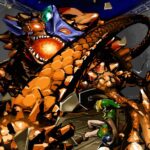
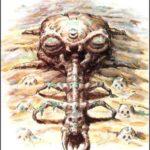
Tusandymon’s III Curse
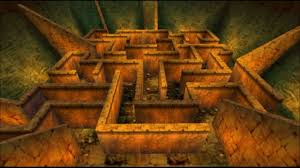
Whoever puts their paw into this sacred precinct shall die a painful death. May your greed find rest in the afterlife
And so the temple of doom shock full of elaborate and fully functional booby traps left behind by the ancients was born. Said traps are often of a dubious technological pedigree, considerably more complex than anything else the civilizations were capable of making (still made with ancient materials but as sophisticated as modern industrial plants). Even more remarkable is the fact that they have not decayed at all, considering that the environment is one that should require extra maintenance, and are just as lethal as they ever were, let alone the fact that any poisons or protecting animals should have decayed centuries ago. Projectile traps might even be capable of reloading themselves an indefinite number of times. Quite the feat indeed.
So does this have any remote parallel to real life or was this just the invention of imaginative science fiction writers and then popularized in films like Indiana Jones? Sadly—or happily for archeologists—fiction usually exceeds reality and, in this case, traps meant to directly harm intruders with technically advanced mechanisms is mostly the realm of fantasy. Egyptians and other cultures certainly wanted to preserve the treasures of their dead from thieves and tomb raiders but the more practical methods were just to put actual guards there, construct false rooms meant to deter further seeking or difficult to access and well hidden locations. There are some Chinese legends about tombs riddled with automatic crossbows though, but they probably would not work after 2000 years of tension. The lost world genre of fiction was popularized in late-Victorian adventure romance. It arose during an era when Westerners were discovering the remnants of lost civilizations around the world, such as the tombs of Egypt’s Valley of the Kings, the semi-mythical stronghold of Troy, the jungle-shrouded pyramids of the Maya, and the cities and palaces of the empire of Assyria. King Solomon’s Mines (1885) is sometimes considered the first lost world narrative with a tomb having traps.
Of course another different story has to do with cursed tombs, where actual magic is in place to cause harm; it was popularized in Western media after the discovery of King Tutankhamun’s tomb in 1922, where the rumor occurred that there was an inscription warning trespassers. Many people involved in its discovery actually died shortly after (many authors and documentaries have argued that these curses are ‘real’ in the sense of having more mundane causes such as bacteria or radiation).
What we see at King Sandybutt’s eternal resting place are the well known variation of the ceiling of doom closing in combined with a labyrinth. This is a Booby Trap in which spiked walls, pistons, or sharp blades ram into each other in a narrow hallway. The way past them for intrepid investigators is to either immediately run through when they are closing in or find a way to jam them. They can either crush you or impale you.
Musical Analysis
Structure: Section 0 / Section 1 / Section 2
Tempo: 170 (Section 0); 138, accelerando to 200 (Section 1); 120 (Section 2)
Melodic and Harmonic Profiles: Chromatic; Double harmonic minor
In-game this is technically another timed mission where the role of the music is to fill the player with tension as the timer counts down to 0. So we get the usual devices like increasing the tempo exponentially and adding more instruments playing exponentially higher pitches. The theme just takes the motif of the first question-answer phrase of the music from the level and then transposes it chromatically for each iteration to create the sense of urgency. Sometimes Grant goes to a lower octave with some of the instruments in order to prevent them getting to unrealistic pitches if they kept going up indefinitely; the percussion reinforces each key change.
The only new material here are strings intro taken directly from classic horror stings (think the Physcho strings) and the cue the player hears if they actually fail to cross the path, a short chromatically descending fanfare played by the brass where the baritone sax plays in unnaturally low pitches to give the final touch of doom.
Maybe the only remedy for these kinds of situations is the coveted power up; and like any other respectable cartoon characters, the bear and the bird follow on the tradition of using the same sport cue whenever you gain an extra source of strength.
Help to keep the rites going around here by supporting the shrine:

Media Files, requests and support for more interactive content

Thou shall donate since this is a cult and you are now a sheep

Help staying awake analyzing game tracks and writing posts or else everything will end up being written by A.I
- Inside The Score – The Legend of Zeda: A Link to the Past – End Credits / Staff Roll
 The land rests As the last few minutes of this extensive journey that has now come to an end fly by, the nostalgia and reflective mood kicks in. Because such a massive enterprise as a Zelda game or a Lord of the Rings movie require multiple endings to convey everything… Read More »Inside The Score – The Legend of Zeda: A Link to the Past – End Credits / Staff Roll
 - Inside The Score – The Legend of Zelda: A Link to the Past – Ending / Epilogue ~ Beautiful HyruleFinal of the fantasy The Triforce has been touched. A wish has been granted. For the occasion, the newly undeceased king of Hyrule has commissioned a march in honor of the legendary hero to the Hylian Sousa, who might as well be composer Nobuo Uematsu since this piece is very… Read More »Inside The Score – The Legend of Zelda: A Link to the Past – Ending / Epilogue ~ Beautiful Hyrule
- Inside The Score – The Legend of Zelda: A Link to the Past – Triforce Chamber / Power of the GodsTake your boots off your feet And thus the Triforce spoke to men. And it became present in history. And you better treasure and contemplate this moment seldom witnessed in the course of the series. The elusive opportunity to interact and touch the most important artifact. You are now in… Read More »Inside The Score – The Legend of Zelda: A Link to the Past – Triforce Chamber / Power of the Gods
- Inside The Score – The Legend of Zelda: A Link to the Past – Ganon Battle / Prince of DarknessProgressive evil En Garde! And you better be prepared since you are about to duel the iconic enemy of the series at perhaps his canonically most powerful incarnation. Right after having touched the sacred Triforce which allowed him to conquer all of the Golden Land and whose evil and darkness… Read More »Inside The Score – The Legend of Zelda: A Link to the Past – Ganon Battle / Prince of Darkness
- Inside The Score – The Legend of Zelda: A Link to the Past – Boss Battle / Anger of the GuardiansQuick mayhem Ah, the simpler times when boss battles where not a multi epic orchestral suite but just an ostinato more basic that even what became the music for standard battle encounters out there. We are a long way from each boss having his own personalized track. And this early… Read More »Inside The Score – The Legend of Zelda: A Link to the Past – Boss Battle / Anger of the Guardians
- Inside The Score – The Legend of Zelda: A Link to the Past – Dark World Dungeon / Dungeon of ShadowsMemento mori We are getting closer to Ganondorf (or at least the wizard Agahnim who ultimately fulfills the same human side of evil role in this game) and that means getting closer to the profiles and motifs of his own theme song (which naturally was the theme of Agahnim at… Read More »Inside The Score – The Legend of Zelda: A Link to the Past – Dark World Dungeon / Dungeon of Shadows