Egyptian desert in Asia
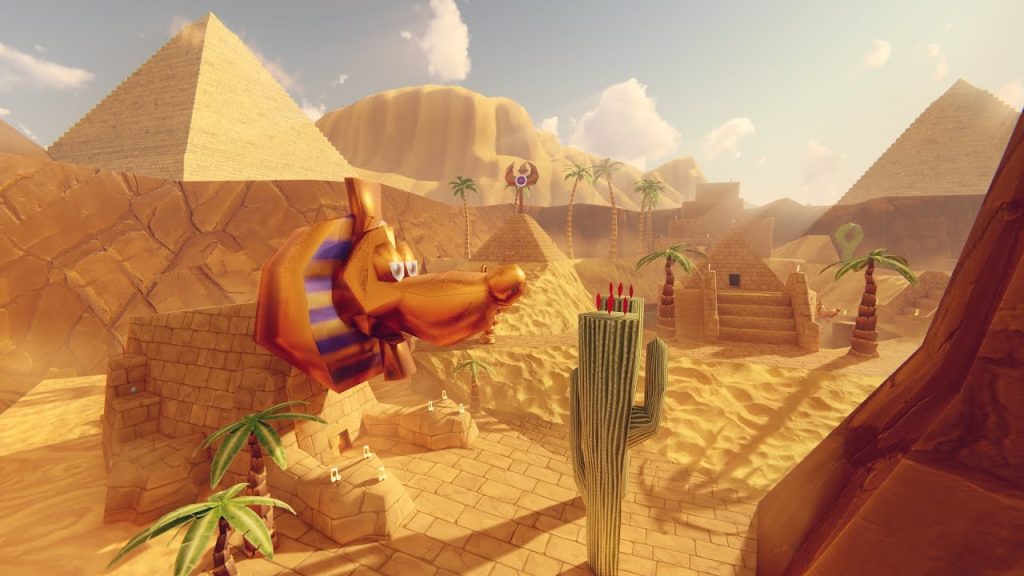
Walk like an Egyptian and enter this magical land in a far away place…among other unapologetic cliches that Banjo-Kazooie will serve itself of in order to bring us a desert engulfed in the ancient and mysterious; it is a miracle there are no belly dancers to be found around. Just like freezing to death was not a problem, the desert environment presents no issue to these animals whose bodies are somehow also well adapted to deal effectively with heat strokes and dehydration—it is not that big of a deal since this is a valley with an oasis and lots of cold buildings.
Ironically named Gobi, a real world desert located north of China, even though it is full of the ancient Egyptian imagery characteristic of a completely different desert—clearly the research team at Rare was more concerned with bodily sounds accuracy—we can theorize that in-game this location was named after Gobi the camel, which likes to travel a lot so perhaps he comes from the other desert (or he was pouched since he is initially captured). So it all makes sense now. In any case, this staple video game level is naturally still trapped in ancient times, has mummies as its main enemies, pyramids, its own custom sphinx, temples of doom, quicksand; alongside other classic Arabic tropes like snake charmers and magic carpets. Of course it also has cacti like many other deserts set in the Sahara; the problem is, these are only found in the Americas in the real world.
The level takes inspiration from Shifting Sand Land in Super Mario 64, a world also based on more abstract Egyptian imagery accompanied by pure Indian music for some reason. It is unclear whether this level in Banjo-Kazooie was present during early development; there were certainly desert and temple locations as beta test levels for movement, but it seems that originally there were plans for a Maya inspired culture as opposed to the more usually depicted Egyptian civilization; they ended up leaving the Mesoamerican influences for both the sequel and Donkey Kong 64, sticking with the same line of Mario 64 and countless other video games. Even so there was still Arabic influenced music made to accompany these Mayincatec locations since composers apparently have a hard time coming up with more historically accurate music for these locales; so they commonly end up with either African or Middle-Eastern inspired music. Just use some exotic scales and nobody will question it.
This was the early version of the music from the ancient civilization-based world
We can definitely say that the final version of the music came later due to it having some of the devices from the late musical direction, like the Kirkhope cadence and the more frantic, fast paced rhythms. The music for these locales is so standardized in media that even without communication both Grant Kirkhope and Koji Kondo ended up trying to reproduce some of the same instrumentation, musical intervals and microtones for their respective games released in 1998. Like on the Spirit Temple from Ocarina of Time, we find a magical intro meant to be played by Oriental chimes, like entering a land full of mystery and the unknown; the celesta here is a stand in for a chimes sample, with Grant manually entering the notes, carefully avoiding intervals that would bring to mind standard Western major/minor scales. There are also the imposing orchestral strings, standardized by the influential film Lawrence of Arabia and even before by the Orientalism of Russian composers as exemplified with pieces like ‘Scheherazade’
The influential score from Lawrence of Arabia, which pretty much set the template for deserts in media.
In both games the main melody is also meant to be played by the same type of instrument, either the pungi or the more sophisticated shehnai, both reed instruments originating in the Indian subcontinent and associated with the practice of snake charming, a practice which itself actually existed in ancient Egypt but whose popular conception is the mystical Indian variant that spread back to Egypt—that is cultural transmission for you. That does not mean it isn’t co-opted in media for ancient Middle-Eastern and North African settings too like the amalgam Banjo-Kazooie paints us, where we find an actual snake charmer living in this desert—the first human being the bear and the bird encounter—who actually plays in diegetic fashion the same instrument we hear on the level cue (the long design of the pungi is what actually “hypnotizes” the snake by appearing as a threat or rival snake to them).
Like on the Spirit Temple there are also conga patterns representing the goblet drums commonly used in the traditional music of Egypt and considered a staple of modern day Egyptian Baladi music, the genre that, at the end of the day, most Western Orientalism is emulating when it comes to Arabic infused places or the ancient past of the desert. Additionally, Grant uses its other percussion samples to create a more intricate rhythm pattern whose only goal is to sound exotic—or perhaps the woodblocks could be though of as camel footsteps.
The other main player exclusive to the Banjo-Kazooie track is the electric guitar used with pitch bending to appear closer to the microtonal maqams used in Arabic musical systems, most likely imitating the timbre of the oud. The same pitch treatment is used for the baritone saxophone, which is here just to remind you that this is still a Banjo-Kazooie game.
Musical Analysis
Structure: PI – {I – ABACAD- A’C}
Tempo: 130
Melodic and Harmonic Profiles: C Harmonic major; C Double harmonic minor; C Neapolitan minor; C Aeolian dominant; F Double harmonic minor; F Neapolitan minor
Even though Maqams are various and complex, the typical scales that tells you you are in Egypt or Arabia are those based in either Phrygian or harmonic tetrachords; the deeper you are into the Arabian night, the more harmonic tetrachords your scale will have (closer to Europe you can start sprinkling more Phrygian in). The characteristic Arabic sound of the harmonic tetrachord appears whenever you have a diminished step between the first and second degree of the scale plus the augmented second interval between the second and third degree. Kirkhope will incorporate various combinations of harmonic and Phrygian tetrachords for the Gobi’s Valley music.
The pre-intro played by the strings descending is the most particular since by using the note D it falls into an harmonic major scale, giving way to the Egyptian oom-pah rhythm played by the bassoons implying standard major chords. The pungi melody cements the Egyptian vibe by focusing on the harmonic tetrachord tail against the I chord, only returning to the tonic at the end of phrases. The A section only uses the harmony C to G, finishing with the Kirkhope cadence Db – G – C, which in this context helps to push forward the Arabic tone thanks to the E natural of the C major chord. The D note found on the G chord prevents the piece from sounding too exotic or with more complex harmonies than the standard major and minor chords found in the score of the game. Its closest maqam counterpart would be known as Hijaz Kar.
There is not really a section B here; the shortness of the pattern played by the pungi after the melody of section A is completed makes it more akin to an interlude or break. For now the piece really seems like a genuine snake charmer tune, with the A section hypnotizing the cobra and the interlude putting it to dance. Grant has come up with a true equal to the Arabian riff snippet known as ‘The Streets of Cairo’ that Hollywood overuses for comedic effect whenever you see a snake charmer or belly dancer on screen.
After a reprise of the A section where the baritone sax mixes in its timbre, the oud responds with a melody of its own in a new section. The oud uses the Phrygian tetrachord for its head but retains both the harmonic tetrachord for the tail and the C chord in major form for the harmony. This being a late development Kirkhope tune, of course it also needed to have featured the tritone interval in the first answer phrase of the melody. The question-answer structure breaks symmetry at the end when the very last answer goes to a coda, ditching the phrygian tetrachord of the head for a major one (by including the D and E natural) and momentarily transforming the harmonic tetrachord of the tail into a Phrygian one, turning it back to an harmonic one for the last flurry of notes.
The harmony for this section consists of:
Db – C – Db – C
Db – C – Db – C – Bb – Ab -G
In rondo form we return to the main A section, with the pungi still supported by the saxophone. Then the strings of Lawrence of Arabia and Hollywood Egypt come to be featured for the last section, ornamenting the piece with chromaticisms and Grant continuing to mix the notes from the Phrygian and harmonic tetrachords in elegant fashion, especially in the coda for the section which also breaks the symmetry of the question-answer phrases. The C section is all about preparing the piece for a new key; the coda presents a descending harmony in order to transition into the new key of F. The chords are of the form:
Bbm – C – Bbm – C
Bbm – C – Bbm – Ab – F# – E – C
By the time we get back to the last C we are now in the dominant degree of the new key, which is where we hear the renovated A section and subsequent B section before the loop restarts the whole process, magically transforming the last dominant chord back into tonic.
The power of the mighty pharaohs is felt whenever you get close to the sphinx Jinxy, which depict the forebears of Banjo, the bear who flourished on this valley in ancient times. (a mummy has had a jiggy for more than 1000 years). The track appropriately gets the heavy orchestral percussion and fanfare like chordal melodies of the brass section, which although were the staples of Western rulers, would certainly be appreciated by the Eastern ones due to their loudness and power (they are known to build giant monuments to themselves after all).
There are many places still left to explore in this vast, ancient valley. some dangers and booby traps await our heroes. Traps that even without the benefit of maintenance for thousands of years are still lethal and ready to exhort forbidden trespassers to turn back.

Help to keep the rites going around here by supporting the shrine:

Media Files, requests and support for more interactive content

Thou shall donate since this is a cult and you are now a sheep

Help staying awake analyzing game tracks and writing posts or else everything will end up being written by A.I
- Inside The Score – The Legend of Zeda: A Link to the Past – End Credits / Staff Roll
 The land rests As the last few minutes of this extensive journey that has now come to an end fly by, the nostalgia and reflective mood kicks in. Because such a massive enterprise as a Zelda game or a Lord of the Rings movie require multiple endings to convey everything… Read More »Inside The Score – The Legend of Zeda: A Link to the Past – End Credits / Staff Roll
 - Inside The Score – The Legend of Zelda: A Link to the Past – Ending / Epilogue ~ Beautiful HyruleFinal of the fantasy The Triforce has been touched. A wish has been granted. For the occasion, the newly undeceased king of Hyrule has commissioned a march in honor of the legendary hero to the Hylian Sousa, who might as well be composer Nobuo Uematsu since this piece is very… Read More »Inside The Score – The Legend of Zelda: A Link to the Past – Ending / Epilogue ~ Beautiful Hyrule
- Inside The Score – The Legend of Zelda: A Link to the Past – Triforce Chamber / Power of the GodsTake your boots off your feet And thus the Triforce spoke to men. And it became present in history. And you better treasure and contemplate this moment seldom witnessed in the course of the series. The elusive opportunity to interact and touch the most important artifact. You are now in… Read More »Inside The Score – The Legend of Zelda: A Link to the Past – Triforce Chamber / Power of the Gods
- Inside The Score – The Legend of Zelda: A Link to the Past – Ganon Battle / Prince of DarknessProgressive evil En Garde! And you better be prepared since you are about to duel the iconic enemy of the series at perhaps his canonically most powerful incarnation. Right after having touched the sacred Triforce which allowed him to conquer all of the Golden Land and whose evil and darkness… Read More »Inside The Score – The Legend of Zelda: A Link to the Past – Ganon Battle / Prince of Darkness
- Inside The Score – The Legend of Zelda: A Link to the Past – Boss Battle / Anger of the GuardiansQuick mayhem Ah, the simpler times when boss battles where not a multi epic orchestral suite but just an ostinato more basic that even what became the music for standard battle encounters out there. We are a long way from each boss having his own personalized track. And this early… Read More »Inside The Score – The Legend of Zelda: A Link to the Past – Boss Battle / Anger of the Guardians
- Inside The Score – The Legend of Zelda: A Link to the Past – Dark World Dungeon / Dungeon of ShadowsMemento mori We are getting closer to Ganondorf (or at least the wizard Agahnim who ultimately fulfills the same human side of evil role in this game) and that means getting closer to the profiles and motifs of his own theme song (which naturally was the theme of Agahnim at… Read More »Inside The Score – The Legend of Zelda: A Link to the Past – Dark World Dungeon / Dungeon of Shadows