Real life energizer cue
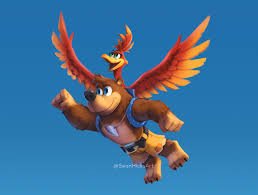
It is Super Banjo time. Cub power, activate!
Just like Mario has its star power up with is own theme alongside its variations of it included with the hats from the Nintendo 64 incarnation and just like Popeye has its own spinach theme, the bear and the bird also have an assortment of abilities bestowed upon them by objects in their environment, conveniently located in places where they would come in handy. They come with the common limiting factor of having them expire after a set amount of time. This is very common with Invincibility Power ups, where a limiting factor is necessary to avoid breaking the game. In many cases, an audio motif indicates the fact that the power-up is in play, vanishing the moment the power-up expires. The only difference is that Banjo and Kazooie, being stepped completely in the tried and true cartoon tradition, have an additional intro preparing the heroes for action, an intro whose origins reside in the sports arena and then was translated to cartoon characters; usually those who are about to dash off on a high-speed run like a shot.
Musical Analysis
Structure: Section 1 / Section 2 / Section 3
Tempo: 155 (Section 1); 160 and 140 (Section 2); 190 (Section 3)
Melodic and Harmonic Profiles: G Ionian/Major; C Lydian
Known as the ‘Charge fanfare’, this six-note tune is a standard frequently played at sporting events, especially in North America. Being a relatively modern snippet, as opposed to some primordial mist used by ancient Olympians and Roman charioteers, we know quite something about it; the fanfare was written by Tommy Walker while a junior at the University of Southern California in the fall of 1946 for college American football. After the notes are played the rooters usually shout “Charge!” Occasionally, the fanfare is repeated one or more times in the same key or in successively higher keys, or is preceded by a lead-in vamp as in baseball events. There are some people who cling to the belief that Walker borrowed the trumpet fanfare from the cavalry bugle call Charge. But If anything, Walker’s Charge is derived from the opening notes of ‘First Call’, a bugle piece used since at least the 1800s that most people identify as the horse racing’s Call to the Post. It is quite possible that Walker, a frequent horse-player, conjured up his call after a trip to the racetrack or it subliminally crept in. The theme of Popeye when he powers up also possesses the exact same rhythm in its motif and since it is older than the Charge fanfare then a case could be made for it to be a source of inspiration.
It wasn’t until 1958 that ‘Charge’ exploded. That year the Dodgers moved to Los Angeles, the land of Hollywood. where the baseball-starved fans of Southern California embraced the song after, allegedly, a musician blew a few notes on a battered trumpet and then yelled “charge” Hundreds of thousands have picked it up since, via TV and radio as the trademark of the Dodgers. After the ’59 World Series broadcasted all over the country that famous trumpet call was appropriated by nearly every team that had a fan with willing lips and a bugle. They even made toy trumpets which played the tune with just a press of a button.
Being from the land of animation it was a matter of time before sports fans animators went along with it and began adapting it to their cartoons to make their characters reap the benefits of this empowering piece, from the original The Flintstones 1960s television cartoon series (typically for Wilma and Betty on the way to a shopping spree) to the puppy power from Scrappy-Doo in the Scooby Doo series. It then has found its way into Banco-Kazooie, one of the series keeping the golden age of cartoons style alive. Grant Kirkhope himself has gone on record saying that he was specifically referencing the cartoon Dastardly and Muttley, where the pigeon, Yankee Doodle plays the bugle before escaping his captors.
The rest of the material is a custom variation of the main theme of the series or, alternatively, the Banjo and Kazooie theme song, each capturing attributes from the power up seen on screen. For the Wonderwing where the bear and the bird become untouchable there is a sense of American show tune sensibility, akin to a celebrity triumphantly walking to receive awards, a fanfare for modern royalty basically, with a walking bass and featuring the respective namesake instruments from the bear and the bird.
The one for the wading boots amps up the hillbilly sensibilities by reinforcing associations between people who dwell in rural, mountainous areas in the United States, primarily in the Appalachian region, and the kinds of works they usually perform at ranches or mines, which often require long boots for muddy terrains and conditions; the music is straight from a jug band, home of cheap, homemade musical instruments, including the addition of the characteristic boing sound of the Jew’s harp or jaw harp, the palm muted guitar sample which sounds closer to a cheap banjo and, curiously enough, the Indian pungi sample, likely being a stand in sonority for some cheap version of another instrument that Grant felt worked well in this context, like a fiddle, harmonica, kazoo or even the rudimentary comb and paper combo instrument which consists of a comb with a piece of paper pressed to it in which you blow.
The last one for the Turbo Trainers is pretty much a fast version of the show tune, with the addition of the woodblock and the marimbas to signify clocking sounds since the shoes are usually found in and used for time based challenges.
In contrast with the rest of the series, or more specifically in contrast with the musical number intro, or to make it higher and thus more exciting, the pieces are based around G as opposed to C.
After spending so much time being threatened by Gruntilda, next stop is the world where her origins, alongside those of the music from the entire series, truly reside.

Help to keep the rites going around here by supporting the shrine:

Media Files, requests and support for more interactive content

Thou shall donate since this is a cult and you are now a sheep

Help staying awake analyzing game tracks and writing posts or else everything will end up being written by A.I
- Inside The Score – The Legend of Zeda: A Link to the Past – End Credits / Staff Roll
 The land rests As the last few minutes of this extensive journey that has now come to an end fly by, the nostalgia and reflective mood kicks in. Because such a massive enterprise as a Zelda game or a Lord of the Rings movie require multiple endings to convey everything… Read More »Inside The Score – The Legend of Zeda: A Link to the Past – End Credits / Staff Roll
 - Inside The Score – The Legend of Zelda: A Link to the Past – Ending / Epilogue ~ Beautiful HyruleFinal of the fantasy The Triforce has been touched. A wish has been granted. For the occasion, the newly undeceased king of Hyrule has commissioned a march in honor of the legendary hero to the Hylian Sousa, who might as well be composer Nobuo Uematsu since this piece is very… Read More »Inside The Score – The Legend of Zelda: A Link to the Past – Ending / Epilogue ~ Beautiful Hyrule
- Inside The Score – The Legend of Zelda: A Link to the Past – Triforce Chamber / Power of the GodsTake your boots off your feet And thus the Triforce spoke to men. And it became present in history. And you better treasure and contemplate this moment seldom witnessed in the course of the series. The elusive opportunity to interact and touch the most important artifact. You are now in… Read More »Inside The Score – The Legend of Zelda: A Link to the Past – Triforce Chamber / Power of the Gods
- Inside The Score – The Legend of Zelda: A Link to the Past – Ganon Battle / Prince of DarknessProgressive evil En Garde! And you better be prepared since you are about to duel the iconic enemy of the series at perhaps his canonically most powerful incarnation. Right after having touched the sacred Triforce which allowed him to conquer all of the Golden Land and whose evil and darkness… Read More »Inside The Score – The Legend of Zelda: A Link to the Past – Ganon Battle / Prince of Darkness
- Inside The Score – The Legend of Zelda: A Link to the Past – Boss Battle / Anger of the GuardiansQuick mayhem Ah, the simpler times when boss battles where not a multi epic orchestral suite but just an ostinato more basic that even what became the music for standard battle encounters out there. We are a long way from each boss having his own personalized track. And this early… Read More »Inside The Score – The Legend of Zelda: A Link to the Past – Boss Battle / Anger of the Guardians
- Inside The Score – The Legend of Zelda: A Link to the Past – Dark World Dungeon / Dungeon of ShadowsMemento mori We are getting closer to Ganondorf (or at least the wizard Agahnim who ultimately fulfills the same human side of evil role in this game) and that means getting closer to the profiles and motifs of his own theme song (which naturally was the theme of Agahnim at… Read More »Inside The Score – The Legend of Zelda: A Link to the Past – Dark World Dungeon / Dungeon of Shadows