Playfully sinister origin
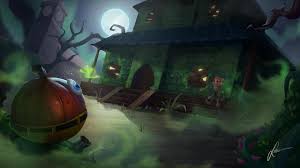
This is it, this is where it is at. Not only the spirits of the dead are roaming this place but the spirit of the entire franchise was also found here in the form of its musical direction, which then spread and permeated the rest of the game by dovetailing on the shoulders of its main villain, a classic witch straight from the horror and Halloween motif that serves as the backbone of this level.
This is the obligatory haunted area in the game finishing the trilogy of obligatory levels where Banjo-Kazooie follows the template set by countless platformer and world based games. Skeletons, ghosts and other undead become the enemies, classic horror locales become the main landmarks, like the centerstage haunted house (perhaps Gruntilda’s own house), a cemetery, a church, a maze and a creepy cellar; it is found surrounded by a thick forest and unavoidably is set at night in contrast with your typical level. Naturally, The background ambience will make generous use of spooky animal sounds, such as hooting owls, howling wolves and bats. It is the Banjo take on the Big Boo’s Haunt level found in Super Mario 64.
Just like the snow level was infused with the Christmas holiday elements, we found ourselves now immersed in the Halloween celebration, the second most popular holiday pretty much celebrated all around the world. It is another Christian tradition at its core, which then, through cultural osmosis, ended up absorbing all kinds of disparate traditions from other societies; as long as it has to do with the otherworldly, death and the macabre it is all fair game. It ended up being referred as Halloween as a portmanteau of All Hallows’ Eve, the eve of the Western Christian feast of All Saints’s day observed on 31th October. In the 9th century, some churches in the British Isles began holding the commemoration of all saints on 1 November, and in the 9th century this was extended to the whole Catholic Church. Its original meaning was to remember the dead, including hallows, martyrs, and all the faithful departed. From celebrating dead there were small steps towards the macabre, the supernatural, the grotesque and then up to the straight horror found in the popular culture of today.
Just like Santa is the mascot of Christmas, the one for Halloween is the jack-o’-lantern, originally made in all kinds of vegetables and objects but most commonly made from a pumpkin today thanks to its abundance in America and the larger surface area available to carve drawings. Its name comes from the phenomenon of strange lights, usually though to be specters, flickering over peat bogs, called jack-o’-lanterns; the tradition was imported largely intact from Celtic influenced immigrants who brought their root vegetable carving traditions (mainly turnips) from their Samhain harvest festival with them to the new world.
Banjo and Kazooie become a literal animate jack-o’-lantern in this level, visit all kinds of haunted places and even play with a Ouija board.
As stated on the Introduction to the Series the music from this level went on to influence the musical direction of the rest of the series, overhauling many of the already completed tracks that sounded more in line with typical mascot platformer fare.
That doesn’t mean Grant Kirkhope had not used the style before Banjo-Kazooie. GoldenEye 007 has similar harmony profiles (more noticeable in the creepy Statue Park level) and the main parts of the tune from Mad Monster Mansion were already present in tracks composed for the previous pirate fantasy adventure Project Dream. It just seems it was the go to music for Grant when musicalizing goblins, monsters and the gothic or supernatural. The composer just didn’t think of incorporating the style into the full game of Banko-Kazooie until reaching the point of creating the track for Mad Monster Mansion and associate it with the character of Gruntilda, giving the series a bar code when it comes to its music.
The chase scene features music for both the heroes and monsters alternating one after the other. Parts of it when into the creation of Mad Monster Mansion and Witchyworld in Banjo-Tooie. the natural music of choice for chase scenes where fast oom-paw rhythms have been a feature in media and cartoon since at least the constant use of the classical musical piece called ‘Sabre Dance’
Here is another version of the tune made for a villainous character:
Musical Analysis
Structure: PI – {I – ABC – A’C’D}
Tempo: 130
Melodic and Harmonic Profiles: C Harmonic minor; Db Harmonic minor; Db Chromatic
The Mad Monster Mansion cue takes its main motif from the Chase theme and expands it with the other familiar contrasting sections. These include an extended intro establishing the harmony of the piece. The harmony came first and then Grant Kirkhope tried to fit melodies into the chosen chords. The chord progression with an organ was taken from a different Danny Elfmann score, a favorite of Grant since it was the first soundtrack release he purchased; it is the music that plays on the film Batman when the characters are in a cathedral. It is heard when the brass enter in full force.
The progression in question is the also tritone based i – bvi – i – bV. It kickstarts the piece in the haunted world of Banjo-Kazooie with the cherry on top being the theremin, which would simply be a crime not to feature on this cue. There is also an exclusive harmonic device for the organ here meant to bring to mind those baroque embellished cadences employed by Bach, where the last chord full form is delayed slightly by altering a single note. This is easy to do fuller with the organ since by maintaining the pedal note on the bass—literally where the name pedal notes come from since it is a pedal pressed by the foot—you can play around with embellishments on the top notes and the harmonic sense will still prevail. So we get an F# with a sharp eleventh before going back to the triad.
After the pretty standard haunted house/monster movie pre-intro, the orchestral percussion signals the start of the Tim Burton movie, with the oom-pah rhythms driving the track. The main instrument is predictably enough the bassoon, the instrument of Gruntilda, usually employed for older characters and, since the debut of the piece ‘The Sorceress’Apprentice’, magic users alike. The melody, taken unmodified from the ‘Bully’theme from Project Dream, follows the harmony changes already established, with the notes taken from parent scales of the chords being played at a time; still, the main scale is that of the Gruntilda’s Lair theme, the cadence from G to Cm establishing an harmonic minor profile.
The main progression goes:
Cm – Abm – Cm – F#
Cm – Abm – Cm – G7 – Cm – G7
There is an interesting disturbance in the bass line played by the low strings; when the second time the song goes to the Abm chord, the pattern that normally goes between perfect fifths is spookily altered to a tritone, giving it an uncanny dissonance in the low register that is not much perceived as felt (when going to lower pitches it is more difficult for the brain to distinguish intervals other than the octave and the fifth), like something is wrong in the air.
The celesta and marimbas join for the reprise of the section, the celesta being also a staple of gothic instruments. Here we can say the marimba can finally play its classic part of representing skeletons dancing in media, made famous by the Disney short The Skeeton Dance (the bones are meant to produce pitches analogous to the plates of a marimba).
Section B is made of new material exclusive to this piece. Or not, since Grant pretty much reused the same melodic contour for the main motif of Creepy Castle in Donkey Kong 64—another tune which also uses the Batman progression—This points to the direction that these melodic patterns derive from a more primitive tradition, most likely those found in classic drama and suspense stings used a lot in radio narratives or early horror films, which had music cues that were useful to clue the audience when something bad was about to happen or a villain finished telling his evil plan. The main idea is quite simple, just play around with the tonic, the minor third to establish the worrying atmosphere and then delay the perfect fifth by sustaining a tritone note for however much you like; the more you sustain the tritone, the more dramatic. The sting usually ends with either the tritone or the dominant in order to not feel a resolution, adding to the sense of uneasy. It is the classic dramatic Dun Dun Duuuuuun you hear parodied all around today.
‘Suspense‘, an American horror show broadcast on CBS Radio between 1942 and 1962, was filled to the brim with these types of sound effects and dramatic stings; its first use was to set the mood when the narrator recounts the protagonist looking through a book of famous poisoners through history, only to come across an image of his own wife, shock!!..
They have become cliche but were very effective back then in hooking and spooking the listeners. In the case of Creepy Castle from Donkey Kong 64 it works twofold since the idea was to reference the ‘Game Start’ sound from the original Donkey Kong arcade, when the villain captures the damsel in distress and climbs the stairs. A tune series creator Shigeru Miyamoto himself presumably created based around the Dragnet theme.
Further into the past, the origins of these types of sting become muddier and more difficult to pinpoint since it’s likely the musical phrase predates radio; the medium tended to adopt already popular tropes to entice listeners. The producers imported musical structure and musical language from vaudeville and Victorian stage melodramas. What ties all this together is the emphasis on the tritone, the most dissonant interval since it is the furthest on the circle of fifths and lacks any sense of resolution; as long as the tonic and the diminished fifth are established, you have your shock stinger.
In any case, back to the cue, the version from the B section of Mad Monster Mansion is not a stinger since it is more melodic; it just features the prolonged tritone—emphasized with a trill—before the perfect fifth. The chords featured for the B section are:
Cm – Cdim -Cm – Fm – D7 – G
The question-answer pairs are exactly the same, creating a completely symmetric section.
The short and frantic C section features a whirlwind of notes from the flute and clarinet with faster chord changes, the bass notes moving through diminished profiles and the protagonist of the F# note.
Cm – F#m – Cm – Bm
Since all the chords are minor and are based on tritone and minor second chord movements the level of dread is at an all time high. The same figure is used on the sequel whenever a boss battle approaches or similarly as the theme from Gruntilda’s evil sisters.
The tritone eases the transition into the new key one semitone up since C# is the fifth of F#. A new and revamped A section begins accompanied by the flurry of notes of the flute and a countermelody played with pitch bends in the theremin. The clarinet takes over the main melody. After that we reach a subdued version of the section, where the organ and the theremin reprise their pre-intro roles with the addition of the melody.
We then get to a more extended frantic section with an added bass melody played by bassoon and low strings. it all comes to one last triumphant outro where the previously minor chords become major out of the blue, as if Banjo and Kazooie just escaped the monsters. This section was already included as the ending for the previous tracks of Project Dream that inspired this tune. Its role is also of returning to the home key, with a series of chromatically descending chords and woodwind chordal fanfares. The melodic phrases follow the major scale of the underlying harmony. It ends with an explosive chromatic ascension full of anticipation just in time for reaching the dominant G that signals the return to the beginning of the piece. Giving us the harmony:
C# – C – B – Bb
E – F – F# – G
If the player gets close enough to the church, the track will add the bell sounds meant to represent the church bells. To create different precise pitches the right instrument to use are the tubular bells, which sound pretty similar to church bells and coincidentally are also a staple of horror orchestration thanks to being featured in the score for the film ‘The Exorcist’
Mad Monster Mansion is the most important piece in the entire series, the ground zero, so it is no wonder Grant Kirkhope has singled it out as his own favorite piece of the game; it just means that much since the game would have a different tone if its influences had not spread out to other tracks in the series. The theme will be reused, appropriately, in the final battle against the witch Gruntilda. There is still more spookiness to cover as Banjo and Emu explore the insides of other classic horror locations, where more solemn variations of the level music can be found.
Thaaaaaaaaaank Yooooouuuuuu for reading!
Help to keep the rites going around here by supporting the shrine:

Media Files, requests and support for more interactive content

Thou shall donate since this is a cult and you are now a sheep

Help staying awake analyzing game tracks and writing posts or else everything will end up being written by A.I
- Inside The Score – The Legend of Zeda: A Link to the Past – End Credits / Staff Roll
 The land rests As the last few minutes of this extensive journey that has now come to an end fly by, the nostalgia and reflective mood kicks in. Because such a massive enterprise as a Zelda game or a Lord of the Rings movie require multiple endings to convey everything… Read More »Inside The Score – The Legend of Zeda: A Link to the Past – End Credits / Staff Roll
 - Inside The Score – The Legend of Zelda: A Link to the Past – Ending / Epilogue ~ Beautiful HyruleFinal of the fantasy The Triforce has been touched. A wish has been granted. For the occasion, the newly undeceased king of Hyrule has commissioned a march in honor of the legendary hero to the Hylian Sousa, who might as well be composer Nobuo Uematsu since this piece is very… Read More »Inside The Score – The Legend of Zelda: A Link to the Past – Ending / Epilogue ~ Beautiful Hyrule
- Inside The Score – The Legend of Zelda: A Link to the Past – Triforce Chamber / Power of the GodsTake your boots off your feet And thus the Triforce spoke to men. And it became present in history. And you better treasure and contemplate this moment seldom witnessed in the course of the series. The elusive opportunity to interact and touch the most important artifact. You are now in… Read More »Inside The Score – The Legend of Zelda: A Link to the Past – Triforce Chamber / Power of the Gods
- Inside The Score – The Legend of Zelda: A Link to the Past – Ganon Battle / Prince of DarknessProgressive evil En Garde! And you better be prepared since you are about to duel the iconic enemy of the series at perhaps his canonically most powerful incarnation. Right after having touched the sacred Triforce which allowed him to conquer all of the Golden Land and whose evil and darkness… Read More »Inside The Score – The Legend of Zelda: A Link to the Past – Ganon Battle / Prince of Darkness
- Inside The Score – The Legend of Zelda: A Link to the Past – Boss Battle / Anger of the GuardiansQuick mayhem Ah, the simpler times when boss battles where not a multi epic orchestral suite but just an ostinato more basic that even what became the music for standard battle encounters out there. We are a long way from each boss having his own personalized track. And this early… Read More »Inside The Score – The Legend of Zelda: A Link to the Past – Boss Battle / Anger of the Guardians
- Inside The Score – The Legend of Zelda: A Link to the Past – Dark World Dungeon / Dungeon of ShadowsMemento mori We are getting closer to Ganondorf (or at least the wizard Agahnim who ultimately fulfills the same human side of evil role in this game) and that means getting closer to the profiles and motifs of his own theme song (which naturally was the theme of Agahnim at… Read More »Inside The Score – The Legend of Zelda: A Link to the Past – Dark World Dungeon / Dungeon of Shadows