Haunted requiem
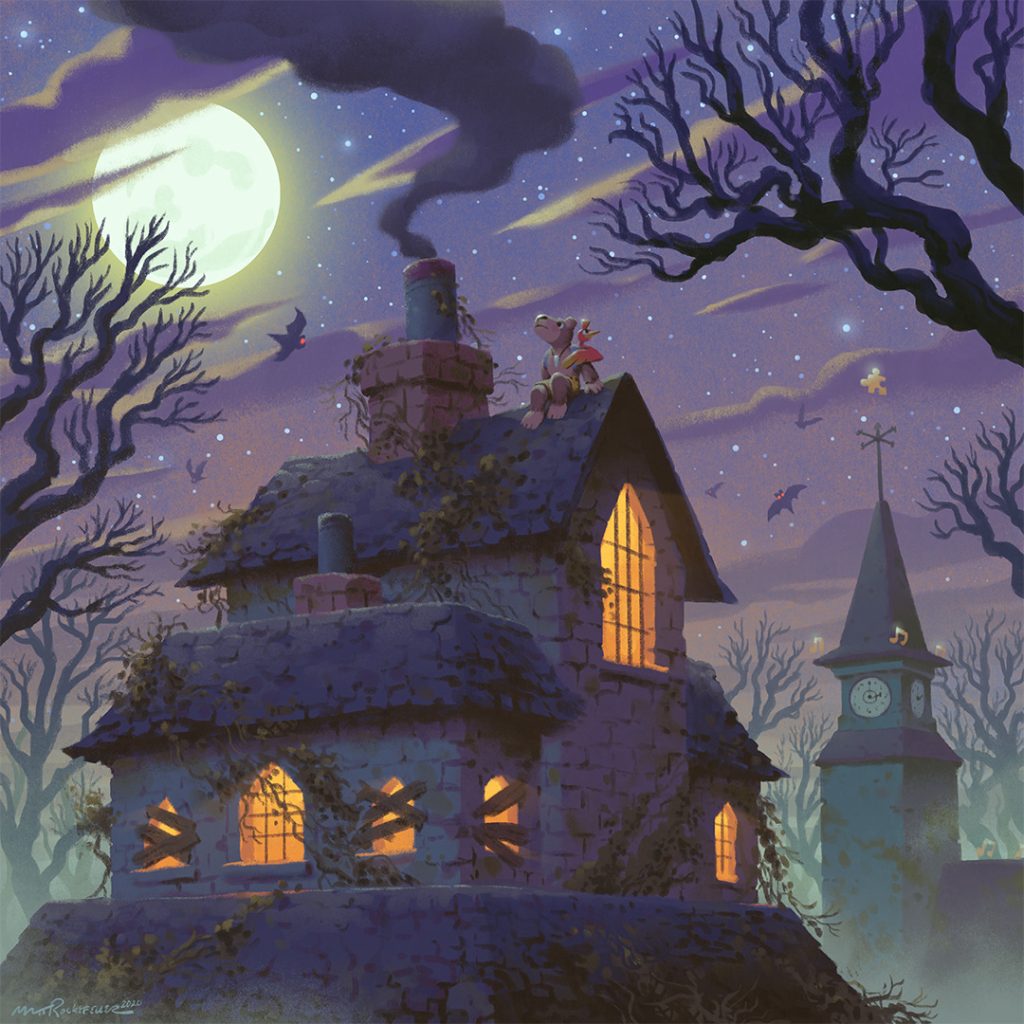
The service is about to begin. Because just like the snow level brought to us the possibility of celebrating Christmas, the haunted level allows for all the kinds of locations where you can deal with the otherworldly, the supernatural, the esoteric, the afterlife. A creepy cathedral is one of the first suspects right after the castle up there on a rock or the old mansion when it comes to eerie ambients. It is normal since churches are known to be the places where mortals can deal with matters of spirit, death, or, in some cases like Catholicism, depiction of torture and martyrdom. Funerals are also standard procedure for many churches and the image and architecture is meant to be grand and mighty. They are a staple of the gothic vibe for a reason.
The cathedral from Banjo-Kazooie is actually modeled after the real life church of Twycross, England, the place where the company Rare is based. The chairs and objects are enormous, implying their original users were creatures of very large proportions long gone. This is reflected in our master of ceremonies, a disembodied giant ghostly hand with only four fingers named Motzand, a portmanteau made with the word hand and the famous classical composer Mozart, even though the composer most associated with the golden age of organ is Bach; they just never found a better pun. The organ is of course the instrument of choice for church services, that is, right after after the human voice itself, due to its powerful and versatile sound that is able to emulate an entire orchestra and carry its sound throughout the expansive buildings where they are engrained. The introduction of church organ music is traditionally believed to date from the time of Pope Vitalian in the 7th century. The design of the organ in Banjo Kazooie more closely resembles a reed organ than a typical church organ, although it posseses pipes and sounds like a pipe organ. In-game the sounds of the organ, which the characters can play as part of a challenge, sound pitches in tune with the background music no matter what key of the instrument is played; there is also accurate sheet music on the stand depicting the main section of Mad Monster Mansion. Since this is also what we hear here then this music can be considered diegetic, the characters inside the game being able to enjoy it.
The other staple is the classic haunted house which is more popular in America in contrast to the haunted castles in Europe since b the time the U.S became a thing nobody built castles anymore. Yet, a big old house ticks most of the same boxes including strange sounds echoing through a big building and lots of rooms to hide.
Musical Analysis
Structure: Section 0 / PI – {I – ABAC – A’B’A’C’} / Section 2 / {I – ABACD}
Tempo: 120 (Section 0) / 90 / 110
Melodic and Harmonic Profiles: C Harmonic minor; Bb Ionian/Major; Ab Ionian/Major; Db Octatonic; Db Harmonic minor; B Ionian/Major; A Ionian/Major; E Harmonic minor; D Ionian/Major; C Ionian/Major
Surprisingly, Gran went for an actual faithful rendition of a church hymn that you would hear on a funeral mass or general worship service, adding accurate organ voicing to brand new sections with the appropriate solemnity and not necessarily creepy. Right before we access the church, a fanfare made with the organ and the church bells is heard—just a back and forth between the intro chords Cm – Abm – Cm— then inside the church the piece opens with the unmistakable notes of the most famous organ piece ever written, the Toccata and Fugue in D minor, BWV 565, which is a composition for organ by, according to the oldest sources although sometimes disputed, German composer Johann Sebastian Bach. Since the earliest of times in film, back when they were silent and a musician had to actually accompany the projection in real time, the piece has been used to convey horror and uneasiness, even though Bach probably never intended for it to be more than an organ exercise to show off his legendary dexterity. This can be asserted due the piece appearing as the recommended accompaniment for horror in some of the manuals that in-house musicians used as reference guides to play in their theaters; by this time the organ had become a symbol of a bygone era and had connotation of being ancient. When music historians and ancient music revivalists first brought these instruments out for public performances after more than a century in storage, the now unfamiliar instruments sounded archaic and creaky to audiences.
The piece is itself ominous, specially that opening in descending minor tonality and that spooky diminished seventh while sustaining a very low pedal note. The composition also became synonymous with horror in the popular consciousness after serving as the opening titles of the film Dr. Jekyll and Mr. Hyde from 1931 which also helped to popularize the trope of the maniac solitary guy playing Bach. Back then when the piece was the real deal; by today standards, it is usually reserved for parody, cartoon depiction and classic monsters like Dracula.
After the Halloween intro, we get to the Mad Monster Mansion hymn rendition from Motzand, The cue uses appropriate voice leading for organ music, prioritizing economy of movement. Where the piece takes us to a more sacred place is on the B section, which, instead of the dwelling on the suspense motif from the main level, goes to the true hymn section where major chords move in a series of perfect fourths, traveling through the circle of fifths counterclockwise. The melody is truly appropriate for accompanying souls in their ascent to heaven. Thus the harmonic profile moves between the major scale of Bb and Ab just before returning to the minor tonality by moving a half step from Ab to dominant G.
Bb – Eb – Ab – Db
Bb – Eb – Ab – G
The other new section is the baroque one, where the ability of the organist of maintaining pedal notes allows them to improvise faster runs on the upper notes showing their improvisation skills. It maintains the same harmony from the frantic C section of the original theme, the notes following a wave like pattern in their arpeggios just like the woodwinds did on the original.
Throughout the piece there is an accompaniment of a bell sound; it is not the same sample of the church bell but rather the same one used for the Christmas tree bells, smaller in sound and with a different timbre, its selection was likely due to the composer wanting to imitate the smaller bells used in church services and processions known as altar bells. Or perhaps imitating the muffled sound of the outside bells as they would presumably be heard from the inside.
When successfully performing the Motzang challenge you hear a phantasmagoric fanfare playing the Kirkhope cadence Db7 – G7 – Cm.
The track heard inside the Mansion is another variation, likely taken and written after the church one since it uses the hymn section that fits better the funeral service. There are a variety of spooky sound effects sprinkled around, including Gruntilda’s own laughter, poltergeist mischievous laughs and movements, among other critters. it is based around pizzicato strings which are a staple of places where you need to watch your steps, tiptoeing around without disturbing the evil presences that inhabit these walls. The theremin is played in the background as per the rules of horror scoring ever since Miklós Rózsa popularized its use in movies like Spellbound and The Red House, using it for otherworldly or supernatural settings since the instrument itself in the way it is played without touching anything seems otherworldly. It includes a couple new sections at the end, a brand new C section replacing the baroque one from the church with a new long progression moving in thirds, a pattern of a major third up, then a minor third down.
Em – Abm – Fm – Am – Gbm – Bbm – Gm – B7 – Em
And then we have a coda subtly imitating the main Mad Monster Mansion harmonic progression (the one from the Batman cathedral).
Em – Cm – Em – Bb
Em – Cm – Em – B – Em – B
This time the piece is in the key of Em either for variation or perhaps because it was the register where Grant Kirkhope felt the pizzicato sounded better. There is no key change a half step up on this version.
After visiting Grunty’s Land it is time to see what is the source of her industrial power in a level that brings back the decayed location theme that became a specialty of the Banjo-Kazooie games.
Help to keep the rites going around here by supporting the shrine:

Media Files, requests and support for more interactive content

Thou shall donate since this is a cult and you are now a sheep

Help staying awake analyzing game tracks and writing posts or else everything will end up being written by A.I
- Inside The Score – The Legend of Zeda: A Link to the Past – End Credits / Staff Roll
 The land rests As the last few minutes of this extensive journey that has now come to an end fly by, the nostalgia and reflective mood kicks in. Because such a massive enterprise as a Zelda game or a Lord of the Rings movie require multiple endings to convey everything… Read More »Inside The Score – The Legend of Zeda: A Link to the Past – End Credits / Staff Roll
 - Inside The Score – The Legend of Zelda: A Link to the Past – Ending / Epilogue ~ Beautiful HyruleFinal of the fantasy The Triforce has been touched. A wish has been granted. For the occasion, the newly undeceased king of Hyrule has commissioned a march in honor of the legendary hero to the Hylian Sousa, who might as well be composer Nobuo Uematsu since this piece is very… Read More »Inside The Score – The Legend of Zelda: A Link to the Past – Ending / Epilogue ~ Beautiful Hyrule
- Inside The Score – The Legend of Zelda: A Link to the Past – Triforce Chamber / Power of the GodsTake your boots off your feet And thus the Triforce spoke to men. And it became present in history. And you better treasure and contemplate this moment seldom witnessed in the course of the series. The elusive opportunity to interact and touch the most important artifact. You are now in… Read More »Inside The Score – The Legend of Zelda: A Link to the Past – Triforce Chamber / Power of the Gods
- Inside The Score – The Legend of Zelda: A Link to the Past – Ganon Battle / Prince of DarknessProgressive evil En Garde! And you better be prepared since you are about to duel the iconic enemy of the series at perhaps his canonically most powerful incarnation. Right after having touched the sacred Triforce which allowed him to conquer all of the Golden Land and whose evil and darkness… Read More »Inside The Score – The Legend of Zelda: A Link to the Past – Ganon Battle / Prince of Darkness
- Inside The Score – The Legend of Zelda: A Link to the Past – Boss Battle / Anger of the GuardiansQuick mayhem Ah, the simpler times when boss battles where not a multi epic orchestral suite but just an ostinato more basic that even what became the music for standard battle encounters out there. We are a long way from each boss having his own personalized track. And this early… Read More »Inside The Score – The Legend of Zelda: A Link to the Past – Boss Battle / Anger of the Guardians
- Inside The Score – The Legend of Zelda: A Link to the Past – Dark World Dungeon / Dungeon of ShadowsMemento mori We are getting closer to Ganondorf (or at least the wizard Agahnim who ultimately fulfills the same human side of evil role in this game) and that means getting closer to the profiles and motifs of his own theme song (which naturally was the theme of Agahnim at… Read More »Inside The Score – The Legend of Zelda: A Link to the Past – Dark World Dungeon / Dungeon of Shadows