A test of fire
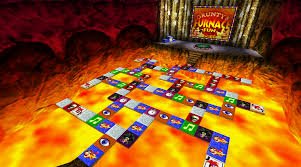
Finally, the high stakes and mighty lava world have arriv….wait, why is there a poster featuring Banjo and Kazooie? What is Tooty doing on a podium? Why are there spectators booing us? And why does the music feel as if we just stumbled in the middle of a black baptist church service? Because this is all about celebration and exhilaration. Turns out the always cruel Gruntilda is hosting an exciting and very dangerous game show/board game hybrid as opposed to your typical head to head final battle, subverting any possible expectations a player may have conjured in their wildest speculations.
Rare and this development team had already dabbled in trivia shows about aspects of the game back in Donkey Kong Country 2, but nobody saw it coming as a final device or obligatory sadistic goal for saving the damsel in distress. This is all about honoring Banjo-Kazooie itself (except for the fact death awaits those who fail on this show). There is even a meta aspect to the trivia since there are music related questions that the protagonists were not supposed to be hearing since they were non-diegetic. After Banjo-Kazooie, it became a staple of the series to feature trivia shows in some capacity.
The idea of Gruntilda starring as the host of her own game show might have come about from her own character inspiration, the witch Grotbags from the TV show Emu’s World. Grotbags was usually featured as a host of her own segment called Grotbags’ Grotto Game Show, based on various formats like the “take the money or open the box” segment of ‘Take Your Pick! This Grotto Game Extravaganza similarly featured the organ on its music cues.
Things started to get suspicious in the corridor leading to the furnace, where a trilling big band music arrangement of the Grintilda’s theme began to creep in; some villains certainly like their jazz in order to appear more sophisticated. Yet this was far from the sonic accompaniment of Grunty or the rest of the game for that matter. The music in this case was setting the literal stage by referencing the myriad of game shows popular since the radio era back in the 1920s, which in their classic iterations are typically accompanied by different jazz genres thanks to their casino heritage and American show business. Gambling saloons became widespread in many major cities like New Orleans, St. Louis, Chicago, San Francisco and so on, which happened to be also jazz hotspots, the hip music of the day. Casinos, American show biz and jazz had their heyday pretty much all at the same time, evolving together and generating a symbiotic relationship that became ingrained in the popular consciousness, to the point that even today many casinos still feature jazz just for the sake of that heritage and association (and its mostly instrumental nature is probably not as distracting to gamblers). Both were a cool new world back then, full of danger and the forbidden; pretty much all casinos in media, including video games, are accompanied by a jazzy soundtrack. In the Grunty’s Furnace Fun track there is an extra tinge of traditional hard gospel music that is synonymous with excitement and euphoria felt in some Christian worship services. It still is closely connected with jazz, blues music bridging the gap between both.
Game shows, one of the oldest TV show types, cousin of gambling houses and the granddaddy of Reality TV, are where individuals or teams compete for cash and prizes in flashy settings, trivia ones being some of the most reliably popular; as part of the show business, they took their cues a step further from the casinos and the first ones that became popular featured what was the cool music of the day, the big band jazz that exploded in popularity in the old 20s and 30s. Televised game shows became popular as soon as TV was a progressively more viable purchase and have never really let go of the air since. Game and variety shows will often incorporate snazzy jazz inflected music (Who Wants to be A Millionaire bucked the trend by featuring a very sophisticated and memorable space/ambient score). Your typical game show tune sounds like this:
Musical Analysis
Structure: PI – {I – A – I’- A’BCA” – A – I – A’BA” – A}
Tempo: 130
Melodic and Harmonic Profiles: C Ionian/Major; F Ionian/Major; G Ionian/Major
As a celebration of their game and as the only contestants gambling here with their lives, the bear and the bird find that the theme tune is a rearrangement of the main theme of the series, the one heard in the opening musical number. But here it is all about that brass, sounding as the theme song of any game show on air. It features many staples like a walking chromatic bass, swing rhythms and heavy syncopation. The melody is altered in many ways but by retaining the core notes and rhythmic profiles it is still recognizable as the theme of the series; some notes are shifted in rhythm or duration, others are added or removed as ornamentation. The trumpet melody is harmonized with an upper voice during the first phrase, however the main melody is still the lower voice since it is where all the movement resides, the higher voice being mainly pedal notes on C (just like the original banjo performance). The dual voices on the trumpets give the piece the big band treatment.
The underlying harmony remains the same one from the original theme, based around the I to bVI movement, this time with added dominant seventh to be more in line with the style; there is also a supporting F chord as part of the organ ostinato, which gives the piece its boisterous soulful edge. The drum kit is playing a faster swing pattern that shines during the interludes meant for clapping and for the band to prepare for the next section.
The theremin is also featured as a melodic instrument. Although here its sound is more in line with a cool synth sound that any typical theremin association. After all, mimicking the actual tone of the theremin is fairly straightforward. In terms of its sound‑generating mechanism, the theremin is at its core a simple analogue synthesizer, so it seems natural to use it also as an analogue synth. The theremin melody is allowed to trespass into Section B of the tune, which was played by Tooty and Mumbo; the jazzy chromaticism has this part losing its original Lydian profile. Nonetheless the piece follows the harmony pattern of the original, being based around the I to bVI chord change in different keys, first on F and then on G, all with added dominant sevenths. Some melodic phrases are changed completely with respect to the original (the fiddle melody played by Mumbo is almost completely gone in favor of jazzy licks). The other major difference between the original and this is that this cue goes back to playing the [A] motif in the original key of C, white the former stays for a little longer on G, playing the Click Clock Wood motif in G. The theremin is then replaced by the clarinet for variety sake. Unlike the original song, the piece never goes to the outro, just more rhythm section interludes before restarting the cycle.
There are orchestral cymbal samples in the track played at the lowest of registers, making them part of the sound effects team as opposed to the musical ensemble; in this case, the cymbals represent volcanic fumes of the cavernous area.
The question blocks of the board have their own musical sound effects and cues, like the banjo main lick for Banjo and Kazooie spaces, humorous trombone for joker spaces or the stock suspense cue for the death skull spaces (same Dragnet sting inspired cue referenced in Mad Monster Mansion).
This is the Banjo and Kazooie commemoration, how thoughtful of Gruntilda. The minions reunited here today celebrate whenever the pair fail, delighting in the prospects of their nemeses facing a fiery fate. But if the bear and the bird persevere and manage to study for their test, they may win one of three prices, a cuddly Gruntilda toy, a washing machine or the highest prize, Tooty, the sister of Banjo, giving us the opportunity to hear her theme song in complete form. a worthy prize in itself.

Help to keep the rites going around here by supporting the shrine:

Media Files, requests and support for more interactive content

Thou shall donate since this is a cult and you are now a sheep

Help staying awake analyzing game tracks and writing posts or else everything will end up being written by A.I
- Inside The Score – The Legend of Zeda: A Link to the Past – End Credits / Staff Roll
 The land rests As the last few minutes of this extensive journey that has now come to an end fly by, the nostalgia and reflective mood kicks in. Because such a massive enterprise as a Zelda game or a Lord of the Rings movie require multiple endings to convey everything… Read More »Inside The Score – The Legend of Zeda: A Link to the Past – End Credits / Staff Roll
 - Inside The Score – The Legend of Zelda: A Link to the Past – Ending / Epilogue ~ Beautiful HyruleFinal of the fantasy The Triforce has been touched. A wish has been granted. For the occasion, the newly undeceased king of Hyrule has commissioned a march in honor of the legendary hero to the Hylian Sousa, who might as well be composer Nobuo Uematsu since this piece is very… Read More »Inside The Score – The Legend of Zelda: A Link to the Past – Ending / Epilogue ~ Beautiful Hyrule
- Inside The Score – The Legend of Zelda: A Link to the Past – Triforce Chamber / Power of the GodsTake your boots off your feet And thus the Triforce spoke to men. And it became present in history. And you better treasure and contemplate this moment seldom witnessed in the course of the series. The elusive opportunity to interact and touch the most important artifact. You are now in… Read More »Inside The Score – The Legend of Zelda: A Link to the Past – Triforce Chamber / Power of the Gods
- Inside The Score – The Legend of Zelda: A Link to the Past – Ganon Battle / Prince of DarknessProgressive evil En Garde! And you better be prepared since you are about to duel the iconic enemy of the series at perhaps his canonically most powerful incarnation. Right after having touched the sacred Triforce which allowed him to conquer all of the Golden Land and whose evil and darkness… Read More »Inside The Score – The Legend of Zelda: A Link to the Past – Ganon Battle / Prince of Darkness
- Inside The Score – The Legend of Zelda: A Link to the Past – Boss Battle / Anger of the GuardiansQuick mayhem Ah, the simpler times when boss battles where not a multi epic orchestral suite but just an ostinato more basic that even what became the music for standard battle encounters out there. We are a long way from each boss having his own personalized track. And this early… Read More »Inside The Score – The Legend of Zelda: A Link to the Past – Boss Battle / Anger of the Guardians
- Inside The Score – The Legend of Zelda: A Link to the Past – Dark World Dungeon / Dungeon of ShadowsMemento mori We are getting closer to Ganondorf (or at least the wizard Agahnim who ultimately fulfills the same human side of evil role in this game) and that means getting closer to the profiles and motifs of his own theme song (which naturally was the theme of Agahnim at… Read More »Inside The Score – The Legend of Zelda: A Link to the Past – Dark World Dungeon / Dungeon of Shadows