Seamen port
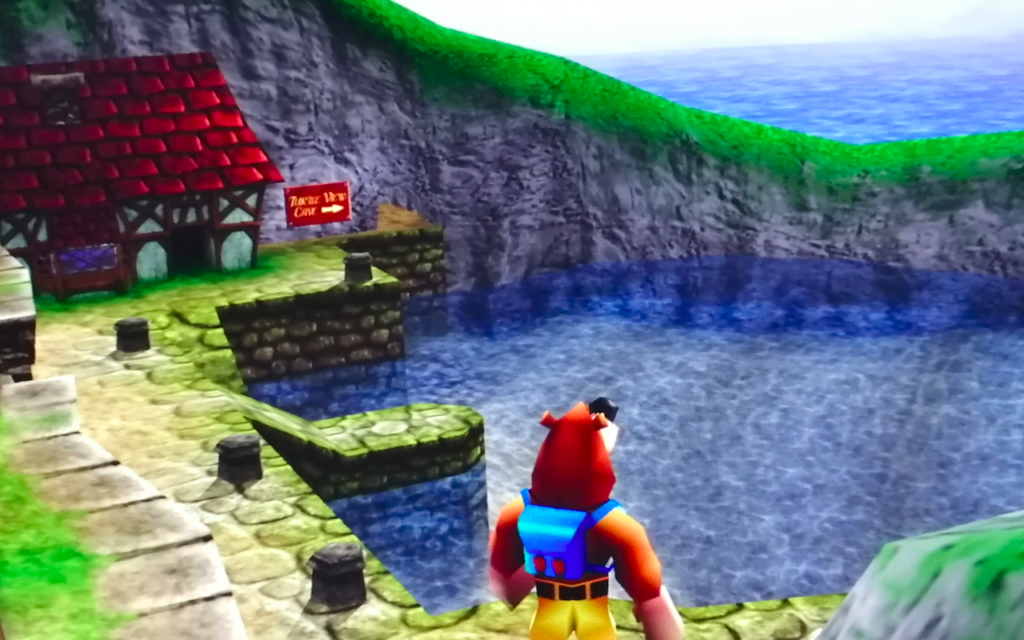
Finally, the developers fulfilled their promise and managed to complete the legendary lost game known as Project Dream…sorta. There is a reason that game was called that since over at Rare some of its lead members always had a thing for pirate adventures, being featured on the 8-bit NES then in Donkey Kong Country 2; the culmination of all this was to be that title known as Project Dream, which was originally planned for the SNES then the N64 before finally morphing for various reasons into what ended up becoming Banjo-Kazooie. Quite a turn of events since only some ideas and music from that almost completed game remain. Jolly Roger’s Lagoon in Banjo-Tooie is the most pure remnant of that dream, using the actual pirate town from that game as the basis of a new world. Even the main villain of that game makes an appearance here; a drunk and washed out pirate lamenting the fact that his game was cancelled. Fortunately, years later the Rare developers actually made their dream come true with the ambitious game Sea of Thieves.
And because the low hanging fruit for level design was already picked in the more traditional singular biomes of Banjo-Kazooie, such as grass, beach, ice, desert, Halloween—yes halloween is a biome—for an ambitious sequel your huge worlds pretty much need to be 2 x 1 and more unexpected in order to make the cut. So Jolly Roger’s Lagoon ends up being a seafaring pirate village for tourist with a secret behind its famous lagoon which will change the tone of the level. The level is named after the famous pirate skull symbol which is nicknamed Jolly Roger and, in-universe, for the proprietary of the local tavern who is clearly a gay frog with a trans partner so don’t complain that the Banjo series does not have representation; at least they tried—although in frog world the female is usually the bulky one so maybe it is a play on that.
But for the cozy town Grant Kirkhope delivers a sweet pirate tune with the usual devices of the style and mostly devoid of his own traditional zany style (except for one section) in favor of a more classic tune and a normal sense of harmony.
Musical Analysis
The instruments are meant to be the ones you would hear aboard a pirate ship for entertainment right after they stole them from the local town. We get the harmonica as accompaniment mimicking the other reed instrument known as the concertina, which is a little accordion, the first use of a recorder which is a simpler flute and some drums and tambourine. The oom-pah rhythms are full of swing, making the track even more..jolly. What sticks out is the harmony which shows that Grant is capable of using minor chords on his major key pieces and using other unique devices for the series like genuine extended chords, making it sound different from the other Banjo tunes.
Section A is the main motif which modulates the same melody through different chords, each repetition sounding higher and more exciting than the last. The chords begin the pattern in C and then shift home base to D, creating groups of I to IV. The last one ends on the iv since we are still in the C Ionian/Major profile. After this we get not the eccentric Kirkhope cadence but a normal IV – V – I. Must feel good to finally being able to write a normal piece.
The harmony for this section thus would be:
C – F – D – G – E – Am – F – G – C
Still lots of major chords but the use of the vi chord will allow the piece to have some earnest bittersweet feel throughout the track. The end phrases of the accompaniment maintain the vaudeville scale run to reach the root note of the chord.
A bittersweet feel that is specially displayed during Section B, perhaps the most straightforward major key melody used in the banjo series; no odd chords found in here, just pure functional harmony so this clearly shows that Kirkhope’s head can function properly. B sections often go to the fourth for variety as the first chord and this is no exception. The harmony is:
F – C – G – C – Am – Em – F – G A
Section repeats.
But normalcy cannot last for long since what is the point of normalcy in Banjo-Kazooie. So the C section goes to the tritone vamp that makes the pieces sound bizarre and comically weird. Still it is a new kind of tritone chord not used before; it is even more abrupt since it is not the Kirkhope cadence [ bII – V – I] neither a vamp involving the tonic but going to the II chord. So it is between D and Ab, sustaining the D. For this part the harmonica might actually be an harmonica or a melodica.
The most special section is the D Section which has new kinds of extended, previously unheard chords and rhythms in the series, sounding pretty much like a sunset with new colors, as if the pirate ship on the Monet painting just departed against it and it is sounding its horns. The sunset section changes the pace by deswinging the piece and introducing the french horns against a bass line that creates the extended jazzy harmony that is seldom heard in the series. The main vamp would be between Eb and Cm; the horn and flute maintain the notes Eb and G as pedal points while the upper notes advance by tones through Bb, C and D creating various chords in inversion. We see colors such as Ebmaj7, Ebmaj7/13, and even the unique Ebmaj7/11 when the bass goes to Ab, making you suspended in the air for a moment. The flutes are desynchronized with the main beat, horns and the trombone, creating some sort of polyrhythm in which they are playing in triplets, the horns in quarter notes and the bass longer notes.
The impressionistic harmony could be something like:
Eb – Cm – Eb – Cm –
Ebmaj7 – Cmadd9 – Ebmaj7 – Cm7
Eb6 – Cm – Eb6 – Cm7
Ebmaj7/11 – Cm (b13) – Ebmaj7 – Cm7 – E
Closer to the spirit of the Mario series or one of those Russian ballets since the Nutcracker march has a similar idea. Grant clearly wanted to do something different for this part.
As you can deduce, the piece has been modulating to higher tones, staring in C then D then Eb. This means that for the last section which is a reprise of the main A Section with new countermelodies it goes to the E profile.
The last part is the C Section in its original key of D played with the quirky sax that Grant was not able to resist putting in. It abruptly goes back to the C key to prepare the loop via the Kirkhope cadence.
A pirate adventure with the Banjo-Kazooie touch. Finally the series went back to its roots.

Help to keep the rites going around here by supporting the shrine:

Media Files, requests and support for more interactive content

Thou shall donate since this is a cult and you are now a sheep

Help staying awake analyzing game tracks and writing posts or else everything will end up being written by A.I
- Inside The Score – The Legend of Zeda: A Link to the Past – End Credits / Staff Roll
 The land rests As the last few minutes of this extensive journey that has now come to an end fly by, the nostalgia and reflective mood kicks in. Because such a massive enterprise as a Zelda game or a Lord of the Rings movie require multiple endings to convey everything… Read More »Inside The Score – The Legend of Zeda: A Link to the Past – End Credits / Staff Roll
 - Inside The Score – The Legend of Zelda: A Link to the Past – Ending / Epilogue ~ Beautiful HyruleFinal of the fantasy The Triforce has been touched. A wish has been granted. For the occasion, the newly undeceased king of Hyrule has commissioned a march in honor of the legendary hero to the Hylian Sousa, who might as well be composer Nobuo Uematsu since this piece is very… Read More »Inside The Score – The Legend of Zelda: A Link to the Past – Ending / Epilogue ~ Beautiful Hyrule
- Inside The Score – The Legend of Zelda: A Link to the Past – Triforce Chamber / Power of the GodsTake your boots off your feet And thus the Triforce spoke to men. And it became present in history. And you better treasure and contemplate this moment seldom witnessed in the course of the series. The elusive opportunity to interact and touch the most important artifact. You are now in… Read More »Inside The Score – The Legend of Zelda: A Link to the Past – Triforce Chamber / Power of the Gods
- Inside The Score – The Legend of Zelda: A Link to the Past – Ganon Battle / Prince of DarknessProgressive evil En Garde! And you better be prepared since you are about to duel the iconic enemy of the series at perhaps his canonically most powerful incarnation. Right after having touched the sacred Triforce which allowed him to conquer all of the Golden Land and whose evil and darkness… Read More »Inside The Score – The Legend of Zelda: A Link to the Past – Ganon Battle / Prince of Darkness
- Inside The Score – The Legend of Zelda: A Link to the Past – Boss Battle / Anger of the GuardiansQuick mayhem Ah, the simpler times when boss battles where not a multi epic orchestral suite but just an ostinato more basic that even what became the music for standard battle encounters out there. We are a long way from each boss having his own personalized track. And this early… Read More »Inside The Score – The Legend of Zelda: A Link to the Past – Boss Battle / Anger of the Guardians
- Inside The Score – The Legend of Zelda: A Link to the Past – Dark World Dungeon / Dungeon of ShadowsMemento mori We are getting closer to Ganondorf (or at least the wizard Agahnim who ultimately fulfills the same human side of evil role in this game) and that means getting closer to the profiles and motifs of his own theme song (which naturally was the theme of Agahnim at… Read More »Inside The Score – The Legend of Zelda: A Link to the Past – Dark World Dungeon / Dungeon of Shadows