Mystic mist
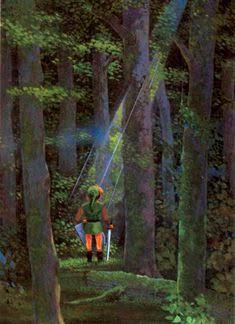
The last of the big three medieval fantasy inspired games on the SNES is of course The Legend of Zelda. And even though it is classified as an action-adventure game it still has a huge debt to the RPG genre. At the end of the day you go and explore towns, fields, dungeons and of course enchanted forests. You just don’t kill the enemies and bosses with a menu.
The iconic woods present from the very first Zelda whose common thread is their labyrinthine layout, where you may or may not need to solve a puzzle in order to not get lost, receive their own cue for the first time. The original Lost Woods theme that was superseded by Saria’s Song for most of the series. They still share some DNA as this one was the parent cue even if the famous one conveyed the quirky troupe of forest children musicians playing with their instruments and this one the pure mystery as if the fog of the woods took on sonic form.
Of course this trope of possibly getting lost in a forest didn’t begin with Zelda since it is a common occurrence in real life and thus legends and stories about the kind of cursed and supernatural situations that can occur in unknown nature arise naturally; as they say, you can’t grow two trees next to each other without some wizard or demon coming along and enchanting them. The version of A Link to the Past is just a labyrinth full of bandits, the only magic involved concerns the strange mist used to protect the sacred Master Sword which debuted here imitating Excalibur. And the sacred groove is a common place where the sword is located in the games. However this one is particular in that it has lots of counterfeit legendary swords. Since there is no Navi here the text that appears when you pick one up is presumably one of the first instances in which the silent protagonist speaks. This forest also introduced the tunnels made of huge tree trunks found all across the series.
Musical Analysis
The primitive sound of the Super Nintendo strings, which somehow capture the thick foggy ambience, are deployed in similar fashion to the opening of the game. They are played in a staccato way as if an echo is pouring through the forest. They are heard in an unsymmetrical way that adds realism to the performance due to the note lengths between voices not being equal. Like on Saria’s Song there is some tension created due to the tritone interval of the F and B notes even though the supposedly happy C Ionian/Major is the parent profile. However this one even has the more mystifying and ambiguous modal mixture between the C Ionian/Major and C Aeolina/Minor by using the Ab and Bb notes. Resulting in the feeling of an Aeolian Dominant profile which has that hybrid major/minor sound because of the major tetrachord as the head and the Phrygian tetrachord as the tail. Not having a proper key being the obvious choice for a place where ambiguity is the name of the game.
This one is also the roots of the Forest Temple theme from Ocarina of Time which also opened with a harmony progression based around E to F; so the composer certainly favors this progression for his forests ambiences. This Forest of Mystery as the track is officially called opens with an E to F(b5) sound that immediately sounds uncanny thanks to that aforementioned tension caused by F and B which formed the basis for Saria’s Song. The original cue is also so much shorter in comparison but in its short run it also manages to encapsulate everything about the environment.
After this quick intro where the flutes just played a little major second interval decoration based around the B note, we are treated with a simple descending melody with just the white keys of the piano; it opens with the interval of B to F, the emphasis on the B note a curious choice for a piece supposedly based around C since it is its major seventh interval. The harmony progression then gets lost by following the circle of fifths counter-clock wise traveling through G – C – F – Bb. We then reach the strangest sounding Mario cadence ever by finishing with Abmaj7 – Bb and ending on C. Is it really the tonic? Sure, you can say that. But the ambiguity is mostly created with the loop going back and starting with that bizarre E major chord, the same chord that ends Saria’s Song; those Zelda forests really need that E to F movement. The other uncanny thing about it is the melody by itself sounding so happy by just traversing the standard Ionian profile while the accompaniment employs the Ab and Bb notes.
A piece as enchanted as the forest and where no children of the forest or cute Kodama spirits live. Just the good ol’ site where the fairy folk can potentially trick you and with enough menace to be more frightening; like the Forest Temple it is the definition of eerie calmness. You may truly never escape from here until the non-diegetic track makes you as mad as the thieves here.

Help to keep the rites going around here by supporting the shrine:

Media Files, requests and support for more interactive content

Thou shall donate since this is a cult and you are now a sheep

Help staying awake analyzing game tracks and writing posts or else everything will end up being written by A.I
- Inside The Score – The Legend of Zeda: A Link to the Past – End Credits / Staff Roll
 The land rests As the last few minutes of this extensive journey that has now come to an end fly by, the nostalgia and reflective mood kicks in. Because such a massive enterprise as a Zelda game or a Lord of the Rings movie require multiple endings to convey everything… Read More »Inside The Score – The Legend of Zeda: A Link to the Past – End Credits / Staff Roll
 - Inside The Score – The Legend of Zelda: A Link to the Past – Ending / Epilogue ~ Beautiful HyruleFinal of the fantasy The Triforce has been touched. A wish has been granted. For the occasion, the newly undeceased king of Hyrule has commissioned a march in honor of the legendary hero to the Hylian Sousa, who might as well be composer Nobuo Uematsu since this piece is very… Read More »Inside The Score – The Legend of Zelda: A Link to the Past – Ending / Epilogue ~ Beautiful Hyrule
- Inside The Score – The Legend of Zelda: A Link to the Past – Triforce Chamber / Power of the GodsTake your boots off your feet And thus the Triforce spoke to men. And it became present in history. And you better treasure and contemplate this moment seldom witnessed in the course of the series. The elusive opportunity to interact and touch the most important artifact. You are now in… Read More »Inside The Score – The Legend of Zelda: A Link to the Past – Triforce Chamber / Power of the Gods
- Inside The Score – The Legend of Zelda: A Link to the Past – Ganon Battle / Prince of DarknessProgressive evil En Garde! And you better be prepared since you are about to duel the iconic enemy of the series at perhaps his canonically most powerful incarnation. Right after having touched the sacred Triforce which allowed him to conquer all of the Golden Land and whose evil and darkness… Read More »Inside The Score – The Legend of Zelda: A Link to the Past – Ganon Battle / Prince of Darkness
- Inside The Score – The Legend of Zelda: A Link to the Past – Boss Battle / Anger of the GuardiansQuick mayhem Ah, the simpler times when boss battles where not a multi epic orchestral suite but just an ostinato more basic that even what became the music for standard battle encounters out there. We are a long way from each boss having his own personalized track. And this early… Read More »Inside The Score – The Legend of Zelda: A Link to the Past – Boss Battle / Anger of the Guardians
- Inside The Score – The Legend of Zelda: A Link to the Past – Dark World Dungeon / Dungeon of ShadowsMemento mori We are getting closer to Ganondorf (or at least the wizard Agahnim who ultimately fulfills the same human side of evil role in this game) and that means getting closer to the profiles and motifs of his own theme song (which naturally was the theme of Agahnim at… Read More »Inside The Score – The Legend of Zelda: A Link to the Past – Dark World Dungeon / Dungeon of Shadows