Holy organum
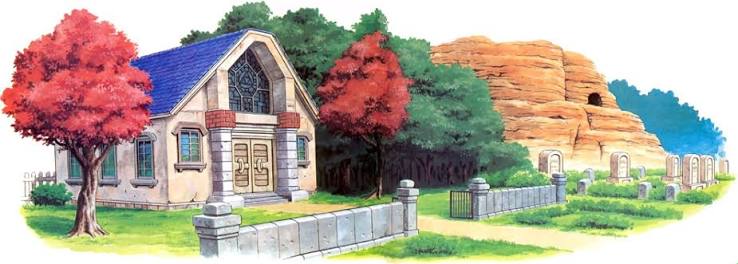
Just like Saria’s Song had its older Lost Woods counterpart, A Link to the Past also had its own original church with its own short and almost forgotten cue that is only revived for the direct sequels right on this so called downfall timeline. And just like Lost Woods, it is a memorable track that you probably never hear again after clearing the site since this one is only meant to be heard on very specific occasions, with little incentive for the player to come here.
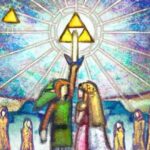
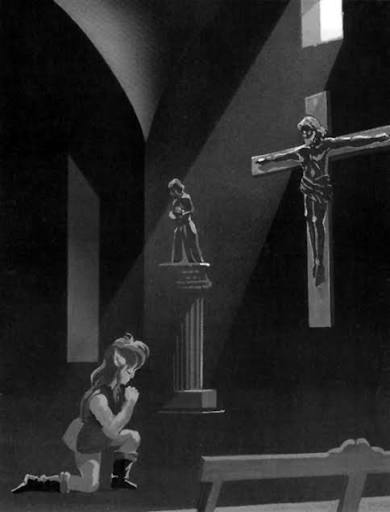
The counterpart to the Temple of Time, back when the series had even stronger ties to classic medieval European traits such as Christianity being the major religion of the land (even though the design of the Temple of Time is way more Roman Catholic than this humble chapel meant to be also a decoy and a secret passage for royalty to escape). At least this one has seats, true stained glass and a priest present, who by the way was changed for the English localization to just a loyal wise man alongside the church being named now just as a sanctuary. At least our boy Link still does the sign of the cross when praying with the Book of Mudora at the altar when this theme returns for the moment, signaling that this theme is the spiritual quota for the game; this is the true celestial choir. There is also some cool official artwork of Link kneeling before a blatant crucifix so the series in its early days certainly leaned toward its medieval influences as seen with the templar shield carried by the knight Link alongside his Bible and cross. Only the manual which was pretty much an afterthought was the one which started to introduce its own lore about three golden goddesses creators of the world, getting the series closer to high fantasy with its own creation story. The discrepancy can still be seen in-game where the Triforce is meant to be an omniscient, omnipotent being capable of speech; to the the developers there weren’t goddesses yet.
Here the Princess of Hyrule pleads for sanctuary and receives asylum for the early part of the game hence the official name of the cue ‘Safety in the Sanctuary’. Based around the concept of protection by ecclesiastical immunity which is the original meaning of the word sanctuary, the sacred places, such as a church, where locations in which fugitives were immune to arrest. While the practice of churches offering sanctuary is still observed in the modern era, it no longer has any legal effect and is respected solely for the sake of tradition. The fact that Ganon minions dare to desecrate this holy place shows how much of a dark lord he is. The bishop sacrifices himself for the princess like a chess piece would, making him one of the first and few human sacrifices in the series; there is actually lots of human sacrifices here.
Musical Analysis
It seems the sacred music of medieval Hyrule has also advanced in a similar fashion to our own history, since at the Temple of Time, which is earlier in the chronology, we had some monks doing monophonic plainchant and after some centuries now the clergyman are experimenting with polyphony thanks to the miracle of music notation which allowed some monks and nuns the pleasure of improvising voices over the written melody that guided them, developing what is known as the organum, a plainchant melody with added voices that began to be used in later stages of the middle ages; over time, composers began to write added parts that were not just improvisations, thus creating true polyphony.
Here we got the low voices, the vox principalis and the the vox organalis or more simply we can hear two independent melodies alongside the bass line. Is this truly meant to be a choir? Or is this supposed to be played by an actual organ instrument? If we take the remake of the track found in A Link Between Worlds to be the definitive intention then it means both are valid since that track has mixed choirs and pipe organ. But the composer here certainly found the definition of ethereal choir, an otherworldly angelic choir whose synthetic sound is used for all voices, giving this choir an unique sound for the Super Nintendo even though the system is certainly capable of reproducing more realistic choir samples like those of Metroid; so it was certainly a design choice to pick these sounds that belong to celestial beings rather than human larynges. The sound alone gives the cue a sort of eerie vibe combined with sacredness and sadness with just a few notes, as if the spirits themselves are lamenting something.
Like the forest cue this one mixes profiles from a scale based around C Minor to make it sound way more ambiguous than if it just limited itself to the standard major/minor. With Zelda it is almost never about the normal keys. This one is like the counterpart to that woods theme in the way that this one uses the minor tetrachord as the head and then goes on to use notes from the major tetrachord of the C scale making it close to a C Melodic Minor sound. And just like the forest cue it also puts some black key notes on its bass line; here the low voice, not sounding anymore like a voice, does a chromatic descent that darkens the melodies played by the high voices that are doing more standard arpeggiated chords.
The composition also opens with that Phrygian Major sounding vamp that uses two major chords separated by just a semitone. Lots of iconic Zelda music moments are based around going back and forth between two chords. Here we get Ab to G ending on the dominant G7 to begin the melody right on Cm.
From there it was supposed to be plain sailing but the low voices decide that they want to do a descending chromatic scale from C to its tritone note Gb, the literal voice leading coloring what would otherwise be just the Cm to G vamp and then back to the Ab to G one. From that chromaticism we get some extended harmony so the progression would be something like:
Cm – G – Cm7 – G/A
Abmaj7 – G – Abmaj7 – G
Cdim7 – G7
The last two chords surprise the pattern by going even lower to that tritone note Gb that gives us that sinister diminished chord and then staying for full bars in contrast to the previous chords. This cadence prepares the loop.
From the third chord on we also get the third independent voice sounding practicing its church rhythmic modes first at a low register with just a semitone figure and then transitioning to a higher voice, so this thing is probably meant to have two nun voices and two monk voices. Since this is no parallel motion then it seems to be polyphony from high middle ages, referred as the Are antiqua period.
Like on the Temple of Time cue we get the huge reverb of the cathedral by just putting delayed notes mimicking the melody.
Just like the best tracks of Zelda this theme carries some ambiguity to it sounding both sacred and haunted via note choices and sound design that seems like an hybrid between the human voice and the theremin, all with just a minuscule amount of time. As we will see, the royal family and even mini-games receive similar ambiguous treatment.

Help to keep the rites going around here by supporting the shrine:

Media Files, requests and support for more interactive content

Thou shall donate since this is a cult and you are now a sheep

Help staying awake analyzing game tracks and writing posts or else everything will end up being written by A.I
- Inside The Score – The Legend of Zeda: A Link to the Past – End Credits / Staff Roll
 The land rests As the last few minutes of this extensive journey that has now come to an end fly by, the nostalgia and reflective mood kicks in. Because such a massive enterprise as a Zelda game or a Lord of the Rings movie require multiple endings to convey everything… Read More »Inside The Score – The Legend of Zeda: A Link to the Past – End Credits / Staff Roll
 - Inside The Score – The Legend of Zelda: A Link to the Past – Ending / Epilogue ~ Beautiful HyruleFinal of the fantasy The Triforce has been touched. A wish has been granted. For the occasion, the newly undeceased king of Hyrule has commissioned a march in honor of the legendary hero to the Hylian Sousa, who might as well be composer Nobuo Uematsu since this piece is very… Read More »Inside The Score – The Legend of Zelda: A Link to the Past – Ending / Epilogue ~ Beautiful Hyrule
- Inside The Score – The Legend of Zelda: A Link to the Past – Triforce Chamber / Power of the GodsTake your boots off your feet And thus the Triforce spoke to men. And it became present in history. And you better treasure and contemplate this moment seldom witnessed in the course of the series. The elusive opportunity to interact and touch the most important artifact. You are now in… Read More »Inside The Score – The Legend of Zelda: A Link to the Past – Triforce Chamber / Power of the Gods
- Inside The Score – The Legend of Zelda: A Link to the Past – Ganon Battle / Prince of DarknessProgressive evil En Garde! And you better be prepared since you are about to duel the iconic enemy of the series at perhaps his canonically most powerful incarnation. Right after having touched the sacred Triforce which allowed him to conquer all of the Golden Land and whose evil and darkness… Read More »Inside The Score – The Legend of Zelda: A Link to the Past – Ganon Battle / Prince of Darkness
- Inside The Score – The Legend of Zelda: A Link to the Past – Boss Battle / Anger of the GuardiansQuick mayhem Ah, the simpler times when boss battles where not a multi epic orchestral suite but just an ostinato more basic that even what became the music for standard battle encounters out there. We are a long way from each boss having his own personalized track. And this early… Read More »Inside The Score – The Legend of Zelda: A Link to the Past – Boss Battle / Anger of the Guardians
- Inside The Score – The Legend of Zelda: A Link to the Past – Dark World Dungeon / Dungeon of ShadowsMemento mori We are getting closer to Ganondorf (or at least the wizard Agahnim who ultimately fulfills the same human side of evil role in this game) and that means getting closer to the profiles and motifs of his own theme song (which naturally was the theme of Agahnim at… Read More »Inside The Score – The Legend of Zelda: A Link to the Past – Dark World Dungeon / Dungeon of Shadows