Kooky saloon
Of course you can make a theme that is both catchy and dissonant or memorable and ugly. And by bringing back that ambiguity present in many tracks of the soundtrack even the innocent seeming mini-games carry that little shade cast upon them.
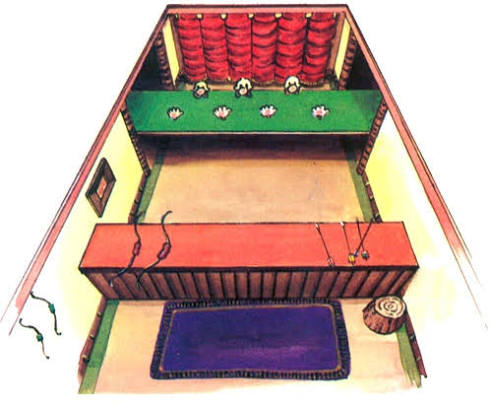
A smaller and simple game within a game; gaming inception. Saving Hyrule can wait while Link tries to get some kind of prize or at least some amusement. They have been a staple for making money since the very first game which had a single luck based gambling game in some hidden tree (as always, the black sheep of the series, Zelda II, wanted to be so different that it was the only one that ditched mini games altogether). Here we pretty much got more elaborate gambling games, now that the Super Nintendo allows the technology of actually having things be inside treasure chests as opposed to items just being in the open—there are no more chests in the future of Hyrule belonging to the decline era apparently—which is pretty much the new version of that proto mini-game from the original; another luck based game with the shovel and the first ever skill based game in the debuting shooting gallery that will be a staple from now on in the series—sadly not the guy hitting the drums whenever you succeed—Most of the mini-games are optional.
Musical Analysis
Just like the mini-game music from Ocarina of Time has some ties to way more modern carnivals, circus and fairs this one seems to get most of its influence from saloons and bars where gambling or other skill based activities such as darts take place; anything where you can get a quick buck. And back in those days or in Western films you had the pianist sitting at the tack upright piano with some detuned strings due to bad maintenance and prolonged use which progressively debilitates the tension on some strings making the notes sound funny, playing frantic pieces with quick left hand movements known as the stride style for accompaniment trying to imitate oom-pah rhythms without a bassist while the gambling inevitably devolved into a bar fight. Based on the official name of the piece, it was specifically composed for the treasure chest guessing game, the OG mini-game of the series.
Some of that energy is here and also, like in Ocarina of Time ,there is some reliance on functional fast tempo to match the fact that there might be a time component and a stress component to the games, communicating that you need to think and act fast. It also relies on that Mixolydian feel but as usual this one is more ambiguous due to mixing this profile with some dizzying whole tone scales that confuse you and tell you that you don’t know what you will get.
The cue opens with monolithic fifth chords based on that Mixolydian movement of the I to bVII, the equivalent to the clock start intro of the Ocarina of Time main mini game theme. This one is Ab to Gb. Then you get the frantic left handed oom-pah rhythms while the melodies play in the different triplet fashion. The composer could have perfectly still maintained that I to bVII and the low bass notes points to that but by leaving the second note of the chord untouched as a pedal the second chord ends with a major sixth interval, making the progression slightly less playful, a I to v; still Mixolydian but darker. So Ab to Ebm. During this part the F note of the melody stays as a pedal note.
But then the Whole Tone profile begins to pop its confused head out, the vamp being transposed now to E and the triplet based melody taking on this more dissonant scale that emphasizes the tritone. The vamp remains the same but transposed, so E to Bm. The idea is to make it more bluesier so the feeling is closer to E7 to D7; yet, again that strange major sixth interval creates some dissonances, specially with the melody notes which go at a different pace than the oom-pah accompaniment. As in, sometimes we get the notes B, C and D sounded at the same time. An appropriately confusing piece all around. The game wants you to miss.
The Section 2 returns to the monolithic fifth chords now with the expected I to bVII but with a strange rhythm where the second phrase begins on the upbeat before each bar. The melodies now unambiguously emphasize the whole Tone profile. Once again the phrases are transposed to E.
With this mix of Whole Tone profiles on the melody with Mixolydian ones on the accompaniment this short composition piece ends up surprisingly sounding very jazzy and sophisticated. Still, at the end of the day, its rhythmic displacements, frantic pace and strange intervals are meant to stress you out and confuse but also convey the bounciness and playfulness of a mini-game sequence. It ends up as an addictive yet strange cue.
Any other insights about this music? Share in the comments.

Help to keep the rites going around here by supporting the shrine:

Media Files, requests and support for more interactive content

Thou shall donate since this is a cult and you are now a sheep

Help staying awake analyzing game tracks and writing posts or else everything will end up being written by A.I
- Inside The Score – The Legend of Zeda: A Link to the Past – End Credits / Staff Roll
 The land rests As the last few minutes of this extensive journey that has now come to an end fly by, the nostalgia and reflective mood kicks in. Because such a massive enterprise as a Zelda game or a Lord of the Rings movie require multiple endings to convey everything… Read More »Inside The Score – The Legend of Zeda: A Link to the Past – End Credits / Staff Roll
 - Inside The Score – The Legend of Zelda: A Link to the Past – Ending / Epilogue ~ Beautiful HyruleFinal of the fantasy The Triforce has been touched. A wish has been granted. For the occasion, the newly undeceased king of Hyrule has commissioned a march in honor of the legendary hero to the Hylian Sousa, who might as well be composer Nobuo Uematsu since this piece is very… Read More »Inside The Score – The Legend of Zelda: A Link to the Past – Ending / Epilogue ~ Beautiful Hyrule
- Inside The Score – The Legend of Zelda: A Link to the Past – Triforce Chamber / Power of the GodsTake your boots off your feet And thus the Triforce spoke to men. And it became present in history. And you better treasure and contemplate this moment seldom witnessed in the course of the series. The elusive opportunity to interact and touch the most important artifact. You are now in… Read More »Inside The Score – The Legend of Zelda: A Link to the Past – Triforce Chamber / Power of the Gods
- Inside The Score – The Legend of Zelda: A Link to the Past – Ganon Battle / Prince of DarknessProgressive evil En Garde! And you better be prepared since you are about to duel the iconic enemy of the series at perhaps his canonically most powerful incarnation. Right after having touched the sacred Triforce which allowed him to conquer all of the Golden Land and whose evil and darkness… Read More »Inside The Score – The Legend of Zelda: A Link to the Past – Ganon Battle / Prince of Darkness
- Inside The Score – The Legend of Zelda: A Link to the Past – Boss Battle / Anger of the GuardiansQuick mayhem Ah, the simpler times when boss battles where not a multi epic orchestral suite but just an ostinato more basic that even what became the music for standard battle encounters out there. We are a long way from each boss having his own personalized track. And this early… Read More »Inside The Score – The Legend of Zelda: A Link to the Past – Boss Battle / Anger of the Guardians
- Inside The Score – The Legend of Zelda: A Link to the Past – Dark World Dungeon / Dungeon of ShadowsMemento mori We are getting closer to Ganondorf (or at least the wizard Agahnim who ultimately fulfills the same human side of evil role in this game) and that means getting closer to the profiles and motifs of his own theme song (which naturally was the theme of Agahnim at… Read More »Inside The Score – The Legend of Zelda: A Link to the Past – Dark World Dungeon / Dungeon of Shadows