Overt fairy tale
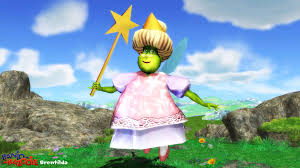
The most difficult decision Grant Kirkhope had when it came to musicalizing this unambiguously good natured fairy godmother was a matter of choosing between the harp or the celesta (same goes for glockenspiel) for the main instrument of the piece as per the natural law of visual storytelling. There are simply no other options allowed.
As the fable of the bear and the bird progresses against the evil witch of the west, it was inevitable that they would find their own helper along the way; unexpectedly, it turns out that their godmother is none other than Grunty’s own sister, Brentilda, who among the Winkybunion siblings is the only one on the path of good, justice and actually talking like a normal person. She is the unabashed embodiment of the fairy godmother trope, one of the latest developments in the conceptualization of the fair folk. Every time the duo find Brentilda she heals and tells them three disgusting yet helpful facts about her sister Gruntilda, ranging from the name of her old boyfriend to her favorite color. Maybe acquiring intel about the enemy will serve the protagonists well when it comes to the final confrontation, ranging from weak spots, to their opponent’s psyche or even a trivia show, the usual stuff for war times.
Modern society has lived with the Disneyfied version of fairies for so long – the Fairy Godmothers of Cinderella and Sleeping Beauty, Tinker Bell in Peter Pan – that it seems hard to imagine that fairies were considered dangerous or mischievous for weary travelers. In contrast, the benevolent fairy godmother is a rather modern development, a fairy with magical powers who acts as a mentor or parent to someone, in the role that an actual godparent was expected to play in many societies; sometimes this character is a subset of the concept of the donor in fairy tales, a character who tests the hero and provides magical assistance. Actual fairy godmothers were rare in fairy tales but nowadays they are what many laymen think of as just a fairy. Brentilda checks all of the boxes that this trope has gained throughout history like insect wings, grandma look and a cute magic wand. Her wardrobe draws heavy inspiration from Glinda the Good Witch of the North from The Wonderful Wizard of Oz and its adaptions, while Gruntilda appears to take features from the Wicked Witch of the West.
Musical Analysis
Structure: Section 0 / {AB}
Tempo: 120 (Section 0); 115
Melodic and Harmonic Profiles: C Pentatonic major; C Lydian; C Ionian/Major; F Ionian/Major
For the music Grant wanted to highlight and enhance the grandmotherly aspects of this character, so it was a matter of finding music that sounded old school enough and then perform it with magic-sounding instruments that can automatically conjure fairies. The harp—normally used for underwater arrangements of the tracks— is used as a sound effect for when she appears to the player, doing a quick strum of a major pentatonic scale that has that endearing feel. The style chosen was the one heard in music halls all over Britain, the analogous to Vaudeville in America. The melody and harmony of the tune is actually straight from the similarly inspired track ‘When I’m 64’ from The Beatles, which John Lennon himself claims is granny music from his bandmate Paul McCartney.
Since the instrumentation is sparse and the centerpiece is the celeste the piece still retains some magic like and ethereal qualities. And even though the first part of the composition follows the template of The Beatles tune, there are some characteristic Grant Kirkhope harmonic sensibilities sprinkled in.
It begins with the whimsy of the Lydian mode and both the celesta and the trombone playing descending walking lines at the end of phrases (Sometimes the trombone ends with ascending lines in contrast with the celesta). The Lydian mode is easily established when focusing on a II chord of a key, in this case, the D major. The celesta is pretty much fitting two roles in the performance that expertly sounds cohesively as one; there is the melody on the top notes and a quarter note arpeggiated accompaniment on the lower notes—the game code has the tempo as being 115 because it was perhaps easier to input the notes that way but the piece can still be felt at half that tempo— This interplay sometimes causes some of the notes of the accompaniment to function as melody notes by filling spaces left by the upper notes (They also salvage the melody of being a note by note rip-off of the motif from ‘When I’m 64’). The melody maintains for the most part that single motif profile transposed to different starting points. The length of the phrases also follows the structure from the fab four song.
The first part of the tune has the chords C – D – G7 – C – D – G7. Then it begins to repeat the first phrase of the period but goes to a coda marked by new chords changing rapidly. So the following phrase goes: C – D – F – Fm6 – C – Ab7 – Db – G – C. The logic of having chosen this particular harmony to end the section is decoded in the notes played by the clarinet; a standard ending of the style is that chromatic walkdown that can be seen in the upper notes played by the clarinet beginning on the F chord. The notes go: A G# G F# F. Most normal composers in music hall would use a D chord to capture that last F note; however, Kirkhope being Kirkhope, he prefers the more unconventional sounding Ab7 chord as opposed to D.
Chord Progression for the coda made by a sane composer: F – Fm6 – C – D – F – G – C
Chord Progression for the coda made by Grant Kirkhope: F – Fm6 – C – Ab7 – Db – G – C
Section B does not contrast as much thanks to it essentially having the same instrumentation and rhythmic accompaniment; so the task of creating variety resides completely on the shoulders of the melody and harmony. Going to the IV is, as usual, the perfect foil to differentiate Section B from the A section; so the song goes to F. The use of the back and forth between F and Db creates a sort of small key change, the music gravitating more around an F tonality for that part; it all comes down to Grant wanting to deploy his second most often used characteristic chord change, the I to bVI (what is sometimes considered a borrowed chord from the parallel minor).
On this section, the answers to the question motif are differentiated unlike in the A section where they consists of transposing the question. For the definitive coda, it goes back to the C tonality and ends with the same harmony from the first section. So the full harmony for the B section ends up being: F – Db – F – Db – G7 – C – D – G7. Then the cue loops.
Rare might not have ended creating its pirate adventure with Project Dream (only many years later would creator Gregg Mayles fulfill his dream of creating a game completely based around the golden age of sea pirates). However, the standard beach level framework of many games still give the bear and the bird an opportunity to experience what could have been.

Help to keep the rites going around here by supporting the shrine:

Media Files, requests and support for more interactive content

Thou shall donate since this is a cult and you are now a sheep

Help staying awake analyzing game tracks and writing posts or else everything will end up being written by A.I
- Inside The Score – The Legend of Zeda: A Link to the Past – End Credits / Staff Roll
 The land rests As the last few minutes of this extensive journey that has now come to an end fly by, the nostalgia and reflective mood kicks in. Because such a massive enterprise as a Zelda game or a Lord of the Rings movie require multiple endings to convey everything… Read More »Inside The Score – The Legend of Zeda: A Link to the Past – End Credits / Staff Roll
 - Inside The Score – The Legend of Zelda: A Link to the Past – Ending / Epilogue ~ Beautiful HyruleFinal of the fantasy The Triforce has been touched. A wish has been granted. For the occasion, the newly undeceased king of Hyrule has commissioned a march in honor of the legendary hero to the Hylian Sousa, who might as well be composer Nobuo Uematsu since this piece is very… Read More »Inside The Score – The Legend of Zelda: A Link to the Past – Ending / Epilogue ~ Beautiful Hyrule
- Inside The Score – The Legend of Zelda: A Link to the Past – Triforce Chamber / Power of the GodsTake your boots off your feet And thus the Triforce spoke to men. And it became present in history. And you better treasure and contemplate this moment seldom witnessed in the course of the series. The elusive opportunity to interact and touch the most important artifact. You are now in… Read More »Inside The Score – The Legend of Zelda: A Link to the Past – Triforce Chamber / Power of the Gods
- Inside The Score – The Legend of Zelda: A Link to the Past – Ganon Battle / Prince of DarknessProgressive evil En Garde! And you better be prepared since you are about to duel the iconic enemy of the series at perhaps his canonically most powerful incarnation. Right after having touched the sacred Triforce which allowed him to conquer all of the Golden Land and whose evil and darkness… Read More »Inside The Score – The Legend of Zelda: A Link to the Past – Ganon Battle / Prince of Darkness
- Inside The Score – The Legend of Zelda: A Link to the Past – Boss Battle / Anger of the GuardiansQuick mayhem Ah, the simpler times when boss battles where not a multi epic orchestral suite but just an ostinato more basic that even what became the music for standard battle encounters out there. We are a long way from each boss having his own personalized track. And this early… Read More »Inside The Score – The Legend of Zelda: A Link to the Past – Boss Battle / Anger of the Guardians
- Inside The Score – The Legend of Zelda: A Link to the Past – Dark World Dungeon / Dungeon of ShadowsMemento mori We are getting closer to Ganondorf (or at least the wizard Agahnim who ultimately fulfills the same human side of evil role in this game) and that means getting closer to the profiles and motifs of his own theme song (which naturally was the theme of Agahnim at… Read More »Inside The Score – The Legend of Zelda: A Link to the Past – Dark World Dungeon / Dungeon of Shadows