Mini Jaws
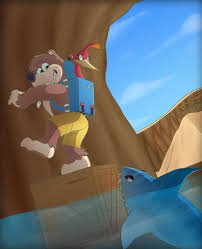
it is a water level, alright. But Rare certainly does not want you to spend too much time exploring the ocean, enter a classic trope with an even more classic music accompaniment that is certainly direct parody and reference. In fact, from a legal standpoint it may have even been risky. No points for guessing what is being referenced here.
Boy, this was certainly a stress inducing moment. Making the ocean full of threatening sharks as unstoppable killing machines waiting for any unlucky swimmer to dip his toes on the water is one of the most effective and easiest ways to increase the tension in a water related situation; it can be one or many sharks, the classic image of their fins slowly surrounding the swimmer and no escape in sigh. Most animals eat to live, but sharks live to eat. That is, mostly in fiction, since in real life they are low in the scale of marine dangers—or animal related injuries in general; despite their rarity, many people fear shark attacks after occasional serial attacks, mostly because they are actually very effective when they decide to strike and because they look the part with those scary teeth all lined up and sharp. It is also true that they can sense blood and your bioelectricity, making them an always present threat for anyone delving into the ocean.
The shark related musical themes invariably play with this sense of imminent danger and no score was more effective or left such an indelible mark as that from John Williams in the movie Jaws, which was party responsible for putting the fear of sharks right up in the collective imagination. Released in June 1975, Jaws was Hollywood’s first Summer Blockbuster, and a launchpad for the career of its director, Steven Spielberg and his fruitful partnership with composer John Williams. The main “shark” theme, a simple alternating pattern of two notes identified as E and F, became a classic piece of suspense music, synonymous with approaching danger; its effectiveness its in the fact that the speed of the ostinato can be manipulated to aurally convey the proximity or velocity of the danger in question. John Williams says that it was meant to represent the shark as an unstoppable force of mindless and instinctive attacks, grinding away at you, just as a shark would do, instinctual, relentless, unstoppable. (And in Banjo the threat is always present indeed since even if you manage to kill it it will respawn after a short time).
Musical Analysis
Structure: Section 1
Tempo: 120
Melodic and Harmonic Profiles: C Chromatic
The theme has become so commonly used with sharks that by now it is used mostly in comedy and cartoony scenarios, Banjo-Kazooie belonging to that long lineage. Grant Kirkhope uses the minor third to kickstart his cue but the central idea is to mimic the ostinato based around minor seconds with two sets of strings doubling each other. The ostinato itself is more complex than in Jaws due to being composed of a discernible question-answer block. The tempo being 120 marches alongside ticking clocks to create feelings that players need to hurry up and get out of the water quickly. However, unlike Jaws, the theme is not dynamically manipulated to fit the closeness or speed of the shark in relation to Banjo.
There are lots of myths surrounding copyright infringement and plagiarism in music. Some people claim that it depends on the amount of time, notes or bars that you use from other compositions, others say that as long as there are different notes it does not qualify, that the melodies have to be close enough, among others. In truth, the issues are not so clear cut and that is why any claim of such nature has to be pursued in court by a variety of experts. The only thing that can be said is that the amount of notes, time or the closeness of a melody or ostinato is not as important as the context in which it is used; it could be two single notes or an entire phrase, does not matter. What matters is the context that is trying to imitate. And while the cue from Banjo-Kazooie is certainly different from Jaws in musical composition, its context may be close enough to merit legal issues if someone cared enough to pursue a suit. At the end of the day it comes down to a case by case basis and navigating the complexities of what it means to fall within fair work, parody or exception.
Snacker is not the only shark we find. There is also a lonely and decayed cyborg shark who actually serves as the basis of an entire, very original level. But before that, Banjo and Kazooie need to take a detour and return home for some fun with their mentor.
Help to keep the rites going around here by supporting the shrine:

Media Files, requests and support for more interactive content

Thou shall donate since this is a cult and you are now a sheep

Help staying awake analyzing game tracks and writing posts or else everything will end up being written by A.I
- Inside The Score – The Legend of Zeda: A Link to the Past – End Credits / Staff Roll
 The land rests As the last few minutes of this extensive journey that has now come to an end fly by, the nostalgia and reflective mood kicks in. Because such a massive enterprise as a Zelda game or a Lord of the Rings movie require multiple endings to convey everything… Read More »Inside The Score – The Legend of Zeda: A Link to the Past – End Credits / Staff Roll
 - Inside The Score – The Legend of Zelda: A Link to the Past – Ending / Epilogue ~ Beautiful HyruleFinal of the fantasy The Triforce has been touched. A wish has been granted. For the occasion, the newly undeceased king of Hyrule has commissioned a march in honor of the legendary hero to the Hylian Sousa, who might as well be composer Nobuo Uematsu since this piece is very… Read More »Inside The Score – The Legend of Zelda: A Link to the Past – Ending / Epilogue ~ Beautiful Hyrule
- Inside The Score – The Legend of Zelda: A Link to the Past – Triforce Chamber / Power of the GodsTake your boots off your feet And thus the Triforce spoke to men. And it became present in history. And you better treasure and contemplate this moment seldom witnessed in the course of the series. The elusive opportunity to interact and touch the most important artifact. You are now in… Read More »Inside The Score – The Legend of Zelda: A Link to the Past – Triforce Chamber / Power of the Gods
- Inside The Score – The Legend of Zelda: A Link to the Past – Ganon Battle / Prince of DarknessProgressive evil En Garde! And you better be prepared since you are about to duel the iconic enemy of the series at perhaps his canonically most powerful incarnation. Right after having touched the sacred Triforce which allowed him to conquer all of the Golden Land and whose evil and darkness… Read More »Inside The Score – The Legend of Zelda: A Link to the Past – Ganon Battle / Prince of Darkness
- Inside The Score – The Legend of Zelda: A Link to the Past – Boss Battle / Anger of the GuardiansQuick mayhem Ah, the simpler times when boss battles where not a multi epic orchestral suite but just an ostinato more basic that even what became the music for standard battle encounters out there. We are a long way from each boss having his own personalized track. And this early… Read More »Inside The Score – The Legend of Zelda: A Link to the Past – Boss Battle / Anger of the Guardians
- Inside The Score – The Legend of Zelda: A Link to the Past – Dark World Dungeon / Dungeon of ShadowsMemento mori We are getting closer to Ganondorf (or at least the wizard Agahnim who ultimately fulfills the same human side of evil role in this game) and that means getting closer to the profiles and motifs of his own theme song (which naturally was the theme of Agahnim at… Read More »Inside The Score – The Legend of Zelda: A Link to the Past – Dark World Dungeon / Dungeon of Shadows