Dark whimsy
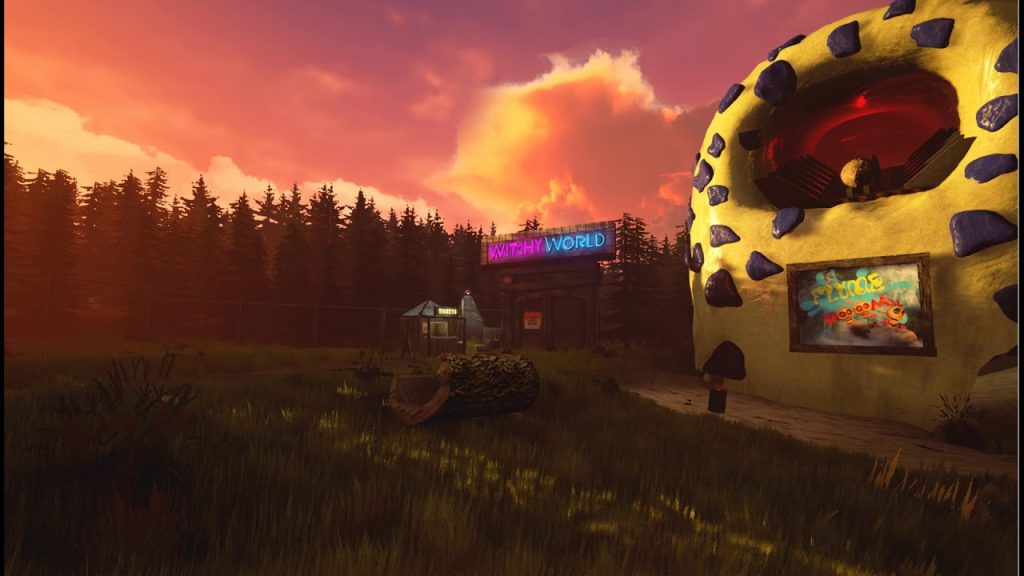
The return to Banjoland is not a pleasant one for the bear and the bird. The tone and atmosphere has shifted, twisted slightly; everything feels more somber, dirtier and larger than life. The game follows the returning protagonists two years later as they attempt to stop the plans of the witch Gruntilda alongside two of her sisters, who intend to vaporize the inhabitants of what turns out to be an island setting. This is not anymore a fairy tale Snow white parody but a world threatening affair. The sequel goes for the bigger, more is more approach; more expansive worlds , more moves, darker and more difficult and, as required, more music. It also has a decidedly more surreal and cynical sense of humor. The witch Gruntilda is now a living pile of bones, Jinjo families go extinct and main characters are seen being killed or converted into living dead.
The music for Banjo-Tooie, composed alongside the games Perfect Dark and Donkey Kong 64, is also decided more ominous; Spiral Mountain is no longer a banjo featured bluegrass tune but an elegy for a world that has been lost. The main hub world is the Isle o’Hags, the grander world from which the entirety of Gruntilda’s castle is but just a small part. The track is the direct successor to the Gruntida’s Lair cue, returning with the skipping through the forest oom-pah rhythm combined with the witchcraft association of the bassoons dating as far back as the piece The Sorceress’ Apprentice and the orchestral bass drum. Yet it sounds decidedly less playful, with composer Grant Kirkhope relying on his disquieting and more mysterious side of his characteristic playfully sinister style. With the mallets gone are also gone their cartoony or childish associations, Isle o’Hags sounding more like an orchestral piece, retaining the playful rhythm but tingeing it with a depressing harmony, melodies and tone; more tenebrous.
Jumpy pizzicatos are replaced by their standard strings counterparts and the comical baritone saxophone is no more here. After all, we are against not one but three witches running a killing machine. The song captures the more somber and dirtier tone of Banjo Too, with a word that is still cartoony yet more decadent and polluted. Pretty much what a normally happy world threatened by destruction would sound like.
Of course we still rely mostly on the C key with all kinds of modal craziness. The tritone progression is back with a vengeance, appearing not even in its major form but the harsher diminished chord; stuff is bleak indeed.
Grant himself feels the music of Banjo-Tooie is more sophisticated, complex and mature. Indeed for the overworld the melody itself is not a question-answer phrase then transposed to a major key as in the original melody of Gruntilda’s Lair but a long form melodic phrase that serves as the basis for various sections, playing and transforming this motif like some classical composers would.
Musical Analysis
The main vamp that opens the hub world is Cm – F#dim, with the less playful strings when compared to the pizzicatos of Gruntilda’s Lair. Then we get to the next favorite chord combination for the composer, the bVI giving us the harmonic progression:
Cm – F#dim
Ab – Ddim
G(5)7
The melody playing within the melodic minor and natural minor profile of C for the head and tail respectively plus its tritone note F# following the harmony progression. The entire phrase is then repeated with the clarinet added on top and a small flourish variation on the melody at the end.
For the B section it changes to play around with a B diminished profile going from Bm to Ab and then to a Dm; yeah, Banjo-Kazooie did not have such a depressing chord progression. Only Grant Kirkhope could get such a catchy tune out of such dissonant intervals and harmony.
B section harmony:
Bm – Ab – Bm – Dm
The melody for the B Section also has the same rhythmic profile as the main melody of Gruntilda’s Lair from Banjo-Kazooie.
But then the shenanigans of going back to a C key in preparation for the A Section reprise take the melody over the the Kirkhope cadence (bII – V – i) which is based around the tritone chord of the dominant or what we could call the secondary tritone of C which would be the zany harmonic language of Grant Kirkhope and his Banjo series based around tritones. So we go to the Db to G7 vamp while the melody plays with the harmonic minor tetrachord of the C key until we finally reach the first note of the A section in smooth fashion.
Since the Banjo series songs are longer than standard N64 fare like Mario 64 we end up in a revamped A section with more accompaniment. This new A section only repeats the melodic phrase once before going into the C section which plays around with the main motif of the the cue, creating a kind of fugue with the strings and the flute melody which is a more distorted tune than the original that uses the natural minor profile as opposed to the melodic minor. The oom-pah rhythms become more playful and the bassoon starts a walking ostinato. Yet the harmony, same as in A Section, is relentlessly sinister, creating this uncanny sound of what a normal cartoony happy world would sound like in its twisted state.
The piece then transposes aggressively the melody one step and a half to what could be now deemed an Eb Lydian profile by way of the Bb major chord. The rate of chord changes also slows down, maintaining a Eb now major chord and then Bm alongside its respective B Aeolian/Minor profile for longer. The same melody has a different flavour due to being now on top of a major chord and it is cut short in order to reach its tail faster, which is a variation of the original tail from A Section.
Then we get one last B section in its original key which connects us back to the beginning. The melody is now played by the strings while the flutes play what was the string accompaniment. As the responsible ones for the low end of the piece, tubas limit themselves to playing the standard muddy-less root plus fifth of chords.
The juxtaposition between playful rhythms and sinister harmony is what makes the Banjo music have this uncanny tone. As Banjo-Tooie was a larger game than its predecessor, Kirkhope had twice the memory space in the game’s cartridge for sound effects and music, allowing him to create even more variations of his dynamic scores. Like the game’s predecessor, the themes heard in the score were designed to be interactive, which dynamically change to reflect the player’s location. His favorite cue for the game was the one for Atlantis, another pretty underwater level.
Help to keep the rites going around here by supporting the shrine:

Media Files, requests and support for more interactive content

Thou shall donate since this is a cult and you are now a sheep

Help staying awake analyzing game tracks and writing posts or else everything will end up being written by A.I
- Inside The Score – The Legend of Zeda: A Link to the Past – End Credits / Staff Roll
 The land rests As the last few minutes of this extensive journey that has now come to an end fly by, the nostalgia and reflective mood kicks in. Because such a massive enterprise as a Zelda game or a Lord of the Rings movie require multiple endings to convey everything… Read More »Inside The Score – The Legend of Zeda: A Link to the Past – End Credits / Staff Roll
 - Inside The Score – The Legend of Zelda: A Link to the Past – Ending / Epilogue ~ Beautiful HyruleFinal of the fantasy The Triforce has been touched. A wish has been granted. For the occasion, the newly undeceased king of Hyrule has commissioned a march in honor of the legendary hero to the Hylian Sousa, who might as well be composer Nobuo Uematsu since this piece is very… Read More »Inside The Score – The Legend of Zelda: A Link to the Past – Ending / Epilogue ~ Beautiful Hyrule
- Inside The Score – The Legend of Zelda: A Link to the Past – Triforce Chamber / Power of the GodsTake your boots off your feet And thus the Triforce spoke to men. And it became present in history. And you better treasure and contemplate this moment seldom witnessed in the course of the series. The elusive opportunity to interact and touch the most important artifact. You are now in… Read More »Inside The Score – The Legend of Zelda: A Link to the Past – Triforce Chamber / Power of the Gods
- Inside The Score – The Legend of Zelda: A Link to the Past – Ganon Battle / Prince of DarknessProgressive evil En Garde! And you better be prepared since you are about to duel the iconic enemy of the series at perhaps his canonically most powerful incarnation. Right after having touched the sacred Triforce which allowed him to conquer all of the Golden Land and whose evil and darkness… Read More »Inside The Score – The Legend of Zelda: A Link to the Past – Ganon Battle / Prince of Darkness
- Inside The Score – The Legend of Zelda: A Link to the Past – Boss Battle / Anger of the GuardiansQuick mayhem Ah, the simpler times when boss battles where not a multi epic orchestral suite but just an ostinato more basic that even what became the music for standard battle encounters out there. We are a long way from each boss having his own personalized track. And this early… Read More »Inside The Score – The Legend of Zelda: A Link to the Past – Boss Battle / Anger of the Guardians
- Inside The Score – The Legend of Zelda: A Link to the Past – Dark World Dungeon / Dungeon of ShadowsMemento mori We are getting closer to Ganondorf (or at least the wizard Agahnim who ultimately fulfills the same human side of evil role in this game) and that means getting closer to the profiles and motifs of his own theme song (which naturally was the theme of Agahnim at… Read More »Inside The Score – The Legend of Zelda: A Link to the Past – Dark World Dungeon / Dungeon of Shadows