Cute dread
Our first encounter with the Dark World, not only in A Link to the Past but in all of Zelda, is not a pleasant affair; nor is it an unpleasant one mind you. Rather it is rather a bizarre moment after you serendipitously step on some portal while exploring Death Mountain and get to know the source from which the ambiguity of A Link to the Past comes from. The corrupted Golden Land from which nobody returns, where the king of evil was sealed a long time ago and slowly his heart modified it.
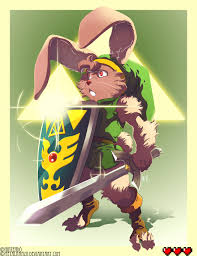
Here the true nature of people is elucidated. Every person who find themselves transforming into strange creatures and forms that reflect what is in their hearts, the greed of those seeking for the gold often transforming them into demons or foxes; we also find some guy turned into a ball, maybe he was a well rounded individual or, as he says, he was very indecisive so it is destined to being kicked around—from his light world counterpart appearance we can speculate that he was actually the first Goron! He even exclaims ‘goro goro’ in the Japanese text—Our hero on the other hand unexpectedly transforms into a pink colored rabbit, same color as his own odd choice for hair—C’mon, we all know this should have been the hair color for Zelda II, but ALttP? Likely this pink hair was a functional design choice to make the sprite stand more against backgrounds such as caverns where blond hair would blend with the environment (as can be elucidated in my awful choice of blonde for the low trumpets). Now this silly pink rabbit, as the fellow companions we encounter calls him, pops out in the storm that is taking place right now in Death Mountain. He is completely helpless against the monsters that inhabit this way more dangerous world.
Why does the heart of the hero reflect the values of a rabbit? We can take The simplest answer given by director Takashi Tezuka, who said that he wanted to create a look that was as striking and different from Link’s regular body as possible and the first thing he thinks of when conjuring images of a dream world is rabbits; so this was actually meant to be a trippy experience, maybe with some influence from Alice in Wonderland. However, this does not answer what could be in Link’s heart. Maybe rabbits reflect a gentle, pure nature since they are just cute and harmless. Likely it is also tied to East Asian folklore and the myth of the moon rabbit, a well known tale in Japan that says a rabbit lives in the moon which will explain why we need to get a Moon Pearl to counter the effects of the Dark World. In Japan the rabbit is seen as virtuous due to the story that he courageously offered his own body to feed a hungry wise man. Touched by the rabbit’s courage, he drew the likeness of the rabbit on the Moon for all to see. The rabbit is believed to be an enlightened Bodhisattva. Huge contrast to the Western world which ,thanks to Playboy, have focused on the lustful nature of rabbits, creatures which reproduce at a high rate (a trend that nevertheless reached Japan).
Anyway, in your desperate attempt to understand what the hell is happening you open the map and discover what is the true massive scope of this game; it seems this world is twice as big. The true adventure is about to begin.
This first short bizarre encounter is accompanied by an equally short, bizarre cue that never comes back. It is heard amidst the rain and thunder, confusing you further and carries with it the ambiguity of the A Link to the Past score. Parallel chords, sus2 sonorities, extended harmony everywhere.
Musical Analysis
The composer decides to use a single brass sample for all registers even though he had access to low brass. Maybe he liked the attack of this sound at the fast speed of the low accompaniment, which is reminiscent of the fast strings that accompanied the previous storm. With brass, however, it all sounds more militaristic, a track that would be closer to the spirit of the Star Fox series—which makes sense since we got anthropomorphic animals there too, Peppy Hare, anyone?—Just check the cue for the Space Armada in the original Star Fox which has a similar melody contour and Dorian inspired profile.
And it is this question-answer contour which produces the main melody of the piece, a chordal melody made strange due to the low note choice which imply all kinds of major and minor seventh chords. The melody question is an ascent though the Dorian head tetrachord: (A B C – G) and then a descending contour through the Dorian tail tetrachord as an answer (F♯ D E – A). So the full phrase would be:
{ [ (A B C – G) – (F♯ D E – A) ] – [ (A B C – G) – (F♯ D E – upper A) ] – [ (A B C – G) – (F♯ D E – A) – Cadence ] }
The cadence introducing the asymmetry that makes this a melody and not just a looping ostinato. The melody is played in the characteristic clave pattern that feels like you are being attacked from above and below; on the onbeat and on then on the offbeat, motif used to great effect all across Zelda II: The Adventure of Link.
However, we cannot say that this is a true A Dorian profile since parallel chords are the name of the game in A Link to the Past and this compositional mindset inevitably leads to notes outside the proper mode since otherwise our reliable foundation made of monolithic perfect fifths would end up using a dissonant tritone interval (meaning here for example we use F natural to harmonize the C note instead of the “correct” F♯). Still from the melody the idea sounds Dorian. As said, the main sonority of the melody is enhanced with parallel perfect fifths and the strangeness is given by the low note which creates major and minor seventh intervals with the upper note.
The accompaniment to the piece can be thought of as a fast change between G5 and D5 or just as an open voiced Gsus2 chord.
The cadence which gives the final off putting touch is none other than what is known as the ‘Mitsuda lick’ since the composer from Chrono Trigger uses it a lot in his tracks and is now a staple of RPG and fantasy games. Nevertheless the earliest example of this melodic figure, which connects a minor third interval via a chromatic scale flourish, is from the original The Legend of Zelda which uses it for the flute motif that transports you to a different place; and you are in a different place indeed. This lick which closes the melody is facilitated by the transposition of the harmony a half step below, so F♯5 to Db5 or F♯sus2.
But wait, there is more strangeness going on. If you pay attention you may notice that the intro of the piece is at a faster tempo than when the brass fanfare melody kicks in. Maybe the composer felt that that is what the ideal pace for the melody is but the accompaniment by itself sounded cooler faster, or maybe it is meant to disorient you and confuse you further in this strange new land that apparently comes from nowhere.
This was the first tease of the parallel world of the adventure, a concept that became a staple of the Zelda series like many other things from A Link to the Past. The notion that the heroic adventure and the kingdom of Hyrule have a sinister face begins here. From the past/future dualism of Ocarina of Time and Oracle of Ages to the small/big dualism of The Minish Cap to the Twilight realm and even the most recent Zelda: Tears of the Kingdom with the Depths mirroring the surface, the two Hyrules for the prices of one all started here.
And if this track represents the confusion and helplessness we find ourselves in the first time. As for the true Dark World theme, our hero has comprehended that this is a destiny that needs to be fulfilled and hence the track becomes now full of hope and determination. Next track is what resilience in the face of evil sounds like.

Help to keep the rites going around here by supporting the shrine:

Media Files, requests and support for more interactive content

Thou shall donate since this is a cult and you are now a sheep

Help staying awake analyzing game tracks and writing posts or else everything will end up being written by A.I
- Inside The Score – The Legend of Zeda: A Link to the Past – End Credits / Staff Roll
 The land rests As the last few minutes of this extensive journey that has now come to an end fly by, the nostalgia and reflective mood kicks in. Because such a massive enterprise as a Zelda game or a Lord of the Rings movie require multiple endings to convey everything… Read More »Inside The Score – The Legend of Zeda: A Link to the Past – End Credits / Staff Roll
 - Inside The Score – The Legend of Zelda: A Link to the Past – Ending / Epilogue ~ Beautiful HyruleFinal of the fantasy The Triforce has been touched. A wish has been granted. For the occasion, the newly undeceased king of Hyrule has commissioned a march in honor of the legendary hero to the Hylian Sousa, who might as well be composer Nobuo Uematsu since this piece is very… Read More »Inside The Score – The Legend of Zelda: A Link to the Past – Ending / Epilogue ~ Beautiful Hyrule
- Inside The Score – The Legend of Zelda: A Link to the Past – Triforce Chamber / Power of the GodsTake your boots off your feet And thus the Triforce spoke to men. And it became present in history. And you better treasure and contemplate this moment seldom witnessed in the course of the series. The elusive opportunity to interact and touch the most important artifact. You are now in… Read More »Inside The Score – The Legend of Zelda: A Link to the Past – Triforce Chamber / Power of the Gods
- Inside The Score – The Legend of Zelda: A Link to the Past – Ganon Battle / Prince of DarknessProgressive evil En Garde! And you better be prepared since you are about to duel the iconic enemy of the series at perhaps his canonically most powerful incarnation. Right after having touched the sacred Triforce which allowed him to conquer all of the Golden Land and whose evil and darkness… Read More »Inside The Score – The Legend of Zelda: A Link to the Past – Ganon Battle / Prince of Darkness
- Inside The Score – The Legend of Zelda: A Link to the Past – Boss Battle / Anger of the GuardiansQuick mayhem Ah, the simpler times when boss battles where not a multi epic orchestral suite but just an ostinato more basic that even what became the music for standard battle encounters out there. We are a long way from each boss having his own personalized track. And this early… Read More »Inside The Score – The Legend of Zelda: A Link to the Past – Boss Battle / Anger of the Guardians
- Inside The Score – The Legend of Zelda: A Link to the Past – Dark World Dungeon / Dungeon of ShadowsMemento mori We are getting closer to Ganondorf (or at least the wizard Agahnim who ultimately fulfills the same human side of evil role in this game) and that means getting closer to the profiles and motifs of his own theme song (which naturally was the theme of Agahnim at… Read More »Inside The Score – The Legend of Zelda: A Link to the Past – Dark World Dungeon / Dungeon of Shadows