A modern town based around time for the Hero of Time
The Termina troupe officially welcomes Link, the Hero of Time, to what will be his new home, his land. The space he has to purify.
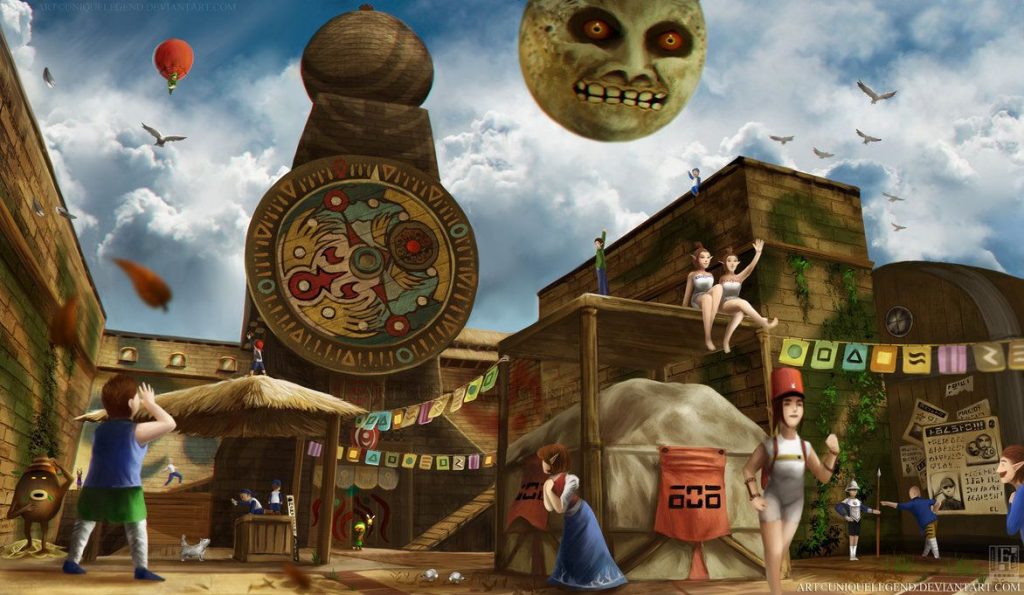
Clock Town is a place that, like the Hero of Time himself, managed to dominate time, aptness which has resulted in unprecedented prosperity and technological progress. it’s no surprise that the place where the Hero of Time is meant to heal and be healed was built around the concept of time and it’s trapped by it. They don’t know it yet but they only have seventy two hours left to solve their problems; Link, on the other hand, can have as much time as he needs. Now he truly claim his title as the Hero of Time.
In order to do so, the world of Termina has been trapped on a cycle, each cycle a new beginning, a new opportunity for Link to try again; trying again is the core concept and mechanic of a video game since the arcade days, here it is taken to its natural conclusion via narrative means. In similar fashion to the movie Groundhog Day (1993), Link will slowly get to know each and every inhabitant of this town, with every cycle bringing him closer to them and what makes their heart tick. Some of them have similar predicaments to Link, like Kafei being turned back to a child or even Tingle, a being that is apparently as ancient as the Carnival of Time, still in denial that he does not belong to the fairy folk. Just remember, never be late with fulfilling your promises.
Clock Town remains to this day one of the most rich, dynamic and cozy villages in all of video games. The Zelda series for all of its technical advancements and continually expansive worlds has yet to create a town as densely rich and complex as the capital of Termina. From the very first step Link takes in town it feels alive, with all of its citizen busy and preparing for the Carnival of Time; sounds of carpentry all around Link, over the corner there is a blue haired masked character that is delivering mail, which in turn is inspected by the postman a few minutes later. The advantage this place has over other hub locations is its three day cycle, that allows the freedom for characters to roam, to have lives outside the protagonist and most important, to being able to choose whether to evolve or devolve.
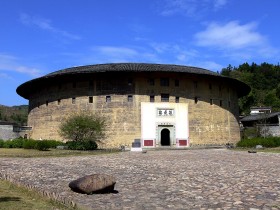
From the opening title screen of Majora’s Mask, the game loud and proud begins to show its town with an almost exclusive focus on its most important asset, its characters. Link needs to feel familiar on this place, so the world has been populated with all kinds of known faces from his adventures and some characters that share his struggles. This familiarity carries to the music, which is one of the few remnants of European classical tradition familiar to the inhabitants of Hyrule. However, Clock Town has already left its medieval and renaissance period. The people here have connected with the heavens, and their mastery of astronomy along their estrangement from monarchs in favor of true democracy has left them right on the baroque period. When the town was designed, the developers were not only inspired by the shape of a clock from above or the fact that this is all about cycles but also the circular buildings of Southeast China.
Musical Analysis
Structure: Section 0 / Section 1 / Section 2 / Section 3
Time Signature: 4/4
Tempo: 110
Melodic and Harmonic Profiles: D Ionian/Major; D Chromatic
In turn, since this is the land of the Hero of Time, Koji Kondo brings almost the same orchestra that he did for Hyrule Castle Town; he also takes the melody inspiration and main motif from Section 2 of the Market cue, where both have the same rhythm profile.
But the music sensibilities are different now; without any pretense at a modal sound whatsoever, lots of counterpoint, and the typical cadences of baroque music phrases. After all, it is where musical traditions start to become more standardized. In the Clock Town theme, every single melodic phrase seems to be resolved to the tonic, which is the same note that begins each phrase. The piece ends up being very compact and organized with easily discernible and delimited question-answer pairs throughout its run; as familiar, warm and welcoming as the town would be in a carnival of time that proceeds normally. A comfortable 4/4 constant tempo folk tune in a simple [ I – V -IV – V ] progression.
The first time we set foot in Clock Town, Koji Kondo teases us with the now classic ‘morning cue’ that played every time the sun rose on the skies of Hyrule. But then, a different drum pattern starts to play and we get a taste of what the musicians from Termina are into—in the official soundtrack release of Majora’s Mask the horn that plays in the sunrise theme was replaced by a bassoon, perhaps to make the piece sound more Clock Townesque by removing the regal associations of the horns that are more fitting to medieval castles.
After the brief percussion intro mimicking and camouflaging itself among the carpentry sounds enveloping the listener, the progression starts at a faster tempo than on the Title Theme, a pattern that we will see with each reprise of the theme. The percussion consists only of folky tambourines with different articulations; Koji uses a pandeiro to create the main drum sound, but any tambourine with a resonant frame will be able to produce this sound; the important thing is to have that mix of a drum sound with the jingles:
The main harmony progression goes:
D – A – G – A
D – A – G-A-D
Just a simple pastoral sound with a really catchy melody in which the question phrases are exactly the same and only a small variation between answers to close and finish them without any ambiguity back to the tonic.
The fiddles take over Section 2, on top of the same progression and similar closed, cyclic melodies starting an ending on D.
The most accomplished player on this troupe seems to be the one with the dulcimer, which is playing arpeggios, harmony and melody with variations in pattern, giving the piece a contrapuntal feel emblematic to the baroque. The dulcimer along with the piccolo elevate the level of complexity of the piece, which could be read now as three different sources of melodic information, making the piece as lively as its diverse cast of characters.
The voices of Clock Town:
Next comes what we could call the bridge. Which would be the most relaxed part of the piece if not for the fact that the doom of the entire town is foreshadowed at its very last minute. It starts with a tender harmony that means peace—this type of harmony is also found on the opening cutscene from Twilight Princess, a sign that everything is alright at the moment— but suddenly, diminished chords start to creep in, indicating that something is about to go wrong.
G – F# m – Em – D
G – F# m-Em-D – C# dim
The diminished chord is brushed off immediately; nothing to worry about here folks, the feast should continue. But on the last phrase there is clearly more nervousness, the music playing the same progression in a higher register when, suddenly… the sound of utter failure. Three days is all that this town has left as the last three descending diminished chords lets it know mercilessly.
G – F# m – D – C# dim – [C# dim – C dim – B dim]
Anyone in need of a game over cue? Just use this:
As said, the concept of Clock Town has various layers to it. Its circular design works as being seen as a clock from above, or alternatively, as the cycle Link finds himself into; the architecture is also most likely inspired by the Chinese communal buildings known as tulou, found in rural places in the country, with the people of Termina practicing the Zelda equivalent of the Nuo folk religion, in which masks play a transcendental role, serving as a sign of being possessed and imbued with emotions. Clock Town also has this similar affinity to masks and also uses them to pray to the gods for good harvest.
The music of Clock Town Serves to contrast and create a sense of familiarity for both the player and Link. This will be their home base, where they can always return after an adventure across this strange land. The music is inspired by what is known as an English country dance, closely linked with Baroque music. The country dance is defined as the repeated execution of a predefined sequence of figures, carefully designed to fit a fixed length of music; it is performed in order to connect a group of people and build community, unlike folk dances such as ballroom dances in which dancers dance with their partners independently of others.
An example of the style here:
Notice how the music always aims to resolve and is full of internal cadences.
The dance still lives to this day, practiced by aficionados and people who enjoy revisiting a bygone era.
We should proceed to do just that; the time is now for going outside and meet some new people on this strange town.
As a fun fact, the little chime you hear whenever you accomplish something in the Bomber’s Notebook is a mini reprise of the Clock Town theme.

Help to keep the rites going around here by supporting the shrine:

Media Files, requests and support for more interactive content

Thou shall donate since this is a cult and you are now a sheep

Help staying awake analyzing game tracks and writing posts or else everything will end up being written by A.I
- Inside The Score – The Legend of Zeda: A Link to the Past – End Credits / Staff Roll
 The land rests As the last few minutes of this extensive journey that has now come to an end fly by, the nostalgia and reflective mood kicks in. Because such a massive enterprise as a Zelda game or a Lord of the Rings movie require multiple endings to convey everything… Read More »Inside The Score – The Legend of Zeda: A Link to the Past – End Credits / Staff Roll
 - Inside The Score – The Legend of Zelda: A Link to the Past – Ending / Epilogue ~ Beautiful HyruleFinal of the fantasy The Triforce has been touched. A wish has been granted. For the occasion, the newly undeceased king of Hyrule has commissioned a march in honor of the legendary hero to the Hylian Sousa, who might as well be composer Nobuo Uematsu since this piece is very… Read More »Inside The Score – The Legend of Zelda: A Link to the Past – Ending / Epilogue ~ Beautiful Hyrule
- Inside The Score – The Legend of Zelda: A Link to the Past – Triforce Chamber / Power of the GodsTake your boots off your feet And thus the Triforce spoke to men. And it became present in history. And you better treasure and contemplate this moment seldom witnessed in the course of the series. The elusive opportunity to interact and touch the most important artifact. You are now in… Read More »Inside The Score – The Legend of Zelda: A Link to the Past – Triforce Chamber / Power of the Gods
- Inside The Score – The Legend of Zelda: A Link to the Past – Ganon Battle / Prince of DarknessProgressive evil En Garde! And you better be prepared since you are about to duel the iconic enemy of the series at perhaps his canonically most powerful incarnation. Right after having touched the sacred Triforce which allowed him to conquer all of the Golden Land and whose evil and darkness… Read More »Inside The Score – The Legend of Zelda: A Link to the Past – Ganon Battle / Prince of Darkness
- Inside The Score – The Legend of Zelda: A Link to the Past – Boss Battle / Anger of the GuardiansQuick mayhem Ah, the simpler times when boss battles where not a multi epic orchestral suite but just an ostinato more basic that even what became the music for standard battle encounters out there. We are a long way from each boss having his own personalized track. And this early… Read More »Inside The Score – The Legend of Zelda: A Link to the Past – Boss Battle / Anger of the Guardians
- Inside The Score – The Legend of Zelda: A Link to the Past – Dark World Dungeon / Dungeon of ShadowsMemento mori We are getting closer to Ganondorf (or at least the wizard Agahnim who ultimately fulfills the same human side of evil role in this game) and that means getting closer to the profiles and motifs of his own theme song (which naturally was the theme of Agahnim at… Read More »Inside The Score – The Legend of Zelda: A Link to the Past – Dark World Dungeon / Dungeon of Shadows