The visiting troupe from the farthest East
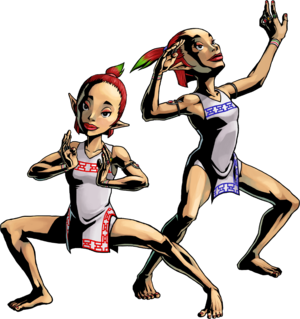
“I planned to bring the world together and stir it into a giant melting pot with my dance!”
The nightlife of Clock Town. As part of the entourage visiting town for the carnival of time, just like Link, is the group of entertainers known as the Gorman Troupe. They are outsiders that come from different villages and are scheduled to perform tomorrow. But like is typical of the souls inhabiting Termina, they are having struggles of their own. Musicians, jugglers, dancers; Link can watch them all throughout the day, practicing their routines and pondering whether the show must go on. Among this selected group are a pair of twins known as the Rosa Sisters, specialized in the art of performative dance. Link can find them during the day while they are staying at the local inn, worried about their moves and the kind of dance they will do. On each night, they are seen on the west side of Clock Town practicing their routine; the music is already finished, it’s just the dance that doesn’t quite fit in. They are desperately in need of a spark of inspiration.
The song they are performing is most likely an arrangement of the original Kamaro’s Dance we hear sometimes on the nights within the fields outside Clock Town. A flute solo performance which itself seems to be inspired on the profiles from the Majora’s Theme; The Eastern influences just keep piling up. But Judo and Marina Rose are no Chinese inspired characters; they are outsiders from a different village so the developers had no problem infusing them with a true Japanese sensibility, even choosing to perform near the kendo academy to feel close to home.
The design of their attire and faces meant to be Oriental in nature, but not as “Oriental” as the Happy Mask Salesman; whatever that means for Japanese artists—usually the eyes—This means they are firmly stepped in traditional Japanese dance. most likely the Kabuki tradition to which the Kamaro’s dance tune belongs; however, the different instruments Kondo decided to use for this arrangement make for an eclectic mix of cultures.
Musical Analysis
Structure: Section 1 / Section 2 (Kamaro’s Dance); Section 0 / Section 1 / Sections 2 (Rosa Sisters)
Time Signature: 4/4
Tempo: 70
Melodic and Harmonic Profiles: B Diminished; Bb Phrygian Dominant
Here you can hear some samples of the primary instruments used on kabuki theater performances, Known for slow hypnotic melodies and chromatic scales:
The classical form of Japanese stage performances called ‘Kabuki’ is known as a stylized drama, for the elaborate masks/make-up (Kumadori) worn by some of its performers, and its dances. It was basically known to be the form of entertainment for the common folk, unlike its more ancient counterpart, the Noh theater, which was enjoyed by the high society of Japan.
Most of the forms of traditional Japanese dance evolved from Buddhist prayers and from the Kagura tradition, a specific type of Shinto ritual ceremonial dance in which female shamans perform a routine; in this setting, the dancer herself turns into a god during the performance.
This dance is still performed today, even appearing in modern Japanese media and movies.
It is, naturally, the more reserved and spiritual kind, often with circling movements, the one preferred by Noh theatre enthusiasts. Kabuki dances, on the other hand, usually gravitate toward a form of dance known as Odori, with more vigorous stepping movements. Although both the music and the dances seen in the game seem to be inspired by the two styles, the attire of the sisters is clearly more in line with Odori tradition that requires more freedom of movement.
So the evolution in simple terms goes: Kagura and Buddhist rituals; as always, religion is the first in line when it comes to culture (perhaps only after environment and biology, which would be ground zero). Then they were followed by Noh theater; entertainment, the culture for the high brow. And of course the more provocative Kabuki ends up being for the low brow (or high brow that wouldn’t admit to liking it).
The very earliest troupes of Kabuki performers were all women, performing dances and dramatic storytelling of everyday life and parodying religious rituals. It grew rapidly in popularity until it caught the attention of the military government—this is all circa 1603— which banned the participation of all women because of the suggestive themes of kabuki and because it was also a means for the dancers to promote their alluring, red-district services—do what you want with this information, we are not privy to the Rosa sisters situation — The women were replaced by male actors playing female roles, known as Onnagata (now we can guess why Kamaro might be slightly effeminate).
As always, the zany configuration of instruments Kondo brings to the table is in fact meant to emulate the sounds and performance styles of other instruments that maybe he didn’t had the access to on his sample libraries. Either that or perhaps this time they are truly the instruments we hear since the Gorman troupe could consist of musicians from different parts of the world. So either option could perfectly work for the narrative.
Included here as part of the ensemble is the flute of Kamaro, which technically is a separate cue. His spirit is tormented and he roams the fields outside of Clock Town as a ghost, waiting for students that can master the dance movements he was never able to pass—just like the same regrets of a certain hero— The piccolo with all of its pitch bends is emulating the highest pitched bamboo flute commonly used in traditional Imperial Noh and Kabuki theatre, the Nohkan. Here is what the real thing sounds like:
The flute featured on Kamaro’s Dance has an unique scale that seems based around B but with very exotic intervals and chromaticism.
The full theme, played alongside the Rosa Sisters, only has the accordion playing harmony. Like with the Majora’s Theme, this accordion may be imitating a free reed instrument from Japan (the shō would be the Japanese equivalent to the Chinese sheng) but we also have to remember that in-game, the character that is set to perform this music with the twins is Guru-Guru, the organ grinder from Ocarina of Time, whose instrument sound was that of the accordion, meaning that from a story standpoint, it would be fitting for the accordion to be present here.
It would be difficult for the characteristic sound of the Indian tanpura to be mistaken for any other instrument—well, perhaps most will confuse it with the Sitar, but the mind is still firmly placed exclusively in India— Its unique and unmistakably droning sound almost doesn’t fit any style of music other than hindustani; it is even easily recognizable as the same sample Koji used for the desert level in Super Mario 64. It may as well be part of this international entertainment troupe; However, if you check the first example of kabuki music here you can hear that the Japanese shamisen also has a drone sound of his own, so Kondo could also have it in his mind.
Same thing with the suona, could be the same instrument or the Japanese double reed Hichiriki is being emulated.
The percussion is easily placed as being imitations of a handful of instruments from Japanese origin; the jingle being the famous Japanese Shinto bells, the Kagura suzu that the Rosa Sisters Themselves may have in their hands (seen on the animation video), and the drums being stand ins for the kabuki tsuzumi, a drum that can change pitch while it is being played.
This instrument uses exactly the same principle of the talking drum from Africa, an instrument that will be used later; some cords that when pushed change the pitch of the drum.
The two different articulations of the djembe (open and bass) are perhaps meant to be two different drums or taiko, as they are known in Japan. All in all, the drums may be emulating different sizes of taiko, from the bigger odaiko to the smaller shimedaiko, all of them used in standard kabuki performances.
Or perhaps it is the other way around since the open articulation of the djembe sounds very much like the tsuzumi previously discussed.
Still, the unique choice of instruments makes the piece sound very original. Few will probably be able to point to a similar set of instruments found together in the real world. Do you know if there is music that sounds really similar to this piece? I would like to hear about it.
Ultimately, in order to solve this predicament, Link has to let himself become possessed by the spirit of Kamaro and through Link, the teacher will finally be able to have a legacy in the world and the Rosa Sisters will end up being inspired and with a new cool dance ready for their performance at the carnival of time. Healing the people of Termina will make easier for Link to fulfill his own quest; he just doesn’t know it yet.
As a fun fact, you can notice that Nintendo really pays attention to the relationship between music and sound effects; the sounds of the insects from Termina during the night are set to perform the same scale as Kamaro’s Dance, who knows which influenced which. Most likely, Kondo took inspiration from the crickets in order to create Kamaro’s Dance, seeing as how he wouldn’t want music and sound design to clash, something that he is very precise about.
Help to keep the rites going around here by supporting the shrine:

Media Files, requests and support for more interactive content

Thou shall donate since this is a cult and you are now a sheep

Help staying awake analyzing game tracks and writing posts or else everything will end up being written by A.I
- Inside The Score – The Legend of Zeda: A Link to the Past – End Credits / Staff Roll
 The land rests As the last few minutes of this extensive journey that has now come to an end fly by, the nostalgia and reflective mood kicks in. Because such a massive enterprise as a Zelda game or a Lord of the Rings movie require multiple endings to convey everything… Read More »Inside The Score – The Legend of Zeda: A Link to the Past – End Credits / Staff Roll
 - Inside The Score – The Legend of Zelda: A Link to the Past – Ending / Epilogue ~ Beautiful HyruleFinal of the fantasy The Triforce has been touched. A wish has been granted. For the occasion, the newly undeceased king of Hyrule has commissioned a march in honor of the legendary hero to the Hylian Sousa, who might as well be composer Nobuo Uematsu since this piece is very… Read More »Inside The Score – The Legend of Zelda: A Link to the Past – Ending / Epilogue ~ Beautiful Hyrule
- Inside The Score – The Legend of Zelda: A Link to the Past – Triforce Chamber / Power of the GodsTake your boots off your feet And thus the Triforce spoke to men. And it became present in history. And you better treasure and contemplate this moment seldom witnessed in the course of the series. The elusive opportunity to interact and touch the most important artifact. You are now in… Read More »Inside The Score – The Legend of Zelda: A Link to the Past – Triforce Chamber / Power of the Gods
- Inside The Score – The Legend of Zelda: A Link to the Past – Ganon Battle / Prince of DarknessProgressive evil En Garde! And you better be prepared since you are about to duel the iconic enemy of the series at perhaps his canonically most powerful incarnation. Right after having touched the sacred Triforce which allowed him to conquer all of the Golden Land and whose evil and darkness… Read More »Inside The Score – The Legend of Zelda: A Link to the Past – Ganon Battle / Prince of Darkness
- Inside The Score – The Legend of Zelda: A Link to the Past – Boss Battle / Anger of the GuardiansQuick mayhem Ah, the simpler times when boss battles where not a multi epic orchestral suite but just an ostinato more basic that even what became the music for standard battle encounters out there. We are a long way from each boss having his own personalized track. And this early… Read More »Inside The Score – The Legend of Zelda: A Link to the Past – Boss Battle / Anger of the Guardians
- Inside The Score – The Legend of Zelda: A Link to the Past – Dark World Dungeon / Dungeon of ShadowsMemento mori We are getting closer to Ganondorf (or at least the wizard Agahnim who ultimately fulfills the same human side of evil role in this game) and that means getting closer to the profiles and motifs of his own theme song (which naturally was the theme of Agahnim at… Read More »Inside The Score – The Legend of Zelda: A Link to the Past – Dark World Dungeon / Dungeon of Shadows