Hybrid Boss Battle 2.0
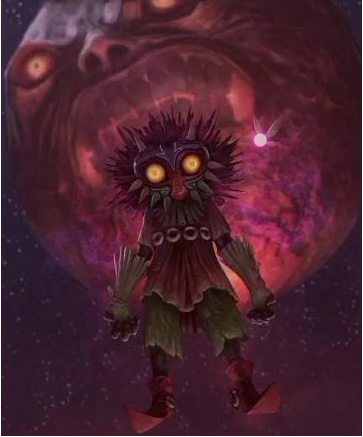
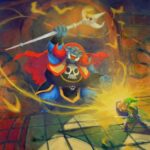
The next and second to last theme contributed by young-24 years old composer Toru Minegishi to the soundtrack, who was given the duty to mark the climax of the first three day cycle; a cliffhanger that will find Link unable to defeat Majora and prevent the moon from collapsing. After the battle, the central mechanic of the game becomes apparent. You cannot win. You can only try again from the beginning, becoming stronger and wiser with each passing cycle and hoping that along the way you find something, anything that can stop this calamity in three days.
The skull kid (or rather Majora in a fit of rage) decides to use all of ita power to accelerate the moon to the earth. The Hero of Time needs to do justice to his title and call upon this entity, as only time can save this town based around time.
Minegishi was in charge of creating the recurrent battle themes of the game. It is difficult to assert whether the track was composed first for the battle against the skull kid and then deemed fit for all mid boss battles or if it was the other way around; however, since the song matches very closely the sensibilities of the boss battle from Ocarina of Time, it was possibly meant to be the original general boss battle cue from Majora’s Mask, later assigned to the mini bosses of the dungeons.
Musical Analysis
Structure: Section 0 / Section 1 / Section 2 / Section 3 / Section 4
Time Signature: 4/4
Tempo: 163 (155 at the end of Section 1)
Melodic and Harmonic Profiles: G Phrygian; F Phrygian; G Diminished; F Diminished; G Chromatic
Either way, whether the game considers the skull kid atop the clock tower a mini boss or the track was composed first for this specific moment, it works to create the sense of imminent danger and seeing the moon just above you slowly moving its way to impending doom. Toru Minegishi probably took the boss battle from Ocarina of Time as a reference right in his desk as he was working on this track; he clearly studied it very closely to be able to match all of its conceptual beats. Piano ostinatos, check; cacophony of the brass section echoing each other lines, check; outro section with timpani going berserk, check. The main way Minegishi differentiates himself from Kondo is that the former likes to inject a more songlike sensibility to his battle cues, making them more catchy and listenable as a stand alone piece of music, while Koji drifts more towards rhythmic displacement, odd time signatures, and unsingable melodies to exclusively create an alarming, uncomfortable mood throughout the battle. Minegishi prefers to make his sections clear and defined, with steady percussion without rhythmic displacement; being mainly a drummer, Minegishi really strives to create a beat with the snares, timpani and crash cymbals instead of using them for ornament and reinforcement, basically treating them as a drum kit—the outro makes it really apparent that a drummer is behind the wheel here. The cue also has a faster tempo than the mini bosses from Ocarina of Time.
An important clue that says that the piece was composed for the battle with skull kid lies in the intro; it matches closely with the action of the cutscene where the imp accelerates the fall of the moon, going immediately to the ostinatos as opposed to a long sustained boss battle intro like on the previous game that gave space for dramatic effect—the question is still open since this intro also matches closely the mini boss battle alarm intro from Ocarina of Time, making also plausible the notion that this theme was meant to be the mini boss cue all along. A surprising aspect of the intro is how this note sweep is almost a major scale that degenerates to a diminished tetrachord right at its tail; another uncanny element coming from Majora’s Mask since this run of notes is seldom found in the franchise or in general battle music for that matter. We can even perceive the corruption of the skull kid as Majora takes more and more power in just this short run of notes: Eb F G Ab Bb B Db D, all while the tuba descends in a chromatic scale, creating all kinds of dissonant interactions.
After this intro, the piano and the timpani take center stage with their respective complementary ostinatos which are the driving force of the piece. The syncopated timpani are so melodic that a base harmony can even be extracted by just listening to them: G5 – Eb5 – D5 – Bb5 – Ab5—a cool heavy metal riff could be born out of this jam—The timpani even partake alongside the piano in the chromatic runs that mark the transition between phrases. In similar fashion to Kondo’s battle writing style, the ostinatos are transposed to a different tone, lowering the accompaniment by one tone just before the the beginning of Section 2. Throughout the piece Minegishi keeps having fun with the timpani, making drum fills as if they were toms on a drum set. The snare drum also presents a more elaborate pattern, with nuanced articulation and differentiated note lengths.
The piano ostinato plays on the same register but it is not as asymmetric and chromatic as the one used by Kondo on the Boss Battle cue from Ocarina; it jumps around in fifths and fourths mainly, playing eight notes. The melodies played by the brass rest on certain notes after doing chromatic runs to travel between notes. The crazy chromatic run done by the strings and the marimba ends on a sus2 chord reminiscent of phrases from the Mid Boss Battle from Ocarina of Time. The horns are also brought out just to play two intervals that sound as if a train is coming to crash directly against Link. On the other hand, the tuba seems to be doing its own thing independent of the rest of the rhythm section, playing intervals on the upbeats that could be interpreted as F5 – Ab5 – Gb5 clashing with the ostinatos of the piano and timpani; it lays mostly at low volumes except for the four resonant notes signaling the start of the marimba note run and when it joins the piano on the descending phrase—it also moves a whole step down along the other accompaniment instruments but only on the second time.
Another strange flirting with major profiles occurs at the very end, with the woodwinds harmonizing a major chord (B major) that descends chromatically, creating parallel major chords; a usually happy sonority that on this context sounds quite unnerving.
In general, the piece manages to find its own identity while following closely the mold set up by Koji Kondo for battle music, using the same timbres and ideas but different rhythms and delimited sections.
At the end, it is a musical instrument what saves Link and Termina from destruction; the magic of the mythic ocarina of time entrusted to the hero by Princess Zelda alongside the Song of Time which now possesses new properties. It inexplicably transforms into another instrument, the Deku pipes—everything is possible in surreal Termina. Link restarts the three day cycle, proving that Majora chose to fight the true Hero of Time, the person needed the most by this land defined by time and trapped by time.
Help to keep the rites going around here by supporting the shrine:

Media Files, requests and support for more interactive content

Thou shall donate since this is a cult and you are now a sheep

Help staying awake analyzing game tracks and writing posts or else everything will end up being written by A.I
- Inside The Score – The Legend of Zeda: A Link to the Past – End Credits / Staff Roll
 The land rests As the last few minutes of this extensive journey that has now come to an end fly by, the nostalgia and reflective mood kicks in. Because such a massive enterprise as a Zelda game or a Lord of the Rings movie require multiple endings to convey everything… Read More »Inside The Score – The Legend of Zeda: A Link to the Past – End Credits / Staff Roll
 - Inside The Score – The Legend of Zelda: A Link to the Past – Ending / Epilogue ~ Beautiful HyruleFinal of the fantasy The Triforce has been touched. A wish has been granted. For the occasion, the newly undeceased king of Hyrule has commissioned a march in honor of the legendary hero to the Hylian Sousa, who might as well be composer Nobuo Uematsu since this piece is very… Read More »Inside The Score – The Legend of Zelda: A Link to the Past – Ending / Epilogue ~ Beautiful Hyrule
- Inside The Score – The Legend of Zelda: A Link to the Past – Triforce Chamber / Power of the GodsTake your boots off your feet And thus the Triforce spoke to men. And it became present in history. And you better treasure and contemplate this moment seldom witnessed in the course of the series. The elusive opportunity to interact and touch the most important artifact. You are now in… Read More »Inside The Score – The Legend of Zelda: A Link to the Past – Triforce Chamber / Power of the Gods
- Inside The Score – The Legend of Zelda: A Link to the Past – Ganon Battle / Prince of DarknessProgressive evil En Garde! And you better be prepared since you are about to duel the iconic enemy of the series at perhaps his canonically most powerful incarnation. Right after having touched the sacred Triforce which allowed him to conquer all of the Golden Land and whose evil and darkness… Read More »Inside The Score – The Legend of Zelda: A Link to the Past – Ganon Battle / Prince of Darkness
- Inside The Score – The Legend of Zelda: A Link to the Past – Boss Battle / Anger of the GuardiansQuick mayhem Ah, the simpler times when boss battles where not a multi epic orchestral suite but just an ostinato more basic that even what became the music for standard battle encounters out there. We are a long way from each boss having his own personalized track. And this early… Read More »Inside The Score – The Legend of Zelda: A Link to the Past – Boss Battle / Anger of the Guardians
- Inside The Score – The Legend of Zelda: A Link to the Past – Dark World Dungeon / Dungeon of ShadowsMemento mori We are getting closer to Ganondorf (or at least the wizard Agahnim who ultimately fulfills the same human side of evil role in this game) and that means getting closer to the profiles and motifs of his own theme song (which naturally was the theme of Agahnim at… Read More »Inside The Score – The Legend of Zelda: A Link to the Past – Dark World Dungeon / Dungeon of Shadows