The Eastern way of the blade
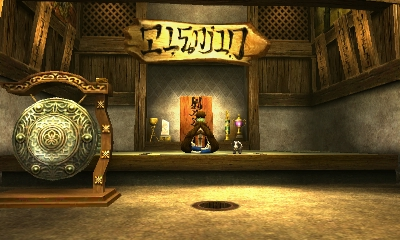
In Clock Town our hero will also have the opportunity to join an Eastern Dojo, allowing him the honor of being the only Hylian of any era that ever mastered both the art of historical European martial arts—presumably the way of the sword in Hyrule— and the conglomerate of Japanese sword arts known as kenjutsu (well, technically the placard reads that this is a kendo academy, which would be way too modern for Termina, but hey, they also have electricity so everything is possible). Basically, kendo is to kenjutsu what Olympics rules fencing is to Historical European Martial Arts. Kenjutsu schools often have a well-preserved lineage, unlike their European counterparts. Because of this, we know a lot more about how the samurai used their weaponry in battle than we do about how actual knights and men-at-arms of Europe used theirs.
The sensei of this school is a famous swordsman arguably so powerful that he claims not even a falling moon would be a threat to him, he can cut it in half with his blade. He will allow Link to train here even though the hero owns only his medieval Kokiri sword—He will refuse to train Link in his Deku form though, remarking that he is just a mere child. And if anybody has seen the film Groundhog Day then you know why the Hero of Time ended up becoming the best swordsman in the series.
Musical Analysis
Structure: Section 1
Time Signature: 4/4
Tempo: 70
Melodic and Harmonic Profiles: C Atonal
Big, giant, ultra loud drums and Japanese martial arts combine just like the organ and baseball. Both China and Japan had a tradition of going to war accompanied of huge drums that frightened enemies and pumped their troops. In Japanese, the term taiko refers to any kind of drum, but outside Japan, it is used specifically to refer to any of the various Japanese drums called wadaiko; and boy does taiko drums have become popular. being almost omnipresent today in the modern film landscape to raise the action and epicness level of any scene. Armies march to the beat of a drum, martial arts tournaments give expectation with them. All in all they are engraved with the concept of a duel. In modern times playing them involves a lot of choreographed movement which many identify with Japanese martial arts, so using them for any Eastern setting is as obvious as one can get.
The timpani found on this swordsman’s school are of course meant to represent the big ol drums from martial arts and kendo sword fighting. They are accompanied by the jingle percussion, which in Japan are called the Suzu bells, used similarly in all kinds of religious and physical activities—it doesn’t need to be said that martial arts are tied deeply and also place emphasis on religion, ethics, and human values in general.
Kondo is using a music production technique known as ‘layering’, which is one of the secrets audio engineers use to enhance the sound of any instrument; more than just raising the volume, equalization, or compression, which novice producers tend to gravitate as a first resort, layering is usually the best technique used to make anything sound bigger, more exciting and more powerful. It is just as simple and straightforward as “two things playing together sound better than just one” only make sure that the sounds complement each other in meaningful ways.
With all this said, although there is low timpani and high timpani playing together, they are meant to represent just one huge taiko drum or perhaps an entire ensemble of taiko players. You can see here the type of drum Kondo would have in mind:
Or here used at an actual kendo combat:
The pattern is repetitive in its rhythmic profile, but in each of the phrases there is enough variation to create the sensation that these drums and suzu are speaking some kind of martial arts code throughout the piece—funny enough, there is an actual gong on this place but it’s not used on the track; if Goron Link punches it, it sounds the sample of the chau gong that accompanies Majora.
At the end of the third day, it turns out that the teacher of the school was just a hack; another victim of denial. If Link goes after the midnight of the final day, he can find the sensei covering in fear of the impending doom.
But is this impending doom everyone seems to be talking about even real? On his second day on Clock Town, Link will see for himself that there is truly reason to worry.
Help to keep the rites going around here by supporting the shrine:

Media Files, requests and support for more interactive content

Thou shall donate since this is a cult and you are now a sheep

Help staying awake analyzing game tracks and writing posts or else everything will end up being written by A.I
- Inside The Score – The Legend of Zeda: A Link to the Past – End Credits / Staff Roll
 The land rests As the last few minutes of this extensive journey that has now come to an end fly by, the nostalgia and reflective mood kicks in. Because such a massive enterprise as a Zelda game or a Lord of the Rings movie require multiple endings to convey everything… Read More »Inside The Score – The Legend of Zeda: A Link to the Past – End Credits / Staff Roll
 - Inside The Score – The Legend of Zelda: A Link to the Past – Ending / Epilogue ~ Beautiful HyruleFinal of the fantasy The Triforce has been touched. A wish has been granted. For the occasion, the newly undeceased king of Hyrule has commissioned a march in honor of the legendary hero to the Hylian Sousa, who might as well be composer Nobuo Uematsu since this piece is very… Read More »Inside The Score – The Legend of Zelda: A Link to the Past – Ending / Epilogue ~ Beautiful Hyrule
- Inside The Score – The Legend of Zelda: A Link to the Past – Triforce Chamber / Power of the GodsTake your boots off your feet And thus the Triforce spoke to men. And it became present in history. And you better treasure and contemplate this moment seldom witnessed in the course of the series. The elusive opportunity to interact and touch the most important artifact. You are now in… Read More »Inside The Score – The Legend of Zelda: A Link to the Past – Triforce Chamber / Power of the Gods
- Inside The Score – The Legend of Zelda: A Link to the Past – Ganon Battle / Prince of DarknessProgressive evil En Garde! And you better be prepared since you are about to duel the iconic enemy of the series at perhaps his canonically most powerful incarnation. Right after having touched the sacred Triforce which allowed him to conquer all of the Golden Land and whose evil and darkness… Read More »Inside The Score – The Legend of Zelda: A Link to the Past – Ganon Battle / Prince of Darkness
- Inside The Score – The Legend of Zelda: A Link to the Past – Boss Battle / Anger of the GuardiansQuick mayhem Ah, the simpler times when boss battles where not a multi epic orchestral suite but just an ostinato more basic that even what became the music for standard battle encounters out there. We are a long way from each boss having his own personalized track. And this early… Read More »Inside The Score – The Legend of Zelda: A Link to the Past – Boss Battle / Anger of the Guardians
- Inside The Score – The Legend of Zelda: A Link to the Past – Dark World Dungeon / Dungeon of ShadowsMemento mori We are getting closer to Ganondorf (or at least the wizard Agahnim who ultimately fulfills the same human side of evil role in this game) and that means getting closer to the profiles and motifs of his own theme song (which naturally was the theme of Agahnim at… Read More »Inside The Score – The Legend of Zelda: A Link to the Past – Dark World Dungeon / Dungeon of Shadows