Land of the hero, twisted theme of the hero
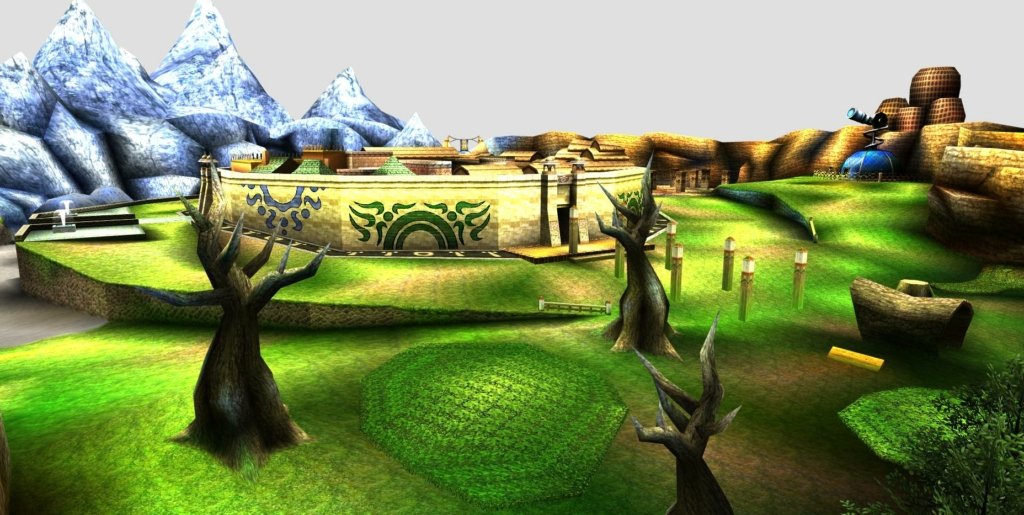
By popular demand we have the return of the main theme of the Zelda series; but as we will see, it is not spared of the uncanniness of Majora’s Mask. It returns in a slightly distorted fashion to let us know we are not at home anymore.
The land of Termina, a land that the Hero of Time needed to find and also a land that needs the Hero of Time. It serves as a literal terminal in a terminal state from which you get to the four stages of awakening Link must complete in order to fulfill his destiny. it is only appropriate that his theme plays once again.
An iconic piece of music across the medium of video games, the Zelda Overworld Theme, originally composed by Koji Kondo for the first ever The Legend of Zelda game for the NES in 1986, has dictated the music sensibilities of the entire franchise for more than thirty years. Its leitmotifs are all over different compositions and moments across the games, signaling heroic instances and transcendental narrative beats. Even if after so many years and iterations the theme has become more of a piece of identity than music for most listeners, it is truly the best representative piece of the series, creating the sense of adventure and exploring different melodic-harmonic profiles just as Link explores diverse lands; the core mechanics of the series is in full display. It also introduced the Andalusian cadence to the series, the sense of danger and the sense of not sounding overtly major or overtly minor, all core characteristics of the character of Zelda music.
Musical Analysis
Structure: Section 0 / Section 1 / Section 2 / Section 3 / Section 4 / Section 5
Time Signature: 4/4
Tempo: 100 (ritardando to 80 Sunrise cue);145
Melodic and Harmonic Profiles: G Ionian/Major; G Mixolydian (Sunrise cue); G Aeolian Dominant; G Aeolian/Minor; G Phrygian; G Lydian; G Ionian/Major; G Harmonic Minor; G Diminished; G Chromatic
The theme was inspired by one of Koji Kondo’s favorite bands growing up, its Spanish influence co-opted from the song April by the English rock band Deep Purple:
The chord progression was combined with the percussion marching rhythm from pieces like Maurice Ravel’s Bolero and the Adventures of Robin Hood; a classic video game tune was born:
Kondo certainly had the influence of Spanish music on his sleeve since he originally planned to open the game with an 8-bit rendition of Maurice Ravel’s Bolero, which was itself based on a Spanish dance. There is a misconception saying that Koji composed the Zelda theme in just one day; in truth the theme that took one day was the Title Theme of the game which had to be replaced by a rearrangement of the normal Overworld Theme due to copyright reasons.
Its appearance here in Majora’s Mask can possibly be mean to represent Link, the only character left as ambassador of the kingdom of Hyrule, who is on a personal journey. Or perhaps it is meant to represent the parallel, twisted nature of Termina with respect to Hyrule; both using the same Overworld song but with different accompaniment—An even more probable option is that Kondo noticed people were asking for the return of the main theme of the series since they missed it in Ocarina of Time and he didn’t want to bother again with the complicated dynamic music implemented on said game since there was not even that much time to begin with. Termina Field’ is indeed way less complicated than ‘Hyrule Field’, just a linear arrangement of the Zelda series main theme that repeats on loop as opposed to changing depending of the state of the player; doing it this way helped to cut development time and hassle for the composer. It was just a matter of injecting Majora’s Maskness into it.
And there is no better candidate to pinpoint this madness than the string accompaniment to the cue, a completely dissonant pattern that is far removed from the adventurous pizzicatos heard across Hyrule Field. As it is typical of some tracks from Majora’s it contrasts with the triumphant melodies, giving the uncanny sensation of a person that stays positive only on the surface; what other overworld theme from an adventure game would dare to use a minor add 9 chord as the bedrock of its accompaniment? As a matter of fact, some of these clustered, dissonant chords will find their way back to the minor sounding overworld theme from Twilight Princess.
The classic Zelda harmony progression barely survives buried within the dissonances and strange chords formed by the strings; the dissonance is not as apparent since the strings play on the upbeats and are at a low volume.
It can be gathered that the Zelda theme here is on a G tonality in order to match the G tonality from Ocarina of Time’s overworld.
Just hear what is accompanying poor Link’s adventure in Termina:
A twisted version of his own theme song, the Hero of Time is in serious need of help.
Section 1
Gmadd9 – Fadd 9 – Ebmaj7 Bbmaj7 Abmaj7 – Gm – A7 – D7
[ Aeolian / Aeolian Dominant ]-[ Phrygian ] – [Lydian/Ionian]
The first chord clashes with the melody, which maintains the major profile of the original theme. As can be seen, the music itself is an adventure throughout different harmony landscapes.
Don’t get fooled by the presence of the romantic maj7 chords, this is just an approximation of the intended harmony and they sound at their most dissonant version, the one featuring a minor second and omitting the fifth; not to mention the diminished chords that end the piece at its most unnerving point.
Section 2 repeats the same phrase but instead of going to the Bbmaj7 it decides to inject the dose of danger courtesy of the harmonic minor profile (this danger was already part of the original) which since 1986 has reminded players that they have to be on their toes if they hope to conquer the quest ahead. It is a detour that ends up again with the Abmaj7 – Gm – A7 – D7 ending.
A shell of its former assured progression from the NES days. Just like Majora’s Mask Itself, these chords sit under the colorful surface of the music, giving an atmosphere of unsettledness to the package.
A la Banjo-Kazzoie, the tuba is here in charge of the bass line, giving a sense of whimsy and an offbeat tone to the piece; it is playing descending fourth intervals of each chord as opposed to the perfect fifths found on the traditional arrangement of this main theme.
Another new addition to the theme that functions to balance the gloominess is a countermelody played by horns first and then the bassoon giving hope and encouraging the hero—it still doesn’t take long for both to get themselves corrupted at the end though. in similar fashion to the Clock Town cue and the themes of the four regions, this song incorporates the three diminished chords of doom ( here they are E dim – Db dim – Bb dim), three descending diminished chords that will unnerve players throughout their entire adventure.
Contrasting with Toru Minegishi, Kondo usually stays with a fixed drum patter, driving the cue and changing it minimally only to produce accents to his melodies. The snare loses almost all its volume and power by the end of the piece; another victim consumed by dissonances.
The main theme of the series continues to be unbeatable for traversing an overworld; a musical composition that travels through notes from different profiles in the same way Link travels to new lands of the world. There are comforting places, magical places, desolate places, and dangerous places, and this applies to both the music composition and The Legend of Zelda as a whole. A hero’s journey in its truest sense.
So Kondo did fulfill the promise of returning to the classic Zelda theme but in a version that sounds off and on its way to degeneration; the Majora’s Mask school. The piece morphs into an unrecognizable mess of dissonant chords by the end of the loop. Termina is just the central land, the terminal from which Link can reach the four lands of the world, lands that are all contaminated by the spirit of Majora. It is Link’s destiny to purify the lands of Termina from its influence. A land as contaminated as the theme that accompanies it.

Help to keep the rites going around here by supporting the shrine:

Media Files, requests and support for more interactive content

Thou shall donate since this is a cult and you are now a sheep

Help staying awake analyzing game tracks and writing posts or else everything will end up being written by A.I
- Inside The Score – The Legend of Zeda: A Link to the Past – End Credits / Staff Roll
 The land rests As the last few minutes of this extensive journey that has now come to an end fly by, the nostalgia and reflective mood kicks in. Because such a massive enterprise as a Zelda game or a Lord of the Rings movie require multiple endings to convey everything… Read More »Inside The Score – The Legend of Zeda: A Link to the Past – End Credits / Staff Roll
 - Inside The Score – The Legend of Zelda: A Link to the Past – Ending / Epilogue ~ Beautiful HyruleFinal of the fantasy The Triforce has been touched. A wish has been granted. For the occasion, the newly undeceased king of Hyrule has commissioned a march in honor of the legendary hero to the Hylian Sousa, who might as well be composer Nobuo Uematsu since this piece is very… Read More »Inside The Score – The Legend of Zelda: A Link to the Past – Ending / Epilogue ~ Beautiful Hyrule
- Inside The Score – The Legend of Zelda: A Link to the Past – Triforce Chamber / Power of the GodsTake your boots off your feet And thus the Triforce spoke to men. And it became present in history. And you better treasure and contemplate this moment seldom witnessed in the course of the series. The elusive opportunity to interact and touch the most important artifact. You are now in… Read More »Inside The Score – The Legend of Zelda: A Link to the Past – Triforce Chamber / Power of the Gods
- Inside The Score – The Legend of Zelda: A Link to the Past – Ganon Battle / Prince of DarknessProgressive evil En Garde! And you better be prepared since you are about to duel the iconic enemy of the series at perhaps his canonically most powerful incarnation. Right after having touched the sacred Triforce which allowed him to conquer all of the Golden Land and whose evil and darkness… Read More »Inside The Score – The Legend of Zelda: A Link to the Past – Ganon Battle / Prince of Darkness
- Inside The Score – The Legend of Zelda: A Link to the Past – Boss Battle / Anger of the GuardiansQuick mayhem Ah, the simpler times when boss battles where not a multi epic orchestral suite but just an ostinato more basic that even what became the music for standard battle encounters out there. We are a long way from each boss having his own personalized track. And this early… Read More »Inside The Score – The Legend of Zelda: A Link to the Past – Boss Battle / Anger of the Guardians
- Inside The Score – The Legend of Zelda: A Link to the Past – Dark World Dungeon / Dungeon of ShadowsMemento mori We are getting closer to Ganondorf (or at least the wizard Agahnim who ultimately fulfills the same human side of evil role in this game) and that means getting closer to the profiles and motifs of his own theme song (which naturally was the theme of Agahnim at… Read More »Inside The Score – The Legend of Zelda: A Link to the Past – Dark World Dungeon / Dungeon of Shadows