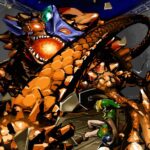
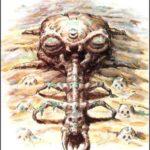
The two faces of the mask
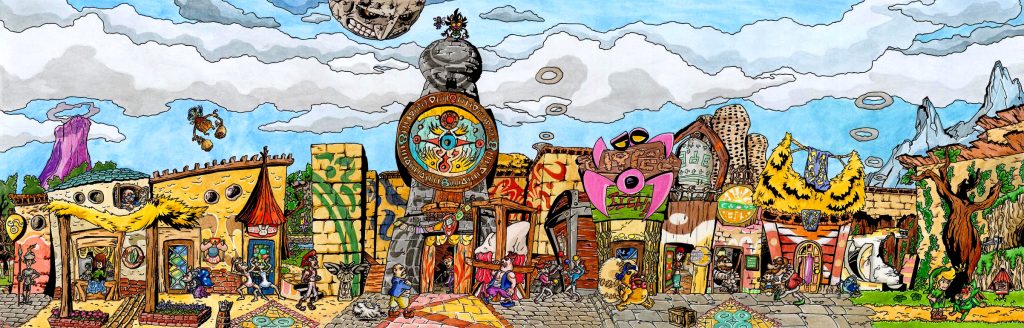
The opening statement of The Legend of Zelda: Majora’s Mask has everything you need to know about this game and how it differentiates itself from its predecessor.
Both title themes start in a peaceful, relaxed way. But unlike in Ocarina of Time, the game establishes its focus on the characters right away by showing us scenes from the townsfolk daily life; lives in which the Hero of Time will find himself immersed in. The game is all about characters after all, epic cinematic shots of the game world are no more. The title screen of Ocarina of Time was all about Link interacting with nature, over here we see Link interacting with fellow human beings. It all is preceded by the unsettling image of the mask known as Majora’s Mask And the Happy Mask Salesman, already distorting and contrasting the images of this town, robbing the player from their security right from the beginning.
Musical Analysis
Structure: Section 0 / Section 1 / Section 2 / Section 3 / Section 4 / Section 5 / Section 6 / Section 7
Time Signature: 4/4
Tempo: 94 (ritardando to 64 at the end of section 0)
Melodic and Harmonic Profiles: D Ionian/Major; D Chromatic; C# Octatonic; C# Diminished
The music is based around the theme of Clock Town—the later being most likely composed first and one which we will explore in-depth later—played with the more delicate harp and no percussion. A baroque dance known as an English Country Dance (more about that on the Clock Town cue analysis). The series has arrived to the future after all, with Termina being roughly 200 to 300 years more advanced than Hyrule—some tech even more futuristic than that!— The development of accurate timekeeping, astronomy and democracy means that a medieval renaissance fair Irish jig is a thing of the past, let’s bring music of the 1600s (for starters, look how contrapuntal the music is now, with multiple melodies taking place at the same time)—the baroque motif also means that the harpsichord will go on to have a more prominent role in the soundtrack.
But if the Ocarina of Time title theme ends on a triumphant, heroic cadence, then the Majora’s Mask couldn’t possibly end any further from that mark, both visually and musically. The title screen ends with the very first sigh of the unforgettable face of the moon, the constant threat looming over Clock Town, inescapable from any corner of the world. The Clock Town Cue slowly starts to morph into the Majora’s Theme and with it we see the entrance of the Chinese troupe of musicians into the series. with the suona and gongs of classic Chinese opera playing the dissonant tune that connects to the masks traditions of the East. In Chinese drama, the entrance of a characters is musicalized with these accelerating rhythms of the percussion. Underlying dissonance contrasting against a peaceful facade will be a staple of Majora’s Mask. A theme of denial present in various characters is captured in musical form.
The first thing that indicates that something is wrong here are the low strings introducing the parallel fourths in chromatic fashion that in the world of Kondo denote evilness. The shift from the simple music of the simple life of Clock Town, made of clearly defined melodic phrases and a folk progression far from the more modal music of Hyrule and accompanied by the piccolo flute playing countermelodies, is jarring to say the least. From unassuming European major tonality music to a completely exotic suona playing microtonal music and diminished intervals. However, the doom of Clock Town was already foreshadowed in the “happy section”, in the form of three descending diminished chords Kondo has hid carefully behind the happy melody that is present at the end of the Clock Town song when it is about to loop. A classic signifier of failure in media [ C# dim – C dim – B dim ] just three remaining days after all.
The stunning intro sets the tone for a game that wants to separate itself as much as possible from the one preceding it; the Zelda logo was never this purple after all. Emphasis on characters, a false sense of calm and the inexplicable evilness emanating from Majora are all captured in this little audiovisual montage.
Help to keep the rites going around here by supporting the shrine:

Media Files, requests and support for more interactive content

Thou shall donate since this is a cult and you are now a sheep

Help staying awake analyzing game tracks and writing posts or else everything will end up being written by A.I
- Inside The Score – The Legend of Zeda: A Link to the Past – End Credits / Staff Roll
 The land rests As the last few minutes of this extensive journey that has now come to an end fly by, the nostalgia and reflective mood kicks in. Because such a massive enterprise as a Zelda game or a Lord of the Rings movie require multiple endings to convey everything… Read More »Inside The Score – The Legend of Zeda: A Link to the Past – End Credits / Staff Roll
 - Inside The Score – The Legend of Zelda: A Link to the Past – Ending / Epilogue ~ Beautiful HyruleFinal of the fantasy The Triforce has been touched. A wish has been granted. For the occasion, the newly undeceased king of Hyrule has commissioned a march in honor of the legendary hero to the Hylian Sousa, who might as well be composer Nobuo Uematsu since this piece is very… Read More »Inside The Score – The Legend of Zelda: A Link to the Past – Ending / Epilogue ~ Beautiful Hyrule
- Inside The Score – The Legend of Zelda: A Link to the Past – Triforce Chamber / Power of the GodsTake your boots off your feet And thus the Triforce spoke to men. And it became present in history. And you better treasure and contemplate this moment seldom witnessed in the course of the series. The elusive opportunity to interact and touch the most important artifact. You are now in… Read More »Inside The Score – The Legend of Zelda: A Link to the Past – Triforce Chamber / Power of the Gods
- Inside The Score – The Legend of Zelda: A Link to the Past – Ganon Battle / Prince of DarknessProgressive evil En Garde! And you better be prepared since you are about to duel the iconic enemy of the series at perhaps his canonically most powerful incarnation. Right after having touched the sacred Triforce which allowed him to conquer all of the Golden Land and whose evil and darkness… Read More »Inside The Score – The Legend of Zelda: A Link to the Past – Ganon Battle / Prince of Darkness
- Inside The Score – The Legend of Zelda: A Link to the Past – Boss Battle / Anger of the GuardiansQuick mayhem Ah, the simpler times when boss battles where not a multi epic orchestral suite but just an ostinato more basic that even what became the music for standard battle encounters out there. We are a long way from each boss having his own personalized track. And this early… Read More »Inside The Score – The Legend of Zelda: A Link to the Past – Boss Battle / Anger of the Guardians
- Inside The Score – The Legend of Zelda: A Link to the Past – Dark World Dungeon / Dungeon of ShadowsMemento mori We are getting closer to Ganondorf (or at least the wizard Agahnim who ultimately fulfills the same human side of evil role in this game) and that means getting closer to the profiles and motifs of his own theme song (which naturally was the theme of Agahnim at… Read More »Inside The Score – The Legend of Zelda: A Link to the Past – Dark World Dungeon / Dungeon of Shadows