Destabilizing meter for a destabilizing situation
We already covered the standard battle music. But if that was all about suspense and dread, this one hits you with all its might and tells you it is time to panic and then prove your courage. Chaos ensues all around you and a cacophony of brass and big drums engulfs you. One thing is for sure, combat music is all about ostinatos and percussion; they are the anchors in which the rest of the discordance can thrive.
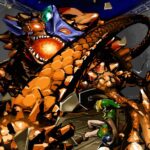
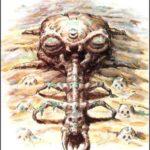
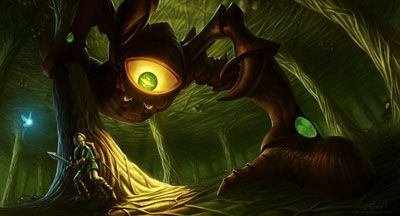
The suspense and calmness before the battle is palpable, you only hear the sounds from a creature moving. Where could it be? The game prompts you to explore its new dimension by making you look around, to the sides and then to the celling where the familiar single eye of a creature that also comes from the first The Legend of Zelda is looking straight at you; it is the only boss that requires this and unlike the abstract bosses of previous Zeldas, here they are more integrated into the story, being a parasite that is slowly draining the life of the patron deity of the Kokiri; you also had the pleasure of encountering her offspring throughout the dungeon.
You only have a slingshot, what on earth could be the weak point of this crab/spider hybrid with a giant, vivid colored eye? Impossible to know. In any case bosses had never looked quite this spectacular, cinematic or imposing before.
Musical Analysis
Structure: Section 0 / Section 1 / Section 2 / Section 3
Time Signature: 6/4
Tempo: Section 0 (Accelerando 120 – 180) / Section 1,2,3 (180)
Melodic and Harmonic Profiles: B Diminished (Section 0 ); Atonal (Section 1,2,3); Chromatic (Harmony)
Succumb to the cacophony; just pure cacophony. As it is characteristic of Koji Kondo battle music, you will find the usual suspects: low end ostinatos, dissonance, and weird time signatures and rhythms.
Bigger enemies mean bigger drums so it is only natural that the timpani are not only deployed alongside the militaristic snare drum but play a solo of their own which does not aim to capture the beauty of music but the chaos of battle. Attacks are coming from everywhere. The brass section are a trumpet and a trombone roleplaying as a second trumpet that pretty much echoes the other, apt for the kind of effect that would take place at the usual spaces where you encounter bosses, huge rooms that must certainly cause sounds to double due to cavernous echo effect.
This high pitched brass contributes to the madness, with the trumpets playing in a way that makes them feel like they are rumbling and echoing everywhere inside your head as opposed to playing melodic phrases, and that danger can come from anywhere. The Section 3 features the timpani in a solo that feels like the steps of the bosses approaching you; this exemplifies the importance of percussion and rhythm in driving combat music, treating the cue with unconventional groupings and ambiguous rhythmic pulse.
On this particular piece, even if the main driving pulse uses a 6/4 time signature, the improvisational melodies on top play as if they were on normal 4/4, giving the piece its oft kilter sensation. Then, coming from nowhere the piano ostinato shifts abruptly mid-song to playing eight notes, making the interplay and following the pulse more complicated. Kondo learned his craft of making battle music a while back since even in A Link to the Past the final clash against Ganon had manic pulse and rhythmic dislocation; odd and unconventional time signatures are the order of the day.
The piano ostinato, which at its lower registers is an instrument from which you can get some menacing timbres, is the chromatic basis of the piece, moving in a wavelike pattern that only barely harmonizes with the brass, practically by chance. As said, the rhythmic interplay between the piano ostinato and the screaming sirens that are the trumpets are at odds. Each one doing its own thing that contributes to the chaos. Like in the standard Battle cues, Kondo avoids using full melodies and instead opts for short fragments composed of dissonant intervals mostly focused on the diminished scale. In fact a descending diminished tetrachord opens the piece. Still, the main motif of the piece are three chromatic notes. The tuba and horns only contribute to the short Section 0 which never loops again since it is the curtain to the scene, a fanfare that announces things just got dangerous, and they then proceed to play a harmonized in minor thirds melody that does not align with the ostinato; it is the longest melodic statement that could reflect the moments where a boss is approaching you. After this, only the fragmentary trumpets play which seem improvised. There is not only dissonance between the rhythms of accompaniment and melody but also between their harmony; only in rare occasion the notes of the two harmonize.
The second ostinato is even more dislocated with respect to the 6/4 pattern, changing to grouping the notes in packets of three that give the illusion of a 12/8 meter or standard 4/4 with triplets. The trumpets, unfaced by this, keep doing their own thing. The ostinato is even more dissonant harmonically since it focuses on the tritone between the first and third note of the group of three. All ostinatos in the piano are played in octaves to generate more weight.
Over this ostinato, out of nowhere and without asking for permission, the percussionist launches into an aggressive solo with the timpani; Koji pretty much just hit keys at random but made sure that the rhythms got progressively more frantic.
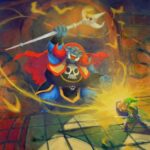
The boss cues ramp up significatively the tension and drama, capturing the initial panic of the player at seeing such huge and macabre beasts, its approximation and then the chaos that ensues while you are thinking of a strategy. Slashing the dragon will reward players with a Boss victory cue, the equivalent mirror image for the Game Over cue but played as an eulogy for the bosses defeated; it is not triumphant, just majestic enough to convey that you have surmounted a very difficult test. Who will die, Link or the monster? We will explore both alternatives next.
As a fun fact, the roars of Gohma are also reused for other bosses and are also the roars of the mighty Ganon.
Help to keep the rites going around here by supporting the shrine:

Media Files, requests and support for more interactive content

Thou shall donate since this is a cult and you are now a sheep

Help staying awake analyzing game tracks and writing posts or else everything will end up being written by A.I
- Inside The Score – The Legend of Zeda: A Link to the Past – End Credits / Staff Roll
 The land rests As the last few minutes of this extensive journey that has now come to an end fly by, the nostalgia and reflective mood kicks in. Because such a massive enterprise as a Zelda game or a Lord of the Rings movie require multiple endings to convey everything… Read More »Inside The Score – The Legend of Zeda: A Link to the Past – End Credits / Staff Roll
 - Inside The Score – The Legend of Zelda: A Link to the Past – Ending / Epilogue ~ Beautiful HyruleFinal of the fantasy The Triforce has been touched. A wish has been granted. For the occasion, the newly undeceased king of Hyrule has commissioned a march in honor of the legendary hero to the Hylian Sousa, who might as well be composer Nobuo Uematsu since this piece is very… Read More »Inside The Score – The Legend of Zelda: A Link to the Past – Ending / Epilogue ~ Beautiful Hyrule
- Inside The Score – The Legend of Zelda: A Link to the Past – Triforce Chamber / Power of the GodsTake your boots off your feet And thus the Triforce spoke to men. And it became present in history. And you better treasure and contemplate this moment seldom witnessed in the course of the series. The elusive opportunity to interact and touch the most important artifact. You are now in… Read More »Inside The Score – The Legend of Zelda: A Link to the Past – Triforce Chamber / Power of the Gods
- Inside The Score – The Legend of Zelda: A Link to the Past – Ganon Battle / Prince of DarknessProgressive evil En Garde! And you better be prepared since you are about to duel the iconic enemy of the series at perhaps his canonically most powerful incarnation. Right after having touched the sacred Triforce which allowed him to conquer all of the Golden Land and whose evil and darkness… Read More »Inside The Score – The Legend of Zelda: A Link to the Past – Ganon Battle / Prince of Darkness
- Inside The Score – The Legend of Zelda: A Link to the Past – Boss Battle / Anger of the GuardiansQuick mayhem Ah, the simpler times when boss battles where not a multi epic orchestral suite but just an ostinato more basic that even what became the music for standard battle encounters out there. We are a long way from each boss having his own personalized track. And this early… Read More »Inside The Score – The Legend of Zelda: A Link to the Past – Boss Battle / Anger of the Guardians
- Inside The Score – The Legend of Zelda: A Link to the Past – Dark World Dungeon / Dungeon of ShadowsMemento mori We are getting closer to Ganondorf (or at least the wizard Agahnim who ultimately fulfills the same human side of evil role in this game) and that means getting closer to the profiles and motifs of his own theme song (which naturally was the theme of Agahnim at… Read More »Inside The Score – The Legend of Zelda: A Link to the Past – Dark World Dungeon / Dungeon of Shadows