A precious gem shines before your eyes and ears
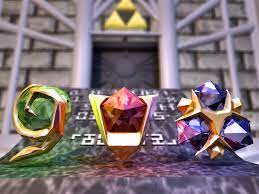
Ah! the Mystical and rare spiritual stones. Forged and sculpted to resemble their respective race’s crests (or was it the other way around?). These sacred jewels are the objects to be acquired throughout the adventure in order to be worthy of opening the doors to the Triforce and to growing up. The format of collecting three jewels began with A Link to the Past, where each dungeon rewarded you with a pendant. Here the stones are tied to the symbols of each culture that you see all over their locations, making you connect with these shapes even before reaching them and their precious cue that achieves the special quality of a not so common reward. They are an emerald, a ruby and a sapphire, colors tied to the elements and environments of each race. You can feel their light shining on your face as they come down to the tune of this composition full of wonder. Like the adventure Link himself has, the music travels through different profiles.
Like many other triumphant moments, like getting treasure or successes, the piece has an ascending motion using major chords. However, it retains a sense of mystique due to the unconventional profiles used to convey the ancientness and power of these relics. Sad to see that this pretty piece only sounds three times since it is more unconventional than its successor, the Get Medallion cue. It is perhaps the least heard success cue in Ocarina of Time.
Musical Analysis
Structure: Section 1 / Section 2
Time Signature: 4/4
Tempo: 75 ( Ritardando to 60 )
Melodic and Harmonic Profiles: Bb Phrygian Major (section 1); E Phrygian Major, A Phrygian Major (Section 2)
Such an underrated piece from the game all due to how infrequently we hear it during the play-through (3 times). It is maybe the most musically satisfying and complex of the acquisition fanfares from the game.
There is a cool effect of rhythmic dislocation going on with the glockenspiel, where it seems like it is going at his own pace while the rest of the piece plays on the background; it is pretty much a sound effect of shine for the stones. It plays an A5 chord
In the short span of the piece Kondo somehow manages to include a mini intro and a theme; separated by the change of harmonic profile to higher registers. As said It follows the tradition of ascending melodies to denote success. They are all major chords in parallel fashion. The harmony would be
Bb – Db – B – Db – Bb – B – Db
E – G – Bb – A
The basis of the harmony is the Phrygian Major profile, also called the Flamenco mode since it is used a lot there. It is basically a Phrygian mode but you just always treat the tonic as major. It starts based around Bb but then the E chord transposes the profile and then it ends on an A. The descending part mimics the stone falling into the hands of the hero while the ascending part the excitement of the accomplishment. Still, the harmony makes the proceedings more mysterious. It asserts that getting these stones are very special recurrences.
Time to depart for Hyrule Castle. Link is about to get his first taste of the outside world. And with his old mentor gone a new one has to step in from the heavens. But there is a goodbye that needs to be said and the first taste of the main instrument of the game.

Help to keep the rites going around here by supporting the shrine:

Media Files, requests and support for more interactive content

Thou shall donate since this is a cult and you are now a sheep

Help staying awake analyzing game tracks and writing posts or else everything will end up being written by A.I
- Inside The Score – The Legend of Zeda: A Link to the Past – End Credits / Staff Roll
 The land rests As the last few minutes of this extensive journey that has now come to an end fly by, the nostalgia and reflective mood kicks in. Because such a massive enterprise as a Zelda game or a Lord of the Rings movie require multiple endings to convey everything… Read More »Inside The Score – The Legend of Zeda: A Link to the Past – End Credits / Staff Roll
 - Inside The Score – The Legend of Zelda: A Link to the Past – Ending / Epilogue ~ Beautiful HyruleFinal of the fantasy The Triforce has been touched. A wish has been granted. For the occasion, the newly undeceased king of Hyrule has commissioned a march in honor of the legendary hero to the Hylian Sousa, who might as well be composer Nobuo Uematsu since this piece is very… Read More »Inside The Score – The Legend of Zelda: A Link to the Past – Ending / Epilogue ~ Beautiful Hyrule
- Inside The Score – The Legend of Zelda: A Link to the Past – Triforce Chamber / Power of the GodsTake your boots off your feet And thus the Triforce spoke to men. And it became present in history. And you better treasure and contemplate this moment seldom witnessed in the course of the series. The elusive opportunity to interact and touch the most important artifact. You are now in… Read More »Inside The Score – The Legend of Zelda: A Link to the Past – Triforce Chamber / Power of the Gods
- Inside The Score – The Legend of Zelda: A Link to the Past – Ganon Battle / Prince of DarknessProgressive evil En Garde! And you better be prepared since you are about to duel the iconic enemy of the series at perhaps his canonically most powerful incarnation. Right after having touched the sacred Triforce which allowed him to conquer all of the Golden Land and whose evil and darkness… Read More »Inside The Score – The Legend of Zelda: A Link to the Past – Ganon Battle / Prince of Darkness
- Inside The Score – The Legend of Zelda: A Link to the Past – Boss Battle / Anger of the GuardiansQuick mayhem Ah, the simpler times when boss battles where not a multi epic orchestral suite but just an ostinato more basic that even what became the music for standard battle encounters out there. We are a long way from each boss having his own personalized track. And this early… Read More »Inside The Score – The Legend of Zelda: A Link to the Past – Boss Battle / Anger of the Guardians
- Inside The Score – The Legend of Zelda: A Link to the Past – Dark World Dungeon / Dungeon of ShadowsMemento mori We are getting closer to Ganondorf (or at least the wizard Agahnim who ultimately fulfills the same human side of evil role in this game) and that means getting closer to the profiles and motifs of his own theme song (which naturally was the theme of Agahnim at… Read More »Inside The Score – The Legend of Zelda: A Link to the Past – Dark World Dungeon / Dungeon of Shadows