The centerpiece of any European medieval fantasy
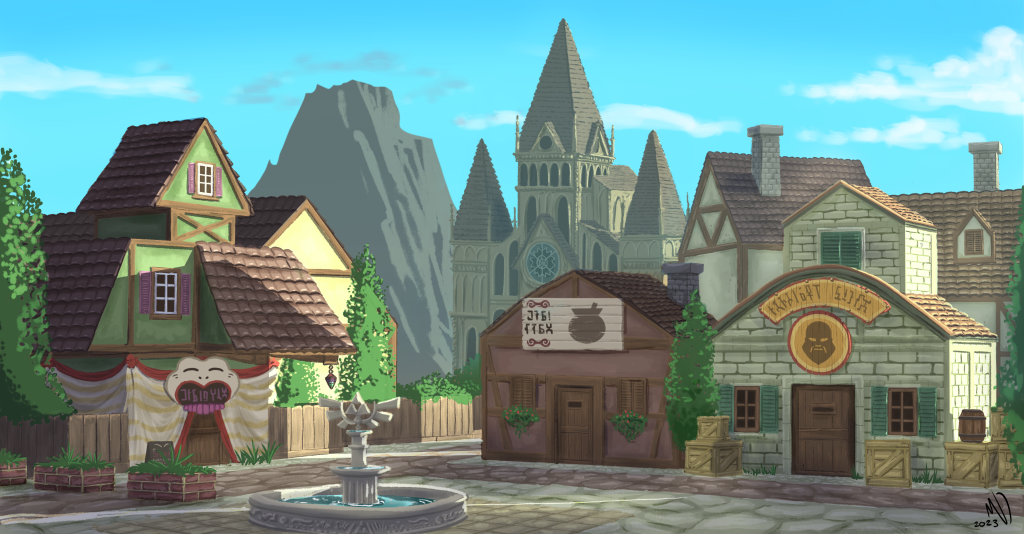
Our traveling young hero is received at the castle town market with the loudness and messiness expected from a medieval capital. After being secluded all of his life it must have been a shock and a reality check for Link to see so many people living their day to day life and going about their businesses. There are old people, adults, kids, guards, chickens and dogs running around busy and not paying attention to him while an unseen troupe of musicians is presumably playing a jig during the day; we even see the dancers here.
As we will see later when we explore the other cultures of Hyrule, the story of Ocarina of Time has some ties with some actual historical events of medieval Europe, particularly Spain, so it is no wonder that their first fully fledged fantasy 3D setting in which some level of realism was called for has a rather accurate depiction of a town from the continent. The Japanese developers actually went to visit an European country close to them, Germany, in order to research the architecture found in the villages of the region, such as castles, churches and plazas; they visited Lower Franconia in northern Bavaria in order to tell their medieval tale of sword and sorcery, with the design of Hyrule Town being inspired by the timber framing construction methods there.
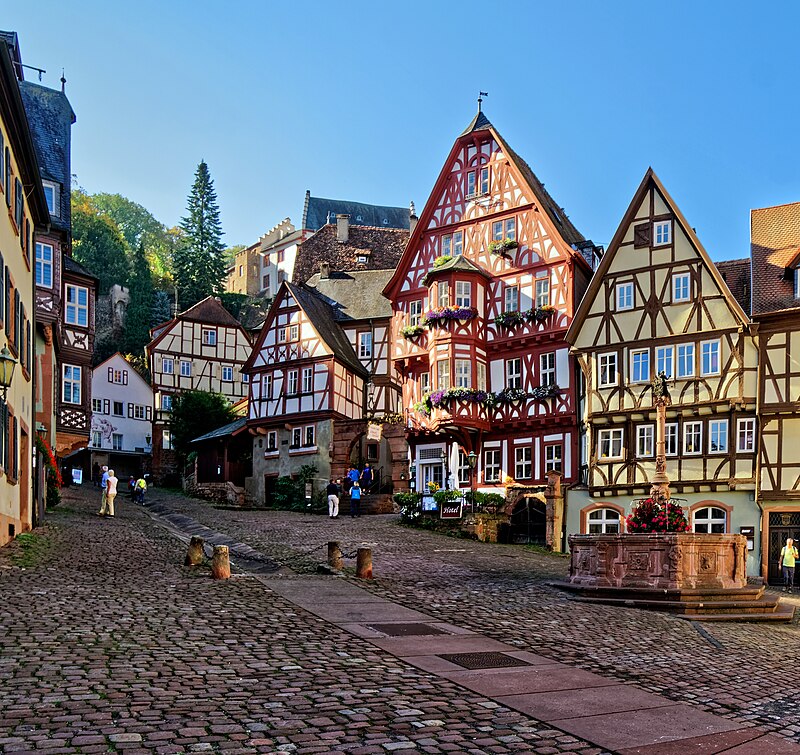
If Kakariko Village is meant to be the peaceful side of the Hylian culture, the market is the one bustling with visual action even if most of the NPC characters only interact with few lines of dialogue. Back in 1998 it felt very lively with all the movement and actual doors you could enter; the sound effects also help a lot.
After the game likely forces you to spend the night right outside the castle gates, allowing you to see the bleakness and monsters that roam the field when it is dark, you are finally allowed inside the plaza, with all kinds of camera angles and corridors—even if the backgrounds are not made of polygons but static images—this marketplace is thriving and full of life, something that is meant to clash heavily with its presentation during the adult portion of the adventure.
We know that the music is likely diegetic and heard by child Link since whenever he goes to the side corridors, the music goes down, as if you got further from the jig party. So you better get close to this English folk tune in order to immerse yourself in this Germanic village that will have some call backs to Spanish history.
Musical Analysis
Structure: Section 1 / Section 2
Time Signature: 4/4
Tempo: 146
Melodic and Harmonic Profiles: G Ionian/Major (Section 1); A Dorian (Section 2)
The dynamic music continues when we arrive at Hyrule Town. The music sounds louder when we are in the main plaza and gets muffled when we go to the back alleys of town. What this implies is that the music actually lives inside the world; Link is hearing the music right there as if a Hylian troupe of musicians was playing and dancing right there in the central plaza, unseen (something that Twilight Princess would take to its natural conclusion). This is known as diegetic music. It contributes to the world feeling alive.
We reach the most ‘Renaissance fair’ sounding tune in the game, mainly due to its instrumentation and symmetric melody phrases that end with the same cadence; its spiritual successor will be the Clock Town theme which pretty much uses the same instrumentation although it is more baroque sounding. Celtic folk music is a staple of medieval RPG inspired games, though its not as featured in Zelda as many people would assume—except perhaps The Wind Waker. It still sets the vibe for the Hyrule market, with people dancing to this Irish jig. Having in mind the influences in the design of the town, it was a no brainer that Kondo went for the safe route of using European folk tunes as inspiration. The tambourine rhythms immediately set the mood with their compound meter. The melody for Section 1—the piece does not have an intro, it all loops—is played by the dulcimer, a common instrument used in both folk and courtly music across various European countries during the renaissance; this instrument also plays its own accompaniment. The rhythm of the melody follows closely the percussion.
The piece is in standard G Ionian/major profile using an ascending chord progression and a classic IV – V – I cadence. The harmony would be:
G – Am – Bm – C
G – Am – C – D – G
Link and his ocarina join the jig after the first few repetitions of the melody, maybe some musician here was actually the one who taught young Link how to play his instrument. This emphasis on symmetric question-answer blocks in the melody are perfect for dancing since it is easier to remember the phrases.
So British is the tune that for Section 2, although there are no bagpipes in the soundtrack, it didn’t stop Kondo of creating an emulation of their air flowing sound with the use of some clever sound design; by tinkering with the attack of the notes and pitch bend, he managed to make the bassoon sound as close as possible to the bagpipes, creating their characteristic droning sound. This section maintains a D chord and the melody could by interpreted as following an A Dorian profile, the relative profile of G Ionian.
Vibrant towns allow Link to find some spare activities to waste time on while the princess is in danger. And whenever fair games are around, modern fair sensibilities are found even though this was supposed to be a medieval setting.

Help to keep the rites going around here by supporting the shrine:

Media Files, requests and support for more interactive content

Thou shall donate since this is a cult and you are now a sheep

Help staying awake analyzing game tracks and writing posts or else everything will end up being written by A.I
- Inside The Score – The Legend of Zeda: A Link to the Past – End Credits / Staff Roll
 The land rests As the last few minutes of this extensive journey that has now come to an end fly by, the nostalgia and reflective mood kicks in. Because such a massive enterprise as a Zelda game or a Lord of the Rings movie require multiple endings to convey everything… Read More »Inside The Score – The Legend of Zeda: A Link to the Past – End Credits / Staff Roll
 - Inside The Score – The Legend of Zelda: A Link to the Past – Ending / Epilogue ~ Beautiful HyruleFinal of the fantasy The Triforce has been touched. A wish has been granted. For the occasion, the newly undeceased king of Hyrule has commissioned a march in honor of the legendary hero to the Hylian Sousa, who might as well be composer Nobuo Uematsu since this piece is very… Read More »Inside The Score – The Legend of Zelda: A Link to the Past – Ending / Epilogue ~ Beautiful Hyrule
- Inside The Score – The Legend of Zelda: A Link to the Past – Triforce Chamber / Power of the GodsTake your boots off your feet And thus the Triforce spoke to men. And it became present in history. And you better treasure and contemplate this moment seldom witnessed in the course of the series. The elusive opportunity to interact and touch the most important artifact. You are now in… Read More »Inside The Score – The Legend of Zelda: A Link to the Past – Triforce Chamber / Power of the Gods
- Inside The Score – The Legend of Zelda: A Link to the Past – Ganon Battle / Prince of DarknessProgressive evil En Garde! And you better be prepared since you are about to duel the iconic enemy of the series at perhaps his canonically most powerful incarnation. Right after having touched the sacred Triforce which allowed him to conquer all of the Golden Land and whose evil and darkness… Read More »Inside The Score – The Legend of Zelda: A Link to the Past – Ganon Battle / Prince of Darkness
- Inside The Score – The Legend of Zelda: A Link to the Past – Boss Battle / Anger of the GuardiansQuick mayhem Ah, the simpler times when boss battles where not a multi epic orchestral suite but just an ostinato more basic that even what became the music for standard battle encounters out there. We are a long way from each boss having his own personalized track. And this early… Read More »Inside The Score – The Legend of Zelda: A Link to the Past – Boss Battle / Anger of the Guardians
- Inside The Score – The Legend of Zelda: A Link to the Past – Dark World Dungeon / Dungeon of ShadowsMemento mori We are getting closer to Ganondorf (or at least the wizard Agahnim who ultimately fulfills the same human side of evil role in this game) and that means getting closer to the profiles and motifs of his own theme song (which naturally was the theme of Agahnim at… Read More »Inside The Score – The Legend of Zelda: A Link to the Past – Dark World Dungeon / Dungeon of Shadows