The playfully sinister piece that completes Zelda’s music puzzle
“I made the Lost Woods theme using TV-CF. I did an orchestral version, but then I thought “oh, there’re already so many arrangements like this”
Koji Kondo
Deep in the woods you feel observed… deep in the woods you feel calm….deep in the woods you feel happy….deep in the woods you feel sad. Do you want to stay? Can you even get out?
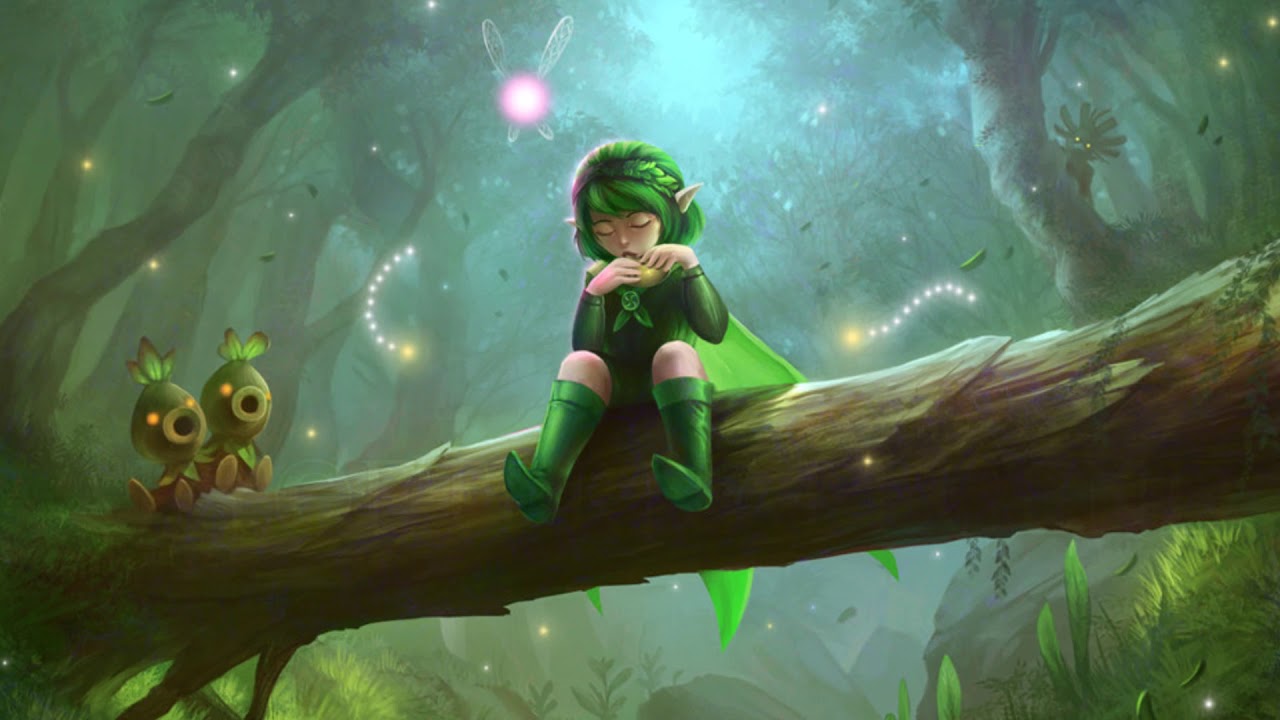
The Lost Woods from The Legend of Zelda series are one of its most ambiguous location. inhabited by all kinds of forest spirits. It’s the only place in Hyrule where whimsy and fear cohabit; dancing together to a jaunty, magical tune.
Who came up with the idea that forests are enchanted anyway?
Are there even regular forests in fantasy works? As with many other creative endeavors, It all starts with the real world; a person missing, a strange sound, not enough information…is only a matter time before human imagination starts to fill holes, and supernatural explanations are always more fun, more disturbing (and sometimes more soothing) than the reality. Hence, it’s no surprise that stories of magical forests are always found in the folklore from regions where big trees find themselves densely packed are commonplace.
In fiction, forests are almost invariably a placeholder location where not many people have courage enough to venture; the villagers constantly advice the hero to never set foot in the forest; monsters, witches and elves usually have to share a home. Almost all fairy tales take place in a forest. Even so, forests are not always bleak, they can also be a place of rest and refuge; wise sorcerers live here, princesses escape from their mundane lives here and, of course, magical helpful fairies with insect wings reside here. The trope goes as far back in time as any trope can go: The Epic of Gilgamesh, the oldest tale in the book, recounts how the heroes Gilgamesh and Enkidu traveled to the Cedar Forest to fight the monsters there and be the first to cut down its trees.
The Legend of Zelda, stepped firmly in the realm of fantasy, has featured an enchanted forest from the very first game. Nintendo has constantly knocked it out of the park when it comes to forest musical themes; they always make sure to capture the ambivalence of the deep, magical woods. The Lost Woods theme from Ocarina of Time may be the culmination of this tradition.
Music Analysis
Structure: Section 0 / Section 1 / Section 2 / Section 3
Time Signature: 2/4
Tempo: 140
Melodic and Harmonic Profiles: Atonal (Section 0); F Lydian (Section 1); C Ionian/Major (Section 2); A Aeolian/Minor, A Harmonic Minor (Section 3)
The quote at the beginning probably refers to the original Lost Woods theme from A Link to the Past— implying that maybe an arrangement of that theme was made for Ocarina of Time at some point— The important thing is that Kondo decided symphonic instrumentation was not suited to this location inhabited by the children of the forest.
One of the missing ingredients that completes the Zelda music cocktail is found growing in these enchanted forests. If the main theme captures the adventure and epic nature of the series, the Temple of Time the sacred and ancient, and the great fairy theme captures its beauty and ethereal nature, then the Lost woods is the piece that grabs the quirkiness, whimsicalness and playfulness of this Nintendo franchise. It is a cue that fits like a glove to this location. The Lost Woods are presented as an ambiguous location in all Zelda games; are they dangerous? Creepy? Fun? The only sure thing is that in Hyrule, they are the dimension where normal things don’t usually happen. How can Kondo capture the mystery behind them and the playfulness of its inhabitants at the same time? Besides the indisputably catchy melody, the Lydian mode, woodwinds and some cool harmonic tricks are the key to this piece.
First thing are the rhythms. The jumpy, staccato rhythms are unapologetically jolly and happy. This is a dance piece after all, as recognized by the Skull Kids and the Goron tribe leader chief Darunia (and basically all of Hyrule in the end credits). The tambourine places its strong hit on a second beat from the measure instead of the first—if we are counting in 2/4—creating that jumpy sound.
Then, there is the choice of instruments. In-game the music is implied to be made by Saria commanding a troupe of skull kids. The cue is very much a diegetic piece that the characters actually hear coming from deep in the forest; Gorons hear it and Link is also guided by it. These instruments are exactly what a group of wanderer minstrel children would play amid the trees, consisting of mostly woodwinds and simple percussion—no fancy brass or orchestral cymbals.
Finally, the composition itself uses different profiles in its short duration to pack a density of ambiguous tones. We can always count on the wacky Lydian mode to give the music an idiosyncratic playful devilish sense. The Lydian tetrachord is the only one that does not end on a perfect fourth. Instead, it ends on the augmented fourth; the dissonant tritone. Composers like Danny Elfman and Grant Kirkhope of Banjo-Kazooie fame always use this tritone to add that sinister edge to otherwise bouncy music. The Simpsons’ theme, for example, is built mostly around the Lydian mode, creating its zany sound.
As has been noted on previous posts, the ocarina “scale” used in the game can be roughly divided into three profiles: the melancholy profile (notes D F A), the off-kilter profile (notes F A B) and the happy profile (notes A B D). The mischievous melody of Saria’s Song is one of two ocarina songs from the game that focuses on the second profile—Malora’s Mask’s favorite one— emphasizing the augmented fourth between F and B in the first part of the melody. This first section is based around a back and forth between F major and C major.
Section 2 of Lost Woods stabilizes the song by going to the more solid C Ionian/Major profile and revolving around a traditional Tin Pan Alley, Brill Building kind of chord progression: the classic ii – V – I – vi, as heard in famous standards like the bridge of The Beatles’ I Want to Hold your Hand
But there is still one last surprise on this jaunty tune. Section 3 begins a rising sequence up to a climax that lands on an unexpected E major chord, changing one more time the direction of the piece. It means thst this last section was based around an A minor profile all along (E major belongs to an A Harmonic Minor scale) adding the final melancholy layer to the cue. Kondo has misdirected us in the same way that the mystical woods do. The harmony would be:
Dm – C – Esus4 – E
Since inside the game the piece is literally the bringer of joy, a case can be made that Kondo was inspired by motifs found on ‘Jupiter, the bringer of jollity by Gustav Holst—A piece Hollywood seems to not get tired off— since Saria’s Song’s melody shares similar rhythms:
Modern western music analysis of this piece would just stick to either a C Major scale or an A Minor scale throughout it and claim that everything weird that happens are exceptions to the rule or borrowed chords. This is practical for music notation purposes, but from a compositional point of view, it fails short of capturing why certain aspects of music pack different sensations, even between songs that are on the same key. Modal analysis is better suited to capture the nuances of how most composers do music— in many times, not using music theory but rather, intuition about how certain colors contribute to the sound.
Arguably the most famous song to come out of the soundtrack, with the introduction of this piece, the world of Hyrule continues to become more akin to a musical and Ocarina of Time continues its motif of making music as dynamic as possible and part of the game world since by chasing this song it becomes part of the game, not of its background.

Help to keep the rites going around here by supporting the shrine:

Media Files, requests and support for more interactive content

Thou shall donate since this is a cult and you are now a sheep

Help staying awake analyzing game tracks and writing posts or else everything will end up being written by A.I
- Inside The Score – The Legend of Zeda: A Link to the Past – End Credits / Staff Roll
 The land rests As the last few minutes of this extensive journey that has now come to an end fly by, the nostalgia and reflective mood kicks in. Because such a massive enterprise as a Zelda game or a Lord of the Rings movie require multiple endings to convey everything that the adventure represented. You… Read More »Inside The Score – The Legend of Zeda: A Link to the Past – End Credits / Staff Roll
 - Inside The Score – The Legend of Zelda: A Link to the Past – Ending / Epilogue ~ Beautiful HyruleFinal of the fantasy The Triforce has been touched. A wish has been granted. For the occasion, the newly undeceased king of Hyrule has commissioned a march in honor of the legendary hero to the Hylian Sousa, who might as well be composer Nobuo Uematsu since this piece is very similar to the main theme… Read More »Inside The Score – The Legend of Zelda: A Link to the Past – Ending / Epilogue ~ Beautiful Hyrule
- Inside The Score – The Legend of Zelda: A Link to the Past – Triforce Chamber / Power of the GodsTake your boots off your feet And thus the Triforce spoke to men. And it became present in history. And you better treasure and contemplate this moment seldom witnessed in the course of the series. The elusive opportunity to interact and touch the most important artifact. You are now in the presence of something truly… Read More »Inside The Score – The Legend of Zelda: A Link to the Past – Triforce Chamber / Power of the Gods
- Inside The Score – The Legend of Zelda: A Link to the Past – Ganon Battle / Prince of DarknessProgressive evil En Garde! And you better be prepared since you are about to duel the iconic enemy of the series at perhaps his canonically most powerful incarnation. Right after having touched the sacred Triforce which allowed him to conquer all of the Golden Land and whose evil and darkness are pouring out into Hyrule.… Read More »Inside The Score – The Legend of Zelda: A Link to the Past – Ganon Battle / Prince of Darkness
- Inside The Score – The Legend of Zelda: A Link to the Past – Boss Battle / Anger of the GuardiansQuick mayhem Ah, the simpler times when boss battles where not a multi epic orchestral suite but just an ostinato more basic that even what became the music for standard battle encounters out there. We are a long way from each boss having his own personalized track. And this early boss battle cue is one… Read More »Inside The Score – The Legend of Zelda: A Link to the Past – Boss Battle / Anger of the Guardians
- Inside The Score – The Legend of Zelda: A Link to the Past – Dark World Dungeon / Dungeon of ShadowsMemento mori We are getting closer to Ganondorf (or at least the wizard Agahnim who ultimately fulfills the same human side of evil role in this game) and that means getting closer to the profiles and motifs of his own theme song (which naturally was the theme of Agahnim at this point) on this dungeon… Read More »Inside The Score – The Legend of Zelda: A Link to the Past – Dark World Dungeon / Dungeon of Shadows