Hello darkness my new friend
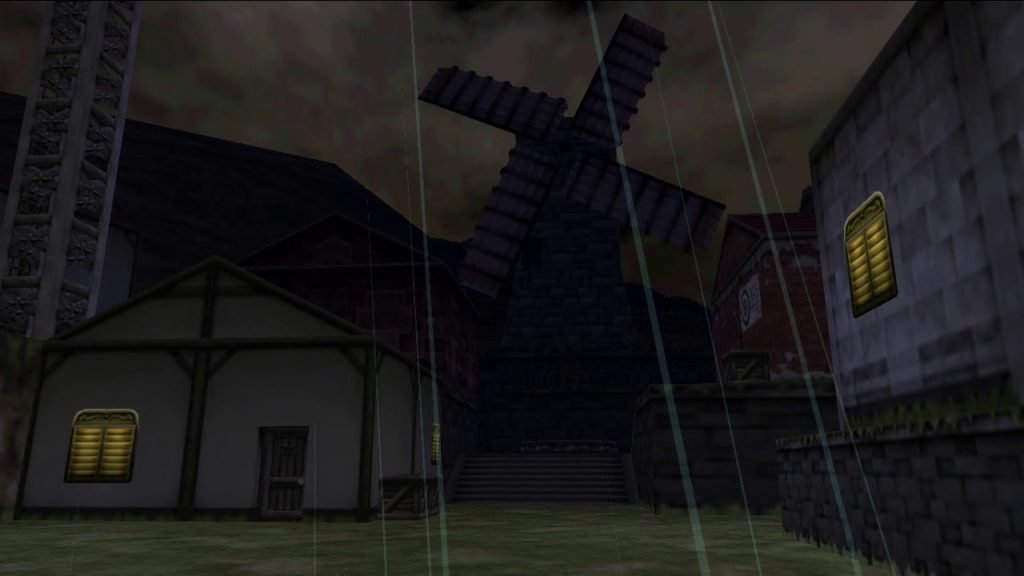
The final arc is upon us. Time is ticking, consequences abound, the poor Skulltula house is getting even more damaged, and what was once the peaceful and pleasant town of Kakariko Village, apparently now the only safe haven in all of Hyrule, is shockingly the setting of one of the most action packed, violent scenes, with both Sheik and Link being attacked by a malevolent, unstoppable presence, the manifestation of the sins of Hyrule which cannot be contained under the rug anymore. Turns out the most sinister temple in all of Hyrule was always under our feet.
If the player decides to visit Kakariko Village after completing the water dungeon they will be received with a startling cutscene. Not only is the superficially peaceful Kakariko Village in flames, but Sheik is there, a troubled look in her eyes. The soothing music of her lyre is nowhere to be heard and, shorty after, the perturbing past of Hyrule starts to surface. It turns out Kakariko Village is a town constructed right above a dungeon and torture chamber; whose disturbing deeds cannot be contained any longer.
Because after tempering himself in courage, power and wisdom respectively the only thing that remains for Link is to meet the dark side of the Hylians and the light side of the Gerudo, a balance that ultimately will allow Link to know who he is fighting for. Thus, the themes of darkness and death start to creep into the game, as Link must go to the vast catacombs of the kingdom and literally traverse the valley of the death to awaken the sage of shadow and fulfill his quest.
Only after the rite of purification and enlightenment Link received at the Water Temple is he prepared to receive the lens of truth, the third eye that will allow him to proceed more secure right into the depths and darkness within Hyrule, to see the true face of the land. Nintendo pretty much decided to leave open the choice of visiting either of the last two dungeons in the game; two dungeons where a theme of duality and death can be found. And even though the Shadow Temple theme would fit more as the last temple in order to complete the thematic exponential curve of a narrative becoming progressively more serious and dark—and in the game menus it actually is implied that this should be the last dungeon—it is likely that players will find this dungeon first since in any case they need to go beneath the well in order to gain their third eye that allows them to see behind Hyrule’s facade and the Gerudo people.
The Shadow Temple is so hidden and secret that it is the only one that can only be accessed by playing the ocarina song attached to it, the Nocturne of Shadow. In music, a nocturne is just any piece that is evocative of the night, which in turn is evocative of darkness; Nocturnes are generally thought of as being slow, expressive and lyrical compositions in minor tonalities; rather gloomy.
Musical Analysis
Structure: Section 1 / Section 2
Time Signature: 4/4
Tempo: 90 (ritardando to 70 at the end of Section 2)
Melodic and Harmonic Profiles: B Super Locrian; C Aeolian/Minor; Db Aeolian/Minor; Db Ionian/Major
The Nocturne of Shadow is the most harmonically and melodically complex of the ocarina melodies, not to mention also the one with the longest question motif that the player inputs (alongside the Bolero of Fire), with unpredictable, angular turns and an ambiguous harmony. It’s the only of two ocarina songs (the other being Saria’s Song) that focuses on the middle partition of the ocarina scale [F A B] for the question motif performed by the player. This is the partition that contains the tritone between F and B, which can sound mysterious or malevolent depending on how it’s accompanied.
In this case, the accompaniment for Section 1 is a series of chromatically moving sus4 chords which, since they are composed of only perfect fifths and perfect fourths, technically don’t give away any functional tonality (it just seems to draw towards B, product of it being the note on top of that first chord). It imbues the piece with a strange uneasiness— like for many rock bands out there playing parallel perfect fifths, the only important thing is the root note as to not having to worry about the proper notes of a scale; same with perfect fourths, which are just inversions of perfect fifths. Functionally, the accompaniment would work as:
B5 – C5 – Db5 – C5 the same as (F#4 – G4 – Ab4 – G4)
Harmonizing this part with innocent major chords could have worked just fine: B – C – Db – C since their interaction with the melody would still have that mysterious quality (with all minor chords on the other hand it would be too overtly infernal).
For the melody, the harp and ocarina play together as always. But behind them the strings are doubling them, like the melody has its own shadow. This same melodic contour and rhythm is repeated and altered in the answering phrases of the outro, transposing the melody not only once, but two times in the tiny span of time left for Section 2. Slowly, the original melody starts to morph more and more into consonance, like it’s shaking its own darkness away, finally managing to reach, like all other warp songs, that triumphant major chord. The accompaniment is an accomplice of this metamorphosis since it also stabilizes the sus4 chords by the favoring of plain perfect fifths.
Here Koji Kondo shows us that his fondness for the Mario cadence knows no boundaries; no longer content with using it once, he doubles down on it here, teasing us with it a first time only to unexpectedly shift the piece one semitone up, ending it in C# major; the listener thinks the piece will go: [Ab – Bb – C] but instead it goes [Ab -Bb – (modulation) – A – B – C#] quite the ride for such a short song. It manages to appear to revolve around three different modes in ascending semitones.
The angular, whirlwind melody of the Nocturne of Shadow and its ambiguous harmonies captures the mystery, hidden darkness and ambivalence of the enigmatic Sheikah tribe. It would not be surprising to hear this theme again associated with this obscure tribe, a tribe that has yet to find a true musical identity.
Help to keep the rites going around here by supporting the shrine:

Media Files, requests and support for more interactive content

Thou shall donate since this is a cult and you are now a sheep

Help staying awake analyzing game tracks and writing posts or else everything will end up being written by A.I
- Inside The Score – The Legend of Zeda: A Link to the Past – End Credits / Staff Roll
 The land rests As the last few minutes of this extensive journey that has now come to an end fly by, the nostalgia and reflective mood kicks in. Because such a massive enterprise as a Zelda game or a Lord of the Rings movie require multiple endings to convey everything… Read More »Inside The Score – The Legend of Zeda: A Link to the Past – End Credits / Staff Roll
 - Inside The Score – The Legend of Zelda: A Link to the Past – Ending / Epilogue ~ Beautiful HyruleFinal of the fantasy The Triforce has been touched. A wish has been granted. For the occasion, the newly undeceased king of Hyrule has commissioned a march in honor of the legendary hero to the Hylian Sousa, who might as well be composer Nobuo Uematsu since this piece is very… Read More »Inside The Score – The Legend of Zelda: A Link to the Past – Ending / Epilogue ~ Beautiful Hyrule
- Inside The Score – The Legend of Zelda: A Link to the Past – Triforce Chamber / Power of the GodsTake your boots off your feet And thus the Triforce spoke to men. And it became present in history. And you better treasure and contemplate this moment seldom witnessed in the course of the series. The elusive opportunity to interact and touch the most important artifact. You are now in… Read More »Inside The Score – The Legend of Zelda: A Link to the Past – Triforce Chamber / Power of the Gods
- Inside The Score – The Legend of Zelda: A Link to the Past – Ganon Battle / Prince of DarknessProgressive evil En Garde! And you better be prepared since you are about to duel the iconic enemy of the series at perhaps his canonically most powerful incarnation. Right after having touched the sacred Triforce which allowed him to conquer all of the Golden Land and whose evil and darkness… Read More »Inside The Score – The Legend of Zelda: A Link to the Past – Ganon Battle / Prince of Darkness
- Inside The Score – The Legend of Zelda: A Link to the Past – Boss Battle / Anger of the GuardiansQuick mayhem Ah, the simpler times when boss battles where not a multi epic orchestral suite but just an ostinato more basic that even what became the music for standard battle encounters out there. We are a long way from each boss having his own personalized track. And this early… Read More »Inside The Score – The Legend of Zelda: A Link to the Past – Boss Battle / Anger of the Guardians
- Inside The Score – The Legend of Zelda: A Link to the Past – Dark World Dungeon / Dungeon of ShadowsMemento mori We are getting closer to Ganondorf (or at least the wizard Agahnim who ultimately fulfills the same human side of evil role in this game) and that means getting closer to the profiles and motifs of his own theme song (which naturally was the theme of Agahnim at… Read More »Inside The Score – The Legend of Zelda: A Link to the Past – Dark World Dungeon / Dungeon of Shadows