Super Whimsical Tree
The first side character to come out of the shadow of Mario; not Luigi, not Princess Peach, nor villain Bowser. Cute dinosaur known as Yoshi debuted in the game Super Mario World for the SNES and then went on to star in his own series alongside his siblings. The series is characterized by its colorful child-like settings and idiosyncratic level design based around storybook artstyles and other handcrafted materials like cardboard and cotton.
The music shares similar features with the parent Mario series, like the reliance in Latin-jazz rhythms and styles. Nevertheless, following the art direction, it has more qualities of children music and tends to sound more cutesy: this is specially the case in the games made after Yoshi’s Island which was composed by Koji Kondo, the composer of the mainland Mario series. The game in question featured in the Super Smash Bros. game was the recently released Yoshi’s Story, the sequel to the original game starring the Yoshi species. Taking place within a pop-up storybook, the game features vivid pre-rendered 3D graphics, illustrating worlds that are crafted from different materials, such as cardboard, fabrics, plastic, and wood: this is captured in the stage design for the Super Smash Bros game. The idea of offering six stages (with alternate routes each time you play) was also used in 1998’s Star Fox 64. This idea of branched paths has not seen much use in Nintendo games since those two. The game also brought some innovative ideas into the 2D platformer genre, like no stage exits to reach. For some reason the iconic enemy of Yoshis are the Shy Guys who debuted on Super Mario Bros. 2.
Yoshi’s Island
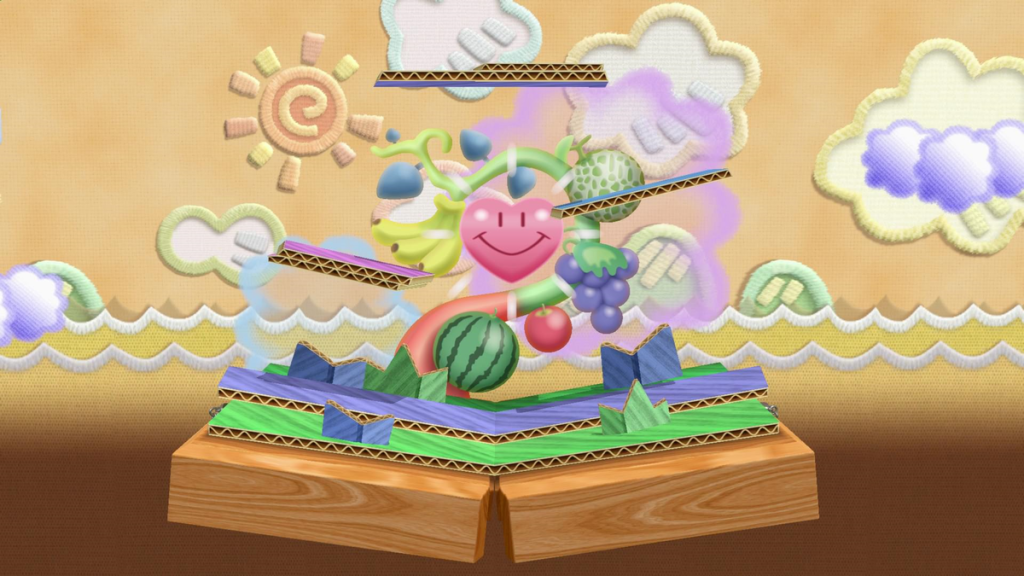
In SSBUltimate this one was renamed to Super Happy Tree in order to distinguish it from the similarly-named Melee and Brawl stages. Visually, the stage looks like it’s made of cardboard. The main platform is an open book, and as such it has a V shape instead of being completely flat. This stage is loosely based on Yoshi’s Story, in which Baby Bowser turns Yoshi’s Island into a storybook and steals the Super Happy Tree. This causes the environment to be turned into various materials such as cardboard, yarn, and fabric. This stage is an amalgamation of the cardboard theme of the first level (Treasure Hunt), and the fabric and cloth theme of the second and third levels (Surprise!! and Rail Lift, respectively); however, the sky was colored blue in those levels, whereas, in this stage, the sky is light orange, giving it a resemblance to the first world’s map screen, supplemented by rotating circular clouds behind the tree, which also appear on the first map behind a set of hills, albeit only in blue as opposed to the blue and orange of the Smash stage’s rotating clouds. The Super Happy Tree is also in the background of the main platform. Yoshi’s Story also features clouds that can be used as platforms, some of which have to be activated by pressing a switch and disappear when the switch’s timer runs out; however, their design is different from the ones in this stage. Eggs spawn over here instead of capsules.
The track featured is the very first mashup for the Super Smash Bros. series, a technique which will become omnipresent in subsequent entries in the franchise, mixing music from the games featured in a single track in creative ways. It is a mix of two music tracks from Yoshi’s Story. The first part of the track is the theme that plays on the first level of Yoshi’s Story, the main theme of the game which is rearranged throughout the levels ala Super Mario World, and the second part comes from Yoshi’s Story title screen.
The original game was all about cute or Kawaii as is known for the Japanese, just a pure flow of good, warm feelings that contrast with some of the bizarre levels and enemies. The yoshis never really die, they are just captured. And the game, following the template of the game featuring a baby Mario, has a child-like quality through and through. The music was composed by famed in-house composer Kazumi Totaka, which is infamous for always sneaking the same piece of music into all of the games that he works on; the Tokata’s Song is a short piece that is very difficult to find inside the games, with players always chasing the way to unlock it. For example, in Yoshi’s Story, Totaka has hidden his 19-note signature melody on the Trial Mode course select screen, after the background music has looped eight times. Kazumi Tokata also provided the endearing voices of the Yoshis, which vary between being human or just a pitched orchestral hit sound (such as in Mario Party)
The game features an interactive soundtrack, where the music will change dynamically. For example, if Yoshi is harmed to the point where the Smile Meter has no remaining petals, the music will sweep down to a lower pitch and tempo, reflecting his dreary mood. But if Yoshi eats a Heart Fruit and becomes Super Happy, the music will instantly switch to a rock version of the currently playing theme.
Arranger Hirokazu Ando had fun with the pieces, infusing them with his characteristic extend harmony that makes it sound more sophisticated and complex. The main progression goes from Eb add9 to Db, giving the Mixolydian flavor to a mostly major key melody. The track features turns for different instruments to play parts, as if each and every Yoshi brought an instrument and is willing to participate; there is literally like 4 different instruments fulfilling the bass role at different times just for the sake of it, same for the melodies.
There are some new instruments featured like a cool electronic drum beat and the muted trumpet; a brass instrument with a mute device changes the instrument’s tone quality (timbre) or lowers its volume. Mutes are commonly used on string and brass instruments, especially the trumpet and trombone, and are occasionally used on woodwinds. Their effect is mostly intended for artistic use. Sometimes it gives off a more jazzy quality. The Rhodes piano is in the suitcase version which had a characteristic percussive sound similar to mallet instruments.
Smash brothers creator Masahiro Sakurai admitted that this was the track he most wanted people to hear.
Yoshi Victory Theme
Just like the parent track of the course music, this little, cute flourish is a combination of two different motifs straight from the recently released Yoshi’s Story for the N64. The first is a sped-up, orchestrated cover of the title music of Yoshi’s Story, which also appeared featured on the course music, while the other is a recognizable musical excerpt from the main theme of Yoshi’s Story, the ending of phrases specifically which is also deployed as a success cue whenever the player completes one of the levels. Thus it naturally incorporates the success cue for the triumph of the ball nosed dinosaur, similar to the treatment of the other contestants. As per the standards of the game, it uses extended harmony to finalize the cue as opposed to how original tracks from their respective games would end.
For some reason the arrangement uses snare samples pitched low instead of actual timpani samples used in other tracks.

Help to keep the rites going around here by supporting the shrine:

Media Files, requests and support for more interactive content

Thou shall donate since this is a cult and you are now a sheep

Help staying awake analyzing game tracks and writing posts or else everything will end up being written by A.I
- Inside The Score – The Legend of Zeda: A Link to the Past – End Credits / Staff Roll
 The land rests As the last few minutes of this extensive journey that has now come to an end fly by, the nostalgia and reflective mood kicks in. Because such a massive enterprise as a Zelda game or a Lord of the Rings movie require multiple endings to convey everything… Read More »Inside The Score – The Legend of Zeda: A Link to the Past – End Credits / Staff Roll
 - Inside The Score – The Legend of Zelda: A Link to the Past – Ending / Epilogue ~ Beautiful HyruleFinal of the fantasy The Triforce has been touched. A wish has been granted. For the occasion, the newly undeceased king of Hyrule has commissioned a march in honor of the legendary hero to the Hylian Sousa, who might as well be composer Nobuo Uematsu since this piece is very… Read More »Inside The Score – The Legend of Zelda: A Link to the Past – Ending / Epilogue ~ Beautiful Hyrule
- Inside The Score – The Legend of Zelda: A Link to the Past – Triforce Chamber / Power of the GodsTake your boots off your feet And thus the Triforce spoke to men. And it became present in history. And you better treasure and contemplate this moment seldom witnessed in the course of the series. The elusive opportunity to interact and touch the most important artifact. You are now in… Read More »Inside The Score – The Legend of Zelda: A Link to the Past – Triforce Chamber / Power of the Gods
- Inside The Score – The Legend of Zelda: A Link to the Past – Ganon Battle / Prince of DarknessProgressive evil En Garde! And you better be prepared since you are about to duel the iconic enemy of the series at perhaps his canonically most powerful incarnation. Right after having touched the sacred Triforce which allowed him to conquer all of the Golden Land and whose evil and darkness… Read More »Inside The Score – The Legend of Zelda: A Link to the Past – Ganon Battle / Prince of Darkness
- Inside The Score – The Legend of Zelda: A Link to the Past – Boss Battle / Anger of the GuardiansQuick mayhem Ah, the simpler times when boss battles where not a multi epic orchestral suite but just an ostinato more basic that even what became the music for standard battle encounters out there. We are a long way from each boss having his own personalized track. And this early… Read More »Inside The Score – The Legend of Zelda: A Link to the Past – Boss Battle / Anger of the Guardians
- Inside The Score – The Legend of Zelda: A Link to the Past – Dark World Dungeon / Dungeon of ShadowsMemento mori We are getting closer to Ganondorf (or at least the wizard Agahnim who ultimately fulfills the same human side of evil role in this game) and that means getting closer to the profiles and motifs of his own theme song (which naturally was the theme of Agahnim at… Read More »Inside The Score – The Legend of Zelda: A Link to the Past – Dark World Dungeon / Dungeon of Shadows