Have a pleasant consumer experience even during medieval times
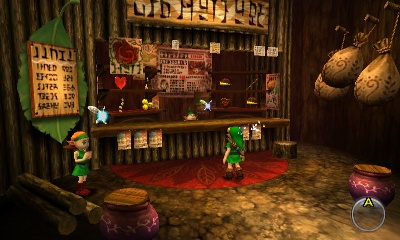
You will certainly not hear a theme like this playing on The Lord of the Rings or other similarly themed medieval European fantasy setting. Thank for that the Japanese RPG genre and their disregard for tone if it means that the gameplay will be accentuated.
This comically anachronistic and completely out of place piece has the only function of making you understand that it is time to go shopping, using the typical music style that you might find in your real world market (muzak). You are allowed to pick your shopping cart and stroll while the background music plays on a speaker. At least for you as a player.
As mentioned, the shops of Hyrule, just like the houses, share a common cue that allows the players to immediately asses where they are and what they can do here. It is just some of the ways that even games that tackle larger than life stories can be quirky as long as they are made in Japan where they usually allow themselves to bend the tone more.
The cue has its influences from Latin American music, specifically Mexican mariachi and Brazilian bossa nova. Koji Kondo’s latin influences, usually reserved for Mario music, give the Zelda games that extra touch of personality that differentiates the series from their more gritty and realistic counterparts.
In real life it was once a common practice for retail to have soft instrumental music piped in as a means of getting the clients comfortable and for various psychological reasons ascribed to music. Background music was widely played in office waiting rooms, restaurants, supermarkets, department stores, phone calls and shopping malls. The music itself was generally a mix of light orchestral, bossa nova, Fifties-esque lounge, and smooth jazz; the main commonality to these genres being that they were all made to blend into the background, as a kind of aural wallpaper, rather than be actively listened to. And even though this is not as common nowadays since establishments now play just popular music, the trope has stuck around in media often for comedic purposes. Video games, having always background music running through their veins already, are some of the biggest culprits when using this device, specially in hotels and elevators.
Musical Analysis
Structure:Section 0 / section 1 / section 2
Time Signature: 4/4
Tempo: 140
Melodic and Harmonic Profiles: C Ionian/Major
We get all of the Latin ensemble to perform for us in these medieval shopping malls. Just like the outside Kokiri Forest, this piece is based around a C profile, yet it uses the standard Ionian/Major with the typical I V IV chords to create that pleasant atmosphere. You have also the spicy Bb note but this time is not used to favor a Mixolydian profile but just as a passing chromatic note that enhances the Latin flavour.
Section 0 is composed of a one time played nylon guitar intro featuring the dominant G chord that goes into the tonic when the first section starts. It is accompanied by the maracas rhythm that establishes the slight swing feel of the piece; it is the kind of rhythm that Latin musicians can also play with a guiro or a cabasa. The Lost Woods tune has a similar rhythm with the tambourine. The end of the intro features a rhythmic motif with the congas that will be reprised at the end of each section to transition into the next one, meaning also the loop as part of Section 2. Kondo had to program the track with organic feel in order to convey the proper Latin taste. You cannot just quantize the rhythms to the grid as perfectly since it is going to kill the vibe.
The main section is played by an accordion doing a chordal melody also with faithfulness to how the instrument can be performed, with the notes of the chord having diverse lengths and sometimes sliding fast between them for a rapid arpeggio articulation. The harmony here is a simple change between C and G, the I and the V. It is as simple an accompaniment as you could get; it facilitates blending as background music. You are supposed to relax here, as if you just were put on hold during a call—”your satisfaction is of the utmost importance to us”. Melodies are also easy to remember since it repeats the same catchy tune twice. The bass player is having the time of his life traveling through both chords via walking notes, mostly the root and fifth as those are the strongest anchor points. It ends its phrases with a typical ending that crosses the scale from the dominant to the tonic. It is all about that bass.
Section 2 goes to the IV as second sections often do. The trombones, here sounding more like trumpets, add the mariachi style to the piece; the trumpets respond emphasizing the respective chord. The trombone melody is also picked up via that same scale device as the bass ends, going from C to F through the scale. The harmony for this part would be:
F – C – G – C
Apt for a Delfino Island commercial
Overall, the melody lines are very symmetrical, repeating each phrase twice and only deviating at the very end for the coda to prepare for the loop. Melody lines are always harmonized. At the very end it showcases the G7 chord as a stronger dominant and then there is a curious thing where the F chord alternates very quickly with its minor counterpart for a split second in the trumpets. Again, is not meant to be registered as a minor chord by the brain but rather as a chromatic decoration that adds Latin spice to the cue. That last part could be played as:
F – C – G7 – C – F – Fm – F – C…..dududududu
Rhythm is the key to any Latin music piece, and being a favorite style of Koji Kondo, he manages to capture what makes the music tick.
The music serves its gameplay function by making connections between players’ actual real experiences shopping in the modern era with shopping inside the game, even if it is totally disconnected tonally with the world of Hyrule. Our hero Link would probably never hear anything like this played by in-game musicians. It is a game only thing reserved for the players that comically parodies the pre-recorded music you may hear at a shopping center. The thing would not be out of place playing at the Nintendo Eshops or the Wii channels (in fact, it might actually have already sounded there). As said, this is all about retail spaces. Latin music, specially the bossa nova rhythms and instruments acquired connotations as the archetypical background music in airports, shops, elevators and company phone calls. Koji is almost parodying this view but his enjoyment of the style is so genuine that he comes with a stylistically appropriate piece that is worth in its own right, just make sure that your randomized playthrough does not play this during the final battle.
No matter where you go shopping in Hyrule, all the shops have the same background music playlist that makes the experience cohesive. It seems like the merchants association of Hyrule provides the same CD to all shopkeepers to assure the consistence of the shopping experience of the consumer in order to achieve corporate uniformity; the king of Hyrule decrees that.
The piece shows that The Legend of Zelda allows not taking itself so seriously even if we are inside a tale with heavy mythology and the clash between good and evil. Most shops in the Zelda series going forward will look back to this track as the reference point.

Help to keep the rites going around here by supporting the shrine:

Media Files, requests and support for more interactive content

Thou shall donate since this is a cult and you are now a sheep

Help staying awake analyzing game tracks and writing posts or else everything will end up being written by A.I
- Inside The Score – The Legend of Zeda: A Link to the Past – End Credits / Staff Roll
 The land rests As the last few minutes of this extensive journey that has now come to an end fly by, the nostalgia and reflective mood kicks in. Because such a massive enterprise as a Zelda game or a Lord of the Rings movie require multiple endings to convey everything… Read More »Inside The Score – The Legend of Zeda: A Link to the Past – End Credits / Staff Roll
 - Inside The Score – The Legend of Zelda: A Link to the Past – Ending / Epilogue ~ Beautiful HyruleFinal of the fantasy The Triforce has been touched. A wish has been granted. For the occasion, the newly undeceased king of Hyrule has commissioned a march in honor of the legendary hero to the Hylian Sousa, who might as well be composer Nobuo Uematsu since this piece is very… Read More »Inside The Score – The Legend of Zelda: A Link to the Past – Ending / Epilogue ~ Beautiful Hyrule
- Inside The Score – The Legend of Zelda: A Link to the Past – Triforce Chamber / Power of the GodsTake your boots off your feet And thus the Triforce spoke to men. And it became present in history. And you better treasure and contemplate this moment seldom witnessed in the course of the series. The elusive opportunity to interact and touch the most important artifact. You are now in… Read More »Inside The Score – The Legend of Zelda: A Link to the Past – Triforce Chamber / Power of the Gods
- Inside The Score – The Legend of Zelda: A Link to the Past – Ganon Battle / Prince of DarknessProgressive evil En Garde! And you better be prepared since you are about to duel the iconic enemy of the series at perhaps his canonically most powerful incarnation. Right after having touched the sacred Triforce which allowed him to conquer all of the Golden Land and whose evil and darkness… Read More »Inside The Score – The Legend of Zelda: A Link to the Past – Ganon Battle / Prince of Darkness
- Inside The Score – The Legend of Zelda: A Link to the Past – Boss Battle / Anger of the GuardiansQuick mayhem Ah, the simpler times when boss battles where not a multi epic orchestral suite but just an ostinato more basic that even what became the music for standard battle encounters out there. We are a long way from each boss having his own personalized track. And this early… Read More »Inside The Score – The Legend of Zelda: A Link to the Past – Boss Battle / Anger of the Guardians
- Inside The Score – The Legend of Zelda: A Link to the Past – Dark World Dungeon / Dungeon of ShadowsMemento mori We are getting closer to Ganondorf (or at least the wizard Agahnim who ultimately fulfills the same human side of evil role in this game) and that means getting closer to the profiles and motifs of his own theme song (which naturally was the theme of Agahnim at… Read More »Inside The Score – The Legend of Zelda: A Link to the Past – Dark World Dungeon / Dungeon of Shadows

/