A literal child-like wonder beginning to a story about growing up
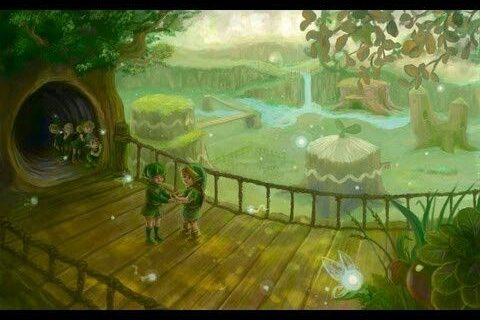
From magical, lush enchanted whimsical forest as a kid to a literal infernal castle full of dread as a grown up. The Legend of Zelda: Ocarina of Time has as perfect a narrative exponential curve as you could get.
The small, secluded, enchanted natural world without any outside influence, inhabited by immortal elves that live young forever and dress in green, the Kokiri Forest is heir to a fantasy staple mostly from European folklore. In this case the most blatant comparison, having in mind Link already has a Tinker Bell companion, is the Neverland from Peter Pan, where children remain children forever and parents are nowhere to be seen. Here we get the fairy folk, the lost children and the entire forest seems to have fairies of all sizes floating around giving this place a magical coat of paint. The Kokiri are sustained and given life by their nature spirit known as the Great Deku Tree. They were also the original explanation in-world as to where the iconic garbs of the hero Link come from, coming full circle to the Peter Pan design that inspired Shigeru Miyamoto.
Elves originated in Germanic mythology as a common type of fairy folk, in fact the term can sometimes be synonymous with fairy. In Britain, elf myths eventually mingled with those of Celtic supernatural beings and much later on, elves and fairies, largely synonymous by this point, were sanitized into diminutive benevolent woodland humanoids. This image is where the modern-day concept of tiny, helpful elves in green clothes and pointy hats, such as Santa’s helpers, ultimately comes from; these are the ones that end showing up in Ocarina of Time. The Deku Tree is not Santa though since he is more of a world tree figure that is linked to the health of the environment, a nature kami straight from Shinto beliefs.
Since Ocarina of Time is the first Zelda to introduce multiple cultures into the series, making it fully high fantasy, the Kokiri could be seen as the analogous to the Lord of the Rings’ Hobbits, the pacifist, small beings just living a pleasant pastoral life confined to their hollowed out homes.
Koji Kondo ought to capture the culture and this non-threatening landscape where players will explore at leisure the enchanted landscape.
Musical Analysis
Structure:Section 0 / Section 1 / Section 2 / Section 3
Time Signature: 4/4
Tempo:145
Melodic and Harmonic Profiles: C Ionian/Major, C Aeolian/Minor (Section 0); C Mixolydian (Section 1); C Ionian/Major, C Aeolian/Minor (Section 2) C Mixolydian (Section 3)
Overall, the Kokiri Forest cue is as light as the fairies that inhabit it and as woody as the houses of the little elves. It is a charming piece featuring various melodic lines from the woodwind section in close sequences whose ends overlap with the beginnings of the next phrase, as if the children of the forest are having a little jam session. It aims to convey a sense of child-like wonder and that magic is in the air. The harpsichord adds an additional layer of elegance to the piece, as if the forest is old enough. Just like the whimsical village, the cue articulates an optimistic and jolly mood.
The piece uses a clear differentiation between accompaniment and melody, with the jumpy pizzicatos playfully supporting the trope of pipers dancing joyfully. It is a bouncy Mixolydian profile that is featured in these early locations like the forest and Hyrule Field—showing that this mode can feel both quirky and heroic. There are two intros, the overture opening that captures the wonder of getting out of your house for the first time and a harmony establishing intro that plays the back and forth of the Mixolydian progression C to Bb; these two sections do not repeat when the loop comes back. The wonder intro plays the ascending harmony G – C6 – G – Ab – Bb (always with a G as a bass note) and it is the only part where a horn is added to gain more weight. As you can see, there is a triumphant Mario cadence sneakily put there to give us that raise when it lands on the I chord to start the proper cue. Even though the opening disappears, it will still be echoed in Section 2 where the Mario cadence returns.
Music is nothing but the interaction between question-answer blocks and a piece like Kokitri Forest is the perfect example since its melodic question and answer lines are actually played by different instruments. The piccolo and marimba pose a question phrase, the oboe answers, and so on; the answer phrase emphasizes the Mixolydian note Bb. The melodies travel between instruments, being relieved as if each musician from this Kokiri troupe wanted their moment on the spotlight. Similarly to the Kokiri, most of the notes are small and quick, with a sense of lively movement due to its rapid note changes and the ornamentation straight from a playful classical piece. There is in fact extensive use of the mordent technique, where a quick note higher than the intended pitch is sounded, a favorite of Mozart.
All this ornamentation in the melody fully blossoms when Kondo deploys the elegant harpsichord, which is the expert in those types of quick melodic decorations, during Section 2 of the piece. It ditches the Mixolydian profile by going to the IV chord as second sections usually do and then goes back and forth between it and the V, so F to G. Then it goes into the Mario Cadence by borrowing the two chords from the minor profile: Ab and Bb; all chords are still major so it is not like the pice gets sad or anything, just more elegant and modal. Because as per Koji Kondo directresses not even the Kokiri should end up with annoying childish music but rather a more sophisticated track apt for a bygone fantasy world.
F – G – F – G — F – G – Ab – Bb
The sense of wonder of the Kokiri Forest is captured when in Section 2 the chords move alternating between a whole tone and then are transposed to the bVI in preparation for the Mario cadence that is favored by Kondo and used on the opening title screen too. Here the harpsichord as a left/right hand instrument takes both accompaniment and melodic roles; the strings move to sustained harmony. All this ornamentation makes the Kokiri Forest feel as if it could be a miniature garden where tea parties take place.
For the final section the mordent idea takes center stage and each Kokiri frenetically tries to play some notes of the descending melody with their respective instruments. The Mixolydian touch comes back and the section is very similar to Section 1, so much that most players will not even notice that the piece has looped since in this context Section 1 ends feeling as if it was always the second part to the melody played during Section 3; basically it is as if Section 1 and 3 are just one big Section that live separated only the first time you hear them. It is one of the most effective loops in the game.
The marimba also has characteristic ornamentation of its own, featuring throughout the last section some tremolo over a minor third. You can think of the sparkly glockenspiel as the contribution of the little fairies floating at the side of the Kokiri musicians.
As you can hear, the accompaniment of the Kokiri Forest composition uses for each section a vamp between two chords. C and Bb for the Sections 1 and 3, and F and G for Section 2. Like the children of the forest, the cue does not need to be as adventurous in its harmonic travels, mostly relegated to alternating between two chords.
The cue is entirely optimistic, using light timbres, jumpy rhythms, playful ornamentation and major chords. The Mixolydian profile adds the whimsy touch in this context and the Mario cadence the triumphant touch of the player/hero combo that is just beginning a life-changing quest.
Since the player will usually restart his or her adventure from Kokiri Forest whenever they turn their game back on, this cue will be one of the most heard and the Mario cadence will always be there to give you encouragement. Its intro opens the curtain not only to the forest but to the Hyrule fantasy that you are about to embark on, the fanfare of adventure for the child era. The Kokiri Forest, the home of the protagonist surrounded by life, green and magic is a stark contrast to the home of the antagonist, a desert that sits in the opposite corner of the map. By the time Link is ending his quest, this track will feel like it is from a different era.
The track has become influential, its motifs being reused in future Zelda games both to convey the home of the protagonist and forest ambiences. It is the basis for the track of Outset Island and the Forest Haven in The Wind Waker, and its playfulness, quirkiness and instrumentation pretty much found its way into its spiritual successor cue, the Knight Academy music from Skyward Sword; it’s definitely its follow up in the sense that both use the playful semi-mysterious and semi-happy Mixolydian mode and for some un-Zelda reason heavily feature the harpsichord instrument.

Help to keep the rites going around here by supporting the shrine:

Media Files, requests and support for more interactive content

Thou shall donate since this is a cult and you are now a sheep

Help staying awake analyzing game tracks and writing posts or else everything will end up being written by A.I
- Inside The Score – The Legend of Zeda: A Link to the Past – End Credits / Staff Roll
 The land rests As the last few minutes of this extensive journey that has now come to an end fly by, the nostalgia and reflective mood kicks in. Because such a massive enterprise as a Zelda game or a Lord of the Rings movie require multiple endings to convey everything… Read More »Inside The Score – The Legend of Zeda: A Link to the Past – End Credits / Staff Roll
 - Inside The Score – The Legend of Zelda: A Link to the Past – Ending / Epilogue ~ Beautiful HyruleFinal of the fantasy The Triforce has been touched. A wish has been granted. For the occasion, the newly undeceased king of Hyrule has commissioned a march in honor of the legendary hero to the Hylian Sousa, who might as well be composer Nobuo Uematsu since this piece is very… Read More »Inside The Score – The Legend of Zelda: A Link to the Past – Ending / Epilogue ~ Beautiful Hyrule
- Inside The Score – The Legend of Zelda: A Link to the Past – Triforce Chamber / Power of the GodsTake your boots off your feet And thus the Triforce spoke to men. And it became present in history. And you better treasure and contemplate this moment seldom witnessed in the course of the series. The elusive opportunity to interact and touch the most important artifact. You are now in… Read More »Inside The Score – The Legend of Zelda: A Link to the Past – Triforce Chamber / Power of the Gods
- Inside The Score – The Legend of Zelda: A Link to the Past – Ganon Battle / Prince of DarknessProgressive evil En Garde! And you better be prepared since you are about to duel the iconic enemy of the series at perhaps his canonically most powerful incarnation. Right after having touched the sacred Triforce which allowed him to conquer all of the Golden Land and whose evil and darkness… Read More »Inside The Score – The Legend of Zelda: A Link to the Past – Ganon Battle / Prince of Darkness
- Inside The Score – The Legend of Zelda: A Link to the Past – Boss Battle / Anger of the GuardiansQuick mayhem Ah, the simpler times when boss battles where not a multi epic orchestral suite but just an ostinato more basic that even what became the music for standard battle encounters out there. We are a long way from each boss having his own personalized track. And this early… Read More »Inside The Score – The Legend of Zelda: A Link to the Past – Boss Battle / Anger of the Guardians
- Inside The Score – The Legend of Zelda: A Link to the Past – Dark World Dungeon / Dungeon of ShadowsMemento mori We are getting closer to Ganondorf (or at least the wizard Agahnim who ultimately fulfills the same human side of evil role in this game) and that means getting closer to the profiles and motifs of his own theme song (which naturally was the theme of Agahnim at… Read More »Inside The Score – The Legend of Zelda: A Link to the Past – Dark World Dungeon / Dungeon of Shadows