Exponential anticipation, release
Our first gameplay cue, not attached to any location of character but to an action, an action as old as the Zelda series, which is acquiring a brand new gadget to play around. What is possible with this new weapon? The player asks to himself.
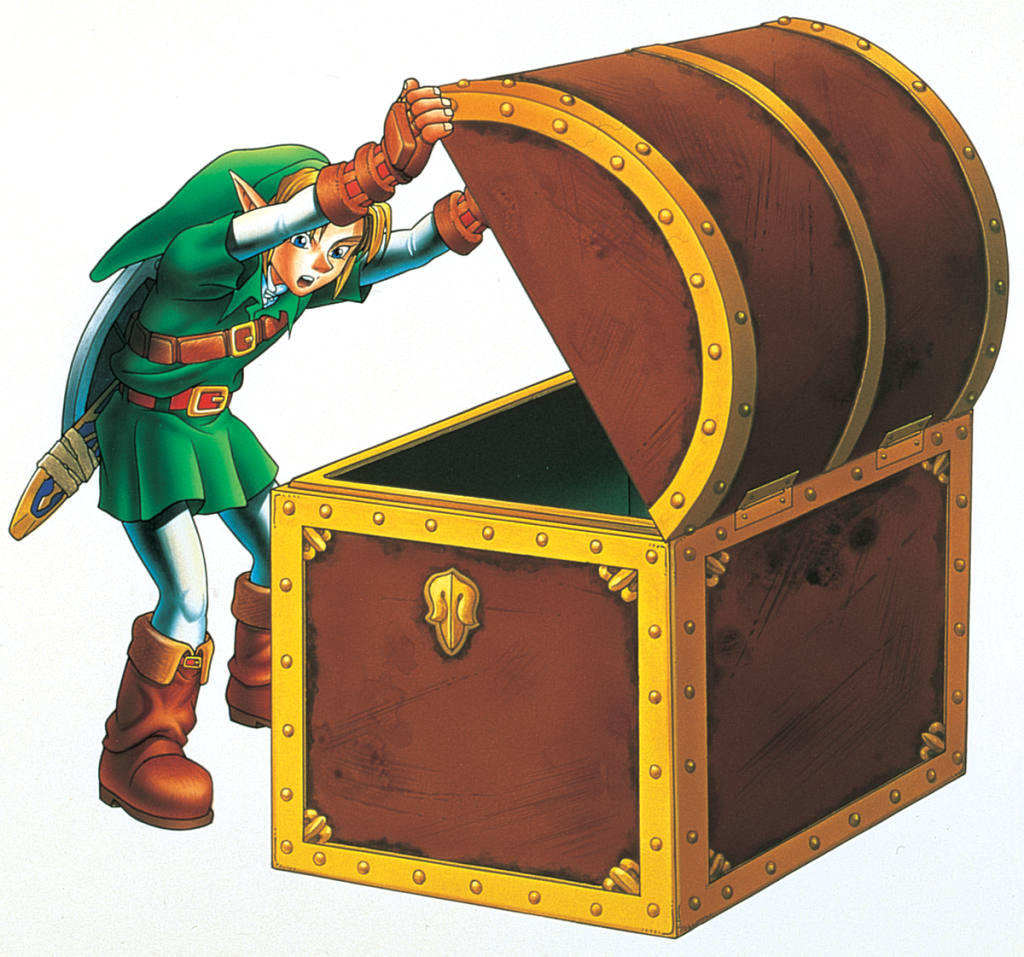
In Ocarina of Time this process is made even more exciting thanks to a new cue and animation attached to the act of opening an important chest, subsequently accompanied by the traditional cue heard since the original NES for when the item is shown proudly by Link to his invisible audience; little did they know, they would go on to use this sound for 36 more years. This is another aspect where games differ from films, a scene that has no place in movies is put together here just for the sake of the player. Besides, only in games can you just take stuff from other peoples’s houses.
We will explore here four of the acquisition cues from the game. They are short cues that reward the player who has just triumphed her way into an exciting new object.
Musical Analysis: Open Treasure Chest
Structure: Section 1
Time Signature: 4/4
Tempo: Accelerando (85 – 116)
Melodic and Harmonic Profiles: Lydian; Chromatic (Harmony)
Everything about this cue screams two things: excitement and curiosity. The way it is achieved is pretty straightforward and a staple of video game music; ascending pitches give the sense of anticipation, tempo slowly gets faster, more instruments are added and the glockenspiel functions as a bell; letting you know you are in for a prize. The curiosity aspect of the music is given courtesy of the mini Lydian tetrachords that the melody is playing; a scale known for its disorienting effect– think of the harps that initialize dream sequences since that tetrachord is the basis of the whole tone scale. The last note prepares the next cue that functions as the continuation, the release.
The bass notes play octaves starting on the A note, ascending chromatically. It gets exponentially faster, not only because of the tempo increase but because after the C note it then decides to change the pitch each beat. Each bar something happens with the cue; first bar you get the strings alone, then the horns join in second bar and finally the note rate change. Something analogous happens in the Lydian tetrachords starting in G where the woodwinds progressively join for each bar. The glockenspiel at that register is pretty much a sound effect as opposed to a musical instrument.
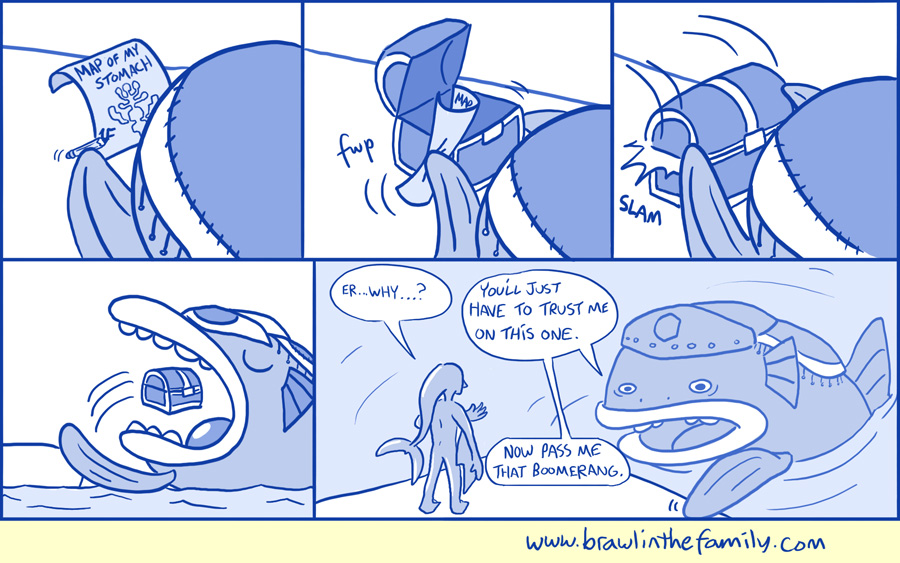
Treasure chests are a staple of adventure games and enhance the sense of exploration, being the poster children of the genre. the reason de’etre of explorers. Somehow they are never locked in Zelda or Link is just very good at forcing locks—even with his feet here. Only in video game logic can all sort of wooden treasure chests end up in the unlikeliest of places such as a tree, inside a whale or in the most remote dungeons, where every culture seems to use the same design; for some reason people just think of using even the biggest ones to hold just a single object—ok, maybe Link just picks what he deems necessary at the moment.
The cue leaves you hanging up in the air with a moment of pause and only makes sense in the context of the release cues that might follow wether you get an item or a heart piece, which has its own custom fanfare.
Musical Analysis: Item Get
Structure: Section 1
Time Signature: 4/4
Tempo: 120
Melodic and Harmonic Profiles: F Chromatic
Dun Dun Dun Duuun!! (Lyrics: I got a thing!) As classic as a cue can get only behind the Secret Discovery cue. This piece goes back to the very first The Legend of Zelda For the NES. Four dominant and triumphant chords ascending, the dominant note of the chord is made by the tuba while the trumpets and trombone–sounding nothing like one since it is the highest voice for some reason—play the upper open triads. There is a reason why the bass note of the previous cue ends on a E note; because it wants to continue ascending chromatically so it attaches to the F7 chromatic progression. The uppermost part plays an A note, also carrying on the chromatic trajectory from the previous opening cue whose upper note landed on G#. The last chord is held longer for dramatic effect in all these cues.
F was the original starting point even in the NES days. Koji Kondo maintains that tradition so the chest cue must have been written in service of this one. There are some instances when you can hear this cue multiple times in a row, like in mini-games that deploy this as a success cue.
It is the not so pure sound of success because chromatic notes still retain a sense of mystery unlike the more triumphant Mario cadence (bVI – bVII – I) which will be used for a brand new acquisition fanfare heard for the first time in Ocarina of Time. The rising notes in chromatic fashion better convey the fact that you are getting something new that maybe you dont know what it is yet, so a sense of curiosity still lingers on.
Musical Analysis: Heart Piece / Skulltula Get
Structure: Section 1
Time Signature: 4/4
Tempo: 120
Melodic and Harmonic Profiles: A Ionian/Major; A Aeolian/Minor
The Mario ca..den…ceeeeee. Another staple of Koji Kondo’s arsenal which is pretty much also a Zelda thing as you will see during this series; he practically single handily codified the use of these three chords to imply victory in the Mario series. Here they are playing as inversions: F, G, A. The opening chest theme ended on a G# in the upper note so this theme is also its natural continuation (the first upper note is an A); The bass note of the chest theme was also an E. Snare drum rolls are used in place of the timpani but the brassy fanfare spirit remains. The rhythm of the notes is also more complex, like a military march with triplets. It is often heard isolated from the chest cue since you can get these objects in the wild.
Unlike the seventh chords of the item get cue here we get the same inversions of the major chords with open voicing but the F chord has a G as a bass note. This harmony sounds way more conclusive than the one for the Item Get. You already know hearts and skulltullas are always a good thing.
Speaking of Skulltulas, there is a cue so mini that in the game files is not actually a cue but it is taken as a sound effect. It is the more synthetic, almost interface-like sound of gold Skulltulas appearing.
It is all about perfect fourth intervals, with just a perfect fifth at the end. Of course it starts and ends on a F note since its fanfare will be based around that. The notes are F Bb Eb Upper Bb F F F. The synthesized sound means this is a purely gameplay cue that gives success information reseved for the player and it is totally disconnected from the fantasy world of Hyrule. It is an appropriate timbre for the kind of abstract token that is a gold Skulltula floating.
There are other kinds of synthetic item sounds that are part of gaming language and the game takes as sound effects even though they contain musical information. For small, inconsequential items like hearts and ammunition you get some arpeggios akin to getting the 1-up in Super Mario. There is a short one and a slightly longer one depending on the quantity or quality of the small object you get. They are similar to the red coin sounds from Super Mario 64
One is just an arpeggio of a Db chord and the other a short, implied cadence of IV – V – I with the chords Db – Eb – Ab. The sounds are straight from a NES game, paying homage to video game tradition.
Musical Analysis: Get Heart Container
Structure: Section 1
Time Signature: 4/4
Tempo: 120
Melodic and Harmonic Profiles: F Dorian
Whenever you get the coveted four heart pieces or the heart container you hear a rising arpeggio through a Dorian profile. A more elegant fanfare for success—for some reason it also appears when you get a big fish on the fishing pond, maybe for comedic or laziness reasons. In any case the game lets you know this moment is more special.
The glockenspiel comes back to its role as a price bell that aurally conveys the sparkling of the heart. It alongside with the harp and chosen notes attain more magical connotations as opposed to just celebratory. It is not as fanfaresque since the brass is pushed to the side in favor of the more mellow strings playing a rising sequence harmonized in thirds with the harp. The Dorian profile of the sequence lets you know these full hears are way more sacred and the moment gains more solemnity. In fact, it plays the same scale that was chosen as the ocarina scale, just being based around F (F Ab C D F).
And these were the treasure cues, the triumphs and successes of the hero often coming right after completing a difficult task. These includes battle encounters which of course have their less pleasant combat music. Time to get worried.

Help to keep the rites going around here by supporting the shrine:

Media Files, requests and support for more interactive content

Thou shall donate since this is a cult and you are now a sheep

Help staying awake analyzing game tracks and writing posts or else everything will end up being written by A.I
- Inside The Score – The Legend of Zeda: A Link to the Past – End Credits / Staff Roll
 The land rests As the last few minutes of this extensive journey that has now come to an end fly by, the nostalgia and reflective mood kicks in. Because such a massive enterprise as a Zelda game or a Lord of the Rings movie require multiple endings to convey everything… Read More »Inside The Score – The Legend of Zeda: A Link to the Past – End Credits / Staff Roll
 - Inside The Score – The Legend of Zelda: A Link to the Past – Ending / Epilogue ~ Beautiful HyruleFinal of the fantasy The Triforce has been touched. A wish has been granted. For the occasion, the newly undeceased king of Hyrule has commissioned a march in honor of the legendary hero to the Hylian Sousa, who might as well be composer Nobuo Uematsu since this piece is very… Read More »Inside The Score – The Legend of Zelda: A Link to the Past – Ending / Epilogue ~ Beautiful Hyrule
- Inside The Score – The Legend of Zelda: A Link to the Past – Triforce Chamber / Power of the GodsTake your boots off your feet And thus the Triforce spoke to men. And it became present in history. And you better treasure and contemplate this moment seldom witnessed in the course of the series. The elusive opportunity to interact and touch the most important artifact. You are now in… Read More »Inside The Score – The Legend of Zelda: A Link to the Past – Triforce Chamber / Power of the Gods
- Inside The Score – The Legend of Zelda: A Link to the Past – Ganon Battle / Prince of DarknessProgressive evil En Garde! And you better be prepared since you are about to duel the iconic enemy of the series at perhaps his canonically most powerful incarnation. Right after having touched the sacred Triforce which allowed him to conquer all of the Golden Land and whose evil and darkness… Read More »Inside The Score – The Legend of Zelda: A Link to the Past – Ganon Battle / Prince of Darkness
- Inside The Score – The Legend of Zelda: A Link to the Past – Boss Battle / Anger of the GuardiansQuick mayhem Ah, the simpler times when boss battles where not a multi epic orchestral suite but just an ostinato more basic that even what became the music for standard battle encounters out there. We are a long way from each boss having his own personalized track. And this early… Read More »Inside The Score – The Legend of Zelda: A Link to the Past – Boss Battle / Anger of the Guardians
- Inside The Score – The Legend of Zelda: A Link to the Past – Dark World Dungeon / Dungeon of ShadowsMemento mori We are getting closer to Ganondorf (or at least the wizard Agahnim who ultimately fulfills the same human side of evil role in this game) and that means getting closer to the profiles and motifs of his own theme song (which naturally was the theme of Agahnim at… Read More »Inside The Score – The Legend of Zelda: A Link to the Past – Dark World Dungeon / Dungeon of Shadows